Most people think a good night’s sleep starts an hour before bed when they turn off the TV. In reality, Master Your Circadian Rhythm begins much earlier, because your sleep quality is strongly influenced by what happens throughout the entire day. Morning light, daily activity, meal timing, caffeine, evening light, and a consistent sleep schedule can all influence the signals that help your body understand when it should feel alert and when it should prepare for sleep.
Your body operates on a roughly 24-hour internal timing system known as the circadian rhythm. This biological clock influences sleep and wakefulness while also interacting with body temperature, hormone signaling, metabolism, digestion, and other physiological processes. When this rhythm becomes inconsistent, falling asleep, staying asleep, or waking up refreshed can become more difficult.
The goal of Master Your Circadian Rhythm is not to force your body into sleep. Instead, it is about creating strong and consistent environmental signals that help your internal clock understand when morning begins and when nighttime should arrive.
Master Your Circadian Rhythm by Understanding Your Internal Clock
The circadian rhythm is your body’s internal timing system. It responds to environmental signals known as zeitgebers, with light being one of the most powerful cues.
Your brain contains a central circadian clock located in the suprachiasmatic nucleus, often called the SCN. This clock receives information from specialized cells in the eyes that are particularly sensitive to light. The information helps the brain coordinate the timing of many daily processes.
This is why light exposure in the morning and darkness in the evening can be so important when trying to Master Your Circadian Rhythm.
A consistent rhythm can help create a predictable pattern in which alertness increases during the day while sleepiness gradually becomes stronger as nighttime approaches.
The Circadian Rhythm and the Cortisol-Melatonin Connection
Two hormones often discussed in relation to daily timing are cortisol and melatonin.
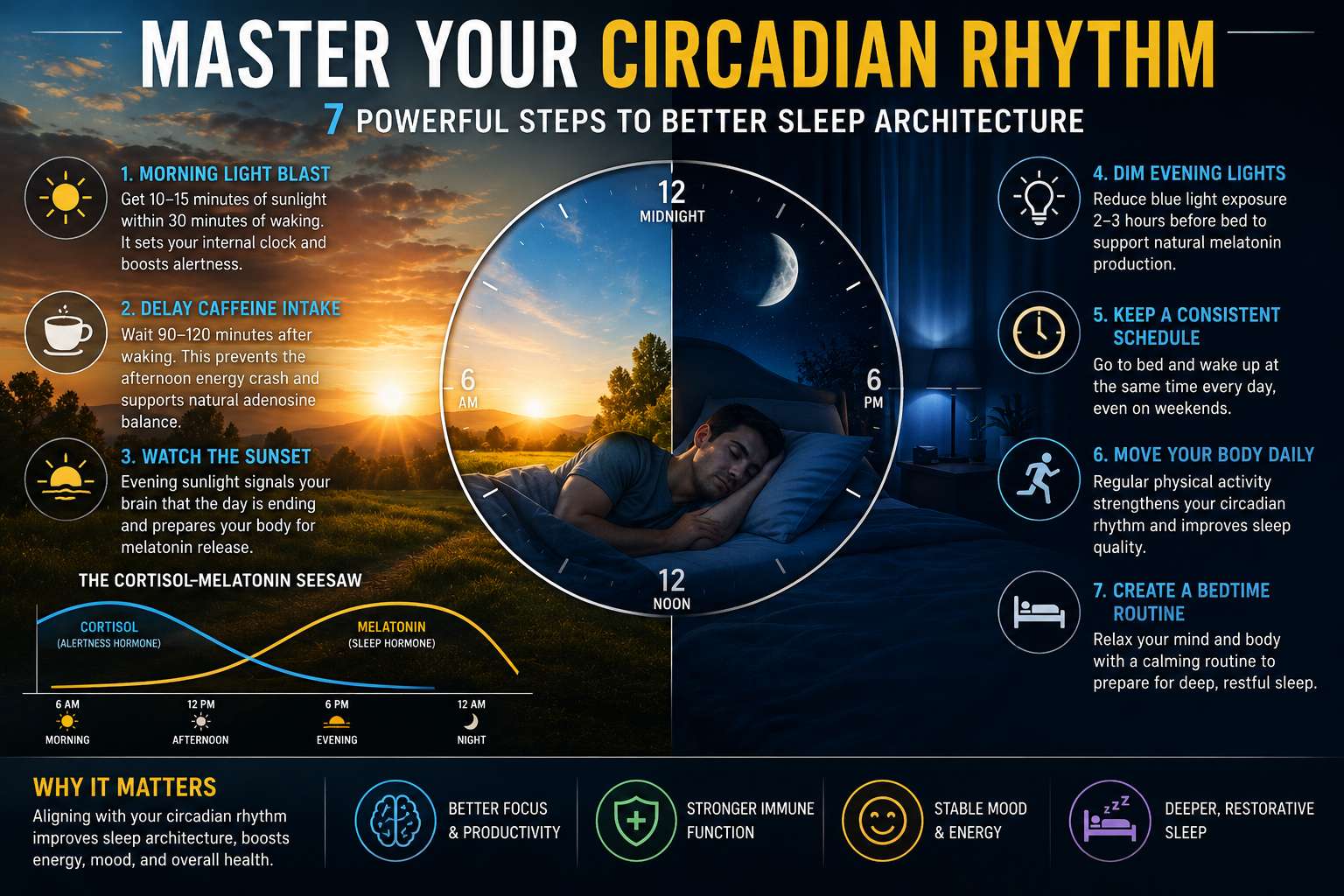
Cortisol is associated with alertness and follows a daily pattern that is normally higher around the beginning of the day. Melatonin, meanwhile, is produced by the pineal gland and generally rises in dim-light conditions during the evening and nighttime.
It is useful to think of these systems as part of a larger biological timing network rather than a simple on-and-off switch.
Morning Light ➔ Daily Clock Signal ➔ Evening Darkness ➔ Melatonin ➔ Sleep
When you Master Your Circadian Rhythm, the objective is to give your body consistent timing signals. Morning light tells your internal clock that the active part of the day has begun, while lower light in the evening helps create an environment that supports the natural transition toward sleep.
This relationship can be visualized through a simple daily pattern:
| Time of Day | Main Environmental Signal | Body’s General Direction |
|---|---|---|
| Early Morning | Bright outdoor light | Alertness increases |
| Morning | Daylight and activity | Wakefulness |
| Afternoon | Daylight and movement | Stable daytime function |
| Evening | Lower light exposure | Transition toward rest |
| Night | Darkness | Melatonin and sleep signaling |
The exact timing differs between individuals, but maintaining a reasonably consistent pattern can make your circadian rhythm easier to regulate.
Master Your Circadian Rhythm With Morning Light
Morning light is one of the most powerful environmental signals for your internal clock. Spending time outdoors soon after waking can provide your eyes with much brighter light than typical indoor lighting.
This outdoor exposure helps communicate to the brain that daytime has begun. The signal can then influence the timing of the circadian system later in the day.
For people trying to Master Your Circadian Rhythm, getting outside in the morning can therefore be a simple but valuable habit.
The amount of light available varies significantly depending on weather, season, latitude, and whether you are indoors or outdoors. Rather than thinking about one exact number of minutes that works for everyone, consistency is more important.
Outdoor daylight is generally much brighter than typical indoor environments, even when the sky is cloudy.
Why Morning Sunlight Matters for Circadian Timing
The eyes contain specialized light-sensitive cells that communicate with the brain’s circadian clock. These cells are especially responsive to shorter-wavelength light and help regulate the timing of melatonin production.
This does not mean you should stare directly at the sun. Safe outdoor light exposure means allowing normal daylight to reach your eyes without looking directly at the sun.
If you want to Master Your Circadian Rhythm, think of morning outdoor light as a daily biological signal rather than simply a source of vitamin D.
Master Your Circadian Rhythm by Managing Caffeine Timing
Caffeine can be extremely useful for increasing alertness, but its effects can last much longer than many people realize.
Caffeine works partly by blocking adenosine receptors. Adenosine is involved in the accumulation of sleep pressure throughout the day. When caffeine blocks its signaling, you may feel more awake even though the underlying sleep pressure continues to accumulate.
This is one reason caffeine timing matters.
Some people prefer to wait after waking before consuming caffeine, while others find that having coffee earlier works perfectly well for them. There is no single universal waiting period that guarantees better sleep for everyone.
However, consuming caffeine later in the day can be more problematic for people who are sensitive to its effects.
If your goal is to Master Your Circadian Rhythm, paying attention to when you drink caffeine may be more useful than simply focusing on how much you consume.
A person who sleeps at 10 p.m. may respond very differently to an afternoon coffee than someone who naturally goes to bed at midnight.
Master Your Circadian Rhythm With Evening Light Control
Morning light helps establish the beginning of your biological day, while evening light can influence the opposite side of the circadian cycle.
Modern lifestyles expose people to artificial lighting, smartphones, computers, televisions, and bright indoor environments long after sunset.
This does not mean every screen automatically destroys sleep. The bigger issue is the overall amount, intensity, timing, and personal sensitivity to evening light.
To Master Your Circadian Rhythm, gradually reducing bright light as bedtime approaches can create a clearer environmental signal that nighttime has arrived.
A darker bedroom can also support sleep by reducing unnecessary light exposure during the night.
The Evening Sunset Signal
Natural sunset light is much less intense than midday sunlight. Spending some time outdoors around sunset can provide a useful transition between daytime and nighttime.
The purpose is not to create a magical sleep response. Instead, it is to create a predictable daily rhythm.
Your body receives thousands of environmental signals every day. Consistency allows those signals to work together instead of constantly changing.
Master Your Circadian Rhythm Through Consistent Sleep Timing
One of the most overlooked elements of circadian health is consistency.
Going to bed at 10 p.m. one night, 1 a.m. the next night, and midnight after that can make it harder for your body to anticipate when sleep should occur.
Your circadian system works best when it receives predictable information.
This is why maintaining a relatively consistent wake-up time can be particularly useful. Even on weekends, large changes in sleep timing may create what is sometimes described as social jet lag.
If you want to Master Your Circadian Rhythm, consistency does not mean every night must be identical. Instead, it means creating a stable pattern that your body can recognize.
Master Your Circadian Rhythm With Daily Movement
Physical activity provides another important daytime signal.
Regular movement can support overall health and may also interact with sleep quality and circadian timing. Walking, resistance training, running, cycling, sports, and other forms of physical activity can all contribute to a more active daytime pattern.
Morning or daytime exercise can be especially useful for creating a clear distinction between active and inactive periods.
However, exercise does not have to be extremely intense.
A daily walk outside combines two potentially valuable signals: movement and natural light.
This makes something as simple as a morning walk a practical habit for people trying to Master Your Circadian Rhythm.
Master Your Circadian Rhythm With Meal Timing
Your circadian system does not operate independently from metabolism.
The timing of meals can provide additional information to the body’s biological systems. Eating patterns influence metabolic processes, digestion, and other physiological functions that interact with daily rhythms.
Late-night eating is not automatically harmful for everyone, but a highly irregular eating schedule can make your overall daily rhythm less predictable.
A more consistent meal schedule may therefore complement other circadian habits.
This does not mean you need to follow an extremely strict eating window. Instead, Master Your Circadian Rhythm by creating a generally predictable pattern of meals that fits your lifestyle and nutritional needs.
A Powerful Daily Circadian Rhythm Graph
The relationship between light, alertness, and sleepiness can be represented with a simple conceptual graph:
Alertness High | ███████████ | █████ ███ | █████ ██ | ███ █ | ██ Low |██________________________________████████ Morning Afternoon Evening Night Daylight → Activity → Dim Light → Sleep
This is a conceptual illustration rather than a measurement of hormone levels. Individual circadian patterns vary, but the general idea is that daytime environmental signals and nighttime darkness help organize the sleep-wake cycle.
Master Your Circadian Rhythm With a Better Evening Routine
Your brain benefits from a transition period between daytime activity and nighttime rest.
If you work on your laptop until the exact moment you get into bed, continue checking notifications, and then expect your brain to immediately switch into deep sleep mode, the transition may be difficult.
A more effective strategy is to gradually reduce stimulating activities before bedtime.
Dimmer lighting, quiet activities, reading, stretching, breathing exercises, or a warm shower can become signals that the active portion of the day is ending.
The goal is not to create a perfect routine. The goal is to create a repeatable routine.
The Powerful Circadian Optimization Schedule
A practical daily schedule can combine the major concepts discussed above without turning your entire life into a rigid sleep experiment.
| Daily Period | Circadian-Friendly Habit | Main Purpose |
|---|---|---|
| Morning | Get outdoor daylight | Strengthen daytime clock signal |
| Morning | Move your body | Increase daytime activity |
| Morning | Use caffeine thoughtfully | Support alertness without disrupting nighttime sleep |
| Afternoon | Stay active and exposed to daylight | Reinforce daytime timing |
| Evening | Reduce bright light | Support nighttime transition |
| Evening | Finish stimulating activities | Prepare mentally for rest |
| Night | Keep the bedroom dark | Support a sleep-friendly environment |
The important point is not perfection. The most effective routine is usually the one you can follow consistently.
What Can Disrupt Your Circadian Rhythm?
Many modern habits can interfere with natural timing.
Irregular sleep schedules, excessive evening light, late caffeine consumption, long periods of inactivity, frequent nighttime awakenings, jet lag, shift work, and inconsistent daily routines can all make circadian regulation more challenging.
Travel across time zones is an obvious example. Your body may still be operating according to the schedule of your previous location while the environment around you follows a new schedule.
Shift workers face an even greater challenge because their work hours may require them to remain awake when their biological system expects sleep.
In these situations, Master Your Circadian Rhythm may require a more individualized strategy.
Master Your Circadian Rhythm Without Chasing Perfection
One of the biggest mistakes people make with sleep optimization is trying to control every variable.
You do not need perfect sunlight exposure, perfectly timed meals, perfectly calculated caffeine intake, or an absolutely identical bedtime every day.
Sleep is influenced by many biological and environmental factors.
Instead of searching for a perfect protocol, focus on the strongest signals you can realistically control.
Morning daylight, consistent wake times, regular physical activity, appropriate caffeine timing, reduced evening brightness, and a comfortable sleep environment provide a strong foundation.
The Future of Circadian Optimization
As sleep science develops, circadian optimization is likely to become increasingly personalized.
Wearable devices can already track sleep patterns, movement, heart rate, and other signals. Future technologies may provide more detailed information about individual biological timing.
Instead of recommending exactly the same bedtime for everyone, personalized systems may eventually help people understand their own circadian patterns and identify which habits have the greatest impact on their sleep.
This could make Master Your Circadian Rhythm less about following generic sleep rules and more about understanding your personal biological clock.
Master Your Circadian Rhythm for Better Sleep Architecture
Deep sleep and REM sleep are important components of healthy sleep. However, the objective should not simply be to manipulate one stage of sleep.
A healthy sleep architecture develops naturally across the night through multiple sleep cycles.
The strongest foundation is therefore a stable circadian rhythm combined with sufficient sleep opportunity and healthy sleep habits.
If your body receives strong daytime signals and a predictable nighttime environment, it has a better opportunity to organize sleep naturally.
This is why Master Your Circadian Rhythm is not simply about falling asleep faster. It is about creating the biological conditions that support a consistent and restorative sleep pattern.
Conclusion
Master Your Circadian Rhythm is ultimately about understanding that better sleep begins long before you get into bed. Your morning light exposure, daily movement, caffeine habits, meal timing, evening environment, and sleep schedule can all contribute to the signals your internal clock receives throughout the day.
The most powerful strategy is not necessarily a complicated supplement routine or an extreme sleep protocol. It is a consistent pattern of daytime activity and light followed by a gradual transition toward darkness and rest.
Morning daylight can help establish the beginning of your biological day. Regular movement can reinforce daytime activity. Thoughtful caffeine timing can reduce unnecessary interference with nighttime sleep. Evening light reduction can create a stronger transition toward rest, while a consistent sleep schedule gives your internal clock predictable information.
The goal is not perfection. The goal is rhythm.
When your daily habits consistently tell your brain when it is time to be awake and when it is time to rest, you create a stronger foundation for healthy sleep. Master Your Circadian Rhythm: 7 Powerful Steps to Better Sleep Architecture is therefore less about forcing sleep and more about giving your body the environmental signals it needs to work with its natural biological timing.