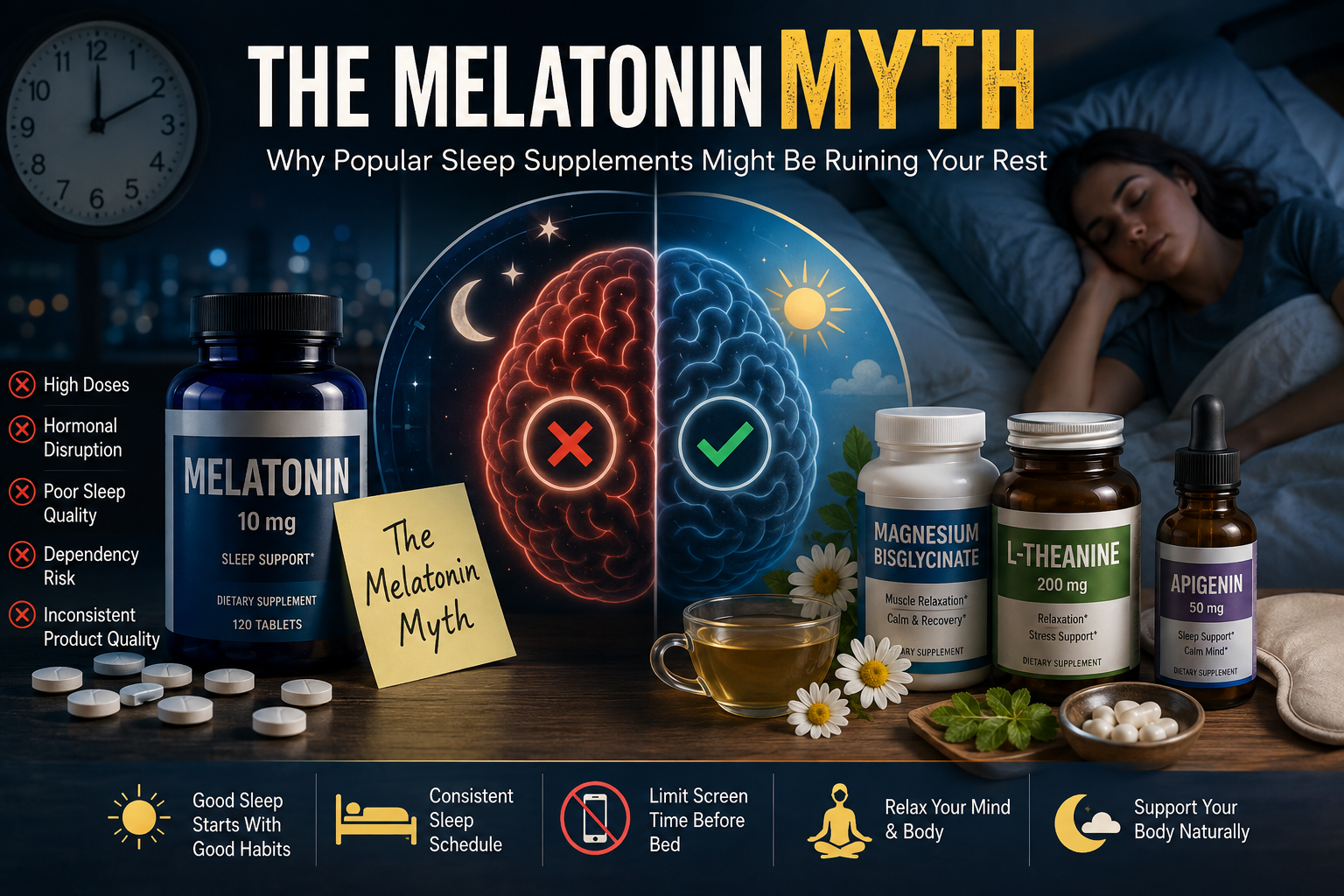
If you struggle to fall asleep, your immediate instinct might be to reach for a bottle of melatonin. It is widely marketed as a natural, safe, non-habit-forming sleep aid. Millions of people use it as a convenient option for sleep, often viewing it almost like a vitamin for rest. But The Melatonin Myth deserves a closer look because melatonin is actually a hormone produced naturally by the body, and using it as a supplement is more complicated than simply taking a regular nutritional supplement.
Emerging research and clinical guidance suggest that melatonin can be useful in certain circumstances, particularly when sleep timing and circadian rhythms are involved, but it is not a universal solution for every sleep problem. The American Academy of Sleep Medicine notes that melatonin supplements have variable doses and limited long-term safety data, while its current guidance does not recommend melatonin as a routine treatment for chronic insomnia.
Understanding The Melatonin Myth means looking beyond the idea that more melatonin automatically means better sleep. The timing, dose, reason for taking it, product quality, and individual circumstances can all matter.
The Melatonin Myth: Why Melatonin Is More Than a Sleep Supplement
Melatonin is not simply an herbal extract or a basic mineral such as magnesium. It is a powerful hormone naturally produced by the pineal gland. Its primary biological role is closely connected to the body’s internal clock and the timing of sleep.
Melatonin levels normally rise in response to darkness and help signal that it is nighttime. This means melatonin is strongly connected to the body’s circadian rhythm rather than acting like a simple sedative that automatically forces someone to sleep.
This distinction is central to understanding The Melatonin Myth. Taking melatonin does not necessarily address every reason someone may be struggling with sleep. Stress, inconsistent schedules, excessive evening light, sleep apnea, restless legs syndrome, medications, caffeine, anxiety, and other factors can all contribute to sleep difficulties.
The American Academy of Sleep Medicine describes melatonin as a hormone that helps regulate the sleep-wake cycle and emphasizes that it is not a one-size-fits-all solution for sleep problems.
The Melatonin Myth and Supplement Dosage
One of the most important issues surrounding The Melatonin Myth is the assumption that a larger dose automatically provides a stronger or better result.
Research and clinical guidelines have examined a wide range of melatonin doses. An AASM clinical practice guideline notes that melatonin doses studied for circadian rhythm sleep-wake disorders have ranged from 0.3 mg to 10 mg, while more recent AASM guidance notes that over-the-counter products can have substantial variability in their actual melatonin content.
This is important because people sometimes assume that a high-dose supplement is automatically more effective. However, melatonin works as a biological signal, and its effects can depend on timing as well as dose.
The goal should therefore not be to take the largest possible amount. The more useful question is whether melatonin is appropriate for the particular sleep problem in the first place.
The Melatonin Myth: What Happens With Long-Term Use?
Long-term melatonin use is an area where more research is needed. It would be inaccurate to say that long-term melatonin use definitely damages the endocrine system or inevitably creates physiological dependency. Current evidence does not establish such a simple conclusion.
Instead, the important issue is that long-term safety data remain limited. The AASM has specifically called for additional research into the lowest effective dose and duration of treatment, as well as long-term physiological effects.
This uncertainty is an important part of The Melatonin Myth. People should not assume that because melatonin is available without a prescription, it has been completely studied for indefinite daily use.
For someone who regularly needs melatonin simply to fall asleep, the underlying cause of the sleep problem may deserve attention. A persistent sleep difficulty could be related to insomnia, circadian rhythm disruption, sleep apnea, medication effects, or other factors.
The Melatonin Myth and Sleep Architecture
Sleep is not one continuous state. During the night, the brain moves through different sleep stages, including lighter sleep, deeper non-REM sleep, and REM sleep.
These stages form a dynamic pattern often called sleep architecture.
It is tempting to assume that taking a sleep supplement automatically improves this entire process. However, improving the ability to fall asleep is not necessarily the same thing as optimizing every aspect of sleep architecture.
Research into melatonin and sleep outcomes has produced mixed findings depending on the population, condition, dose, and timing. For chronic insomnia in adults, the AASM’s pharmacologic guideline found the evidence for melatonin benefit to be weak and noted limited systematic evidence regarding harms.
Therefore, The Melatonin Myth should not be interpreted as saying that melatonin always ruins sleep architecture. A more accurate conclusion is that melatonin should not automatically be treated as a guaranteed solution for achieving better-quality sleep.
The Melatonin Myth: Why Timing Matters
Timing is one of the most fascinating aspects of melatonin.
Because melatonin is closely connected to the circadian system, taking it at different times can produce different effects. The AASM notes that melatonin can have both sleep-promoting and phase-resetting effects depending on the dose and timing.
This means that simply taking a melatonin tablet immediately before bed may not always be the most appropriate approach.
Someone experiencing jet lag may have a different reason for using melatonin than someone experiencing chronic insomnia. A person working night shifts may also have different circadian needs.
This is why The Melatonin Myth is ultimately about understanding biology rather than simply labeling melatonin as good or bad.
The Melatonin Myth and Product Quality
Another powerful issue is the consistency of commercial melatonin supplements.
Unlike many prescription medications, melatonin is commonly sold as a dietary supplement. The amount of melatonin contained in a product may not always perfectly match what appears on the label.
The AASM’s 2025 clinical practice guideline for shift work disorder cites research showing actual melatonin content ranging from −83% to +478% of the labeled amount, with chewable and capsule formulations showing particularly high variability.
This creates a genuine concern for consumers.
If someone believes they are taking a specific amount but the actual content differs substantially, their experience may not be predictable. This is one reason product quality and reputable sourcing matter when considering any supplement.
The Melatonin Myth: What About High-Dose Melatonin?
High-dose melatonin products are widely available, but higher does not automatically mean better.
The body naturally produces melatonin in relatively small quantities, but comparing a physiological nighttime secretion directly with a supplement dose can be misleading because absorption, metabolism, formulation, timing, and individual biology all influence the resulting exposure.
Instead of focusing only on the number printed on a bottle, people should consider why they are taking melatonin and whether there is evidence that it is appropriate for their particular sleep problem.
The smart approach is to avoid treating high-dose melatonin as a universal shortcut to better sleep.
The Melatonin Myth and Chronic Insomnia
Chronic insomnia is different from occasionally having trouble falling asleep.
Someone with chronic insomnia may repeatedly struggle with falling asleep, staying asleep, waking too early, or experiencing inadequate sleep despite having enough opportunity to sleep.
For chronic insomnia, the American Academy of Sleep Medicine states that cognitive behavioral therapy for insomnia, commonly known as CBT-I, is the first-line treatment. Its current consumer guidance says melatonin should generally not be used as the treatment for chronic insomnia in adults or children.
This is an important part of The Melatonin Myth because a supplement may distract someone from addressing the underlying sleep issue.
If sleep problems continue for weeks or months, identifying the cause can be more valuable than repeatedly increasing or changing supplements.
A Smarter Approach to Better Sleep
Instead of relying entirely on supplements, a strong sleep strategy begins with the fundamentals.
A consistent sleep and wake schedule can help reinforce the body’s internal clock. Keeping the bedroom dark, cool, and quiet can create a more supportive environment. Limiting stimulating activities and bright light before bedtime may also help establish a clearer transition toward sleep.
Regular physical activity and a predictable evening routine can further support healthy sleep habits.
For people with chronic insomnia, evidence-based behavioral approaches such as CBT-I can be particularly important. The AASM identifies CBT-I as the first-line treatment approach for chronic insomnia.
The Melatonin Myth: Comparing Common Sleep Approaches
| Sleep Approach | Main Purpose | Key Consideration |
|---|---|---|
| Melatonin | Supports circadian timing and sleep-related signaling | Timing, dose, product quality, and individual needs matter |
| Consistent sleep schedule | Strengthens regular sleep timing | Requires consistency |
| Dark bedroom | Supports natural nighttime signaling | Light exposure can affect circadian rhythms |
| Relaxing bedtime routine | Helps transition toward sleep | Works best when repeated consistently |
| Regular exercise | Supports overall sleep health | Timing and intensity may matter for some people |
| CBT-I | Treats chronic insomnia through behavioral strategies | Considered first-line for chronic insomnia |
| Medical evaluation | Identifies underlying sleep problems | Important when sleep difficulties persist |
The table highlights why The Melatonin Myth cannot be reduced to a simple statement that melatonin is either good or bad. Different sleep problems require different approaches.
The Melatonin Myth: Non-Hormonal Sleep Support
If someone wants to explore non-hormonal supplements, several options are commonly discussed, including magnesium, L-theanine, and apigenin. However, these supplements should not automatically be considered proven replacements for medical treatment or established behavioral approaches.
Magnesium is involved in numerous physiological processes and is often promoted for relaxation and sleep. However, the evidence for different magnesium formulations and sleep outcomes varies.
L-theanine is an amino acid found naturally in tea and is commonly studied for relaxation and cognitive effects. Its potential role in sleep may relate partly to its ability to promote relaxation rather than acting as a conventional sedative.
Apigenin is a plant flavonoid found in foods and herbs such as chamomile. It is also frequently discussed in connection with relaxation and sleep, although evidence for using it as a sleep treatment is not as established as evidence for behavioral treatments such as CBT-I.
These options should therefore be approached carefully rather than presented as guaranteed solutions.
The Melatonin Myth: When Professional Advice Matters
Persistent sleep problems deserve more attention than simply adding another supplement.
If someone regularly struggles with sleep, experiences significant daytime sleepiness, snores heavily, wakes gasping, has unusual nighttime movements, or notices that sleep problems are affecting daily life, professional evaluation can help identify potential underlying causes.
A healthcare professional can consider the person’s sleep pattern, medications, health history, lifestyle, and symptoms before recommending an appropriate approach.
This is particularly important for children and adolescents. The AASM recommends that parents and caregivers consult a healthcare professional before giving melatonin to children and emphasizes safe storage because accidental ingestion can occur.
The Future of Sleep Supplements
The future of sleep science is likely to focus increasingly on personalization.
Instead of treating everyone with the same supplement or the same dose, researchers may increasingly examine individual circadian rhythms, sleep patterns, genetics, lifestyle, and specific sleep disorders.
This could lead to more targeted approaches in which interventions are chosen according to the underlying problem.
Melatonin may remain useful for specific circadian rhythm conditions, but its role will likely continue to be defined by evidence rather than marketing. Current AASM guidance identifies several circadian rhythm disorders where melatonin may have a role, while emphasizing that its use should be appropriate to the specific situation.
The Melatonin Myth: What the Evidence Really Suggests
The most important lesson from The Melatonin Myth is that melatonin is neither a miracle supplement nor something that should automatically be considered harmful.
It is a naturally occurring hormone with a genuine biological role in regulating the sleep-wake cycle. It can be useful in certain circumstances, particularly when circadian timing is involved. At the same time, it is not a universal treatment for insomnia, and the long-term safety of routine supplementation remains incompletely understood.
Product variability adds another layer of uncertainty. Actual supplement contents can differ substantially from labels, making quality and appropriate dosing important considerations.
The strongest approach is therefore to understand the reason behind the sleep problem before reaching for a supplement.
Conclusion: The Melatonin Myth
The Melatonin Myth challenges the simple idea that melatonin is automatically the best answer whenever someone cannot sleep.
Melatonin is a powerful biological signal, not simply a vitamin for rest. Its effects depend on timing, dose, individual circumstances, and the reason it is being used. Research also shows that commercial supplement content can vary considerably, while long-term safety data remain limited.
For chronic insomnia, behavioral treatment such as CBT-I has a stronger evidence-based role, and persistent sleep problems may require professional evaluation.
The future of better sleep is unlikely to depend on taking more supplements. A more powerful and sustainable approach combines healthy sleep habits, accurate understanding of circadian biology, appropriate medical guidance, and evidence-based treatment when needed.
Understanding The Melatonin Myth is ultimately about making smarter decisions about sleep rather than believing that one supplement can solve every sleep problem.