For years, the fitness industry has focused on extreme workouts, heavy lifting, exhausting cardio sessions, and high-intensity interval training. While intense exercise has an important place in fitness, Zone 2 Cardio offers a calmer and more sustainable approach to improving cardiovascular fitness, endurance, metabolic health, and long-term physical performance. It is a steady form of aerobic exercise that allows you to work at a moderate intensity while still being able to hold a conversation.
The growing popularity of Zone 2 Cardio comes from a simple idea: you do not need to destroy your body during every workout to become fitter. A strong fitness routine can include different levels of exercise intensity, and moderate aerobic training can provide an important foundation. For people interested in healthy aging, fat loss, endurance, and sustainable fitness, Zone 2 training can become a valuable part of a long-term exercise routine.
What Is Zone 2 Cardio?
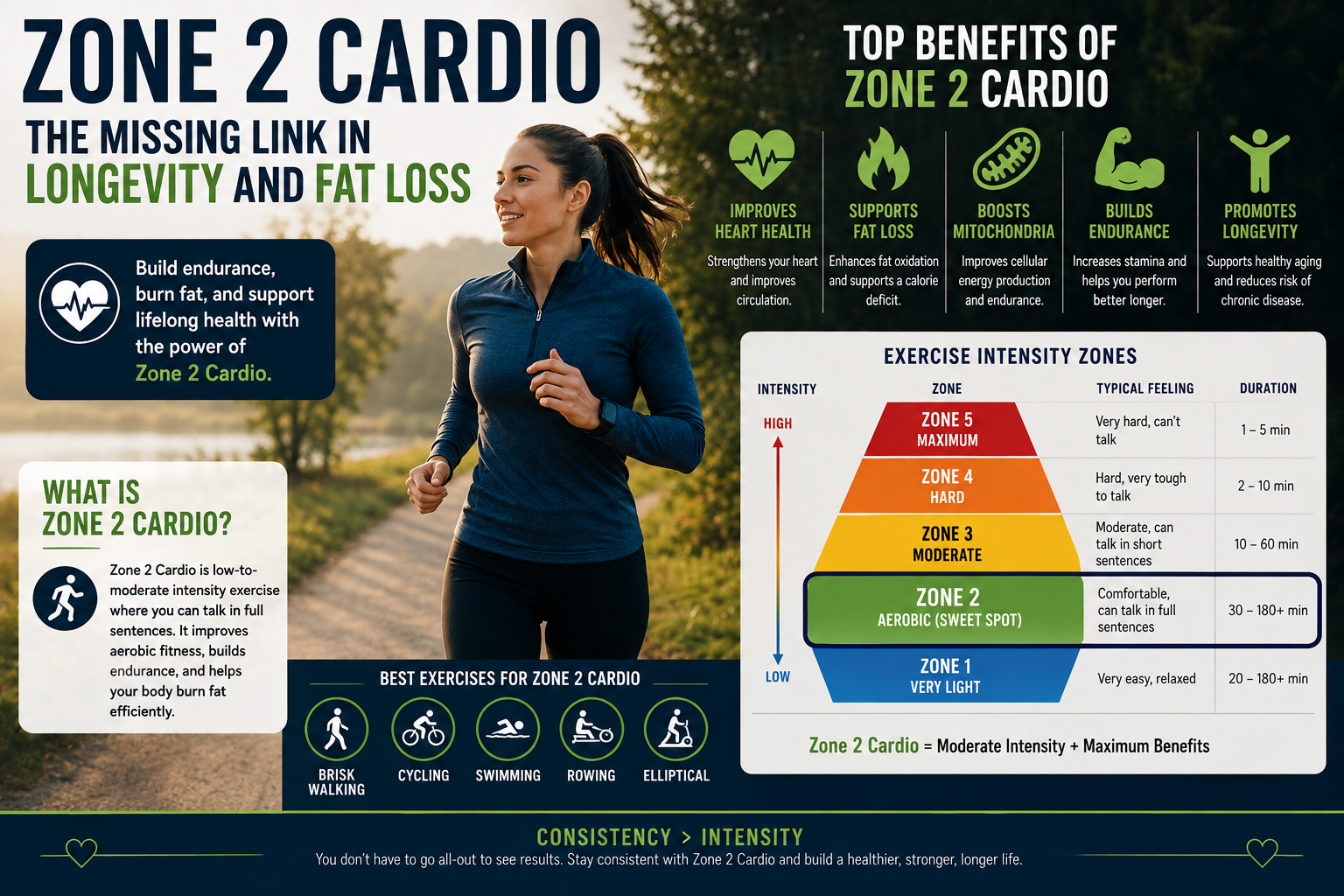
Zone 2 Cardio refers to steady-state aerobic exercise performed at a relatively moderate intensity. During this type of training, your body uses oxygen to help produce energy for working muscles. The intensity is high enough to challenge your cardiovascular system but low enough that you can continue exercising for a relatively long period.
Zone 2 is not exactly the same for everyone. Your training zone can be influenced by age, fitness level, genetics, medications, exercise history, and the method used to calculate your heart-rate zones. Because of these differences, a specific heart-rate number should not automatically be considered the perfect Zone 2 intensity for every person.
A practical way to understand Zone 2 Cardio is through the talk test. You should be able to speak in complete sentences while exercising, although your breathing should be noticeably faster than when you are resting. If you are struggling to speak because you are breathing heavily, you may have moved into a higher intensity.
Walking, cycling, swimming, rowing, jogging, and using an elliptical machine can all become Zone 2 activities depending on your individual fitness level.
Zone 2 Cardio and Aerobic Fitness
One of the biggest benefits associated with Zone 2 Cardio is its ability to support aerobic fitness. Aerobic fitness refers to how effectively your cardiovascular and respiratory systems deliver oxygen to your muscles during physical activity.
When you regularly perform aerobic exercise, your body adapts to the repeated demand. Your heart becomes more efficient at pumping blood, your muscles become better at using oxygen, and your ability to sustain physical activity can improve over time.
Zone 2 training is particularly useful because it allows you to spend a meaningful amount of time exercising without the extreme fatigue associated with repeated maximum-effort workouts. This makes it easier for many people to build a consistent aerobic foundation.
Why Zone 2 Cardio Feels Sustainable
The sustainable nature of Zone 2 Cardio is one of its biggest advantages. A very intense workout may leave you exhausted and require significant recovery. A moderate aerobic session can often be repeated more regularly.
This does not mean Zone 2 exercise is effortless. You should still feel that your body is working, your heart rate is elevated, and your breathing is faster. The difference is that the intensity remains controlled.
For someone who struggles to maintain a regular exercise routine, this level of training can feel much more manageable than constantly trying to achieve maximum performance.
Zone 2 Cardio and Mitochondrial Health
Mitochondria are structures inside cells that help produce energy. Because muscles require large amounts of energy during exercise, mitochondrial function plays an important role in endurance and physical performance.
Regular aerobic exercise can stimulate adaptations that improve the muscles’ ability to use oxygen and produce energy efficiently. This is one reason Zone 2 Cardio is frequently discussed in conversations about mitochondrial health and endurance.
It is important, however, not to describe Zone 2 as a magical workout that automatically creates new mitochondria or prevents aging. Exercise adaptations are complex and result from repeated training over time.
Zone 2 Cardio and Metabolic Efficiency
Metabolic flexibility describes the body’s ability to adjust its use of different energy sources depending on exercise intensity, food availability, and other conditions.
During lower-intensity aerobic exercise, fat contributes substantially to energy production, although carbohydrates are also used. The exact balance varies between individuals and changes according to exercise intensity and training status.
This means Zone 2 Cardio should not be viewed as an exercise where your body burns only fat. Instead, it is an aerobic intensity where fat oxidation can make an important contribution while the body continues using other energy sources as needed.
Zone 2 Cardio for Fat Loss
Fat loss is primarily influenced by overall energy balance. If the body consistently uses more energy than it receives from food, stored energy can be used over time. No single exercise zone can guarantee fat loss.
However, Zone 2 Cardio can support a fat-loss routine because it allows people to increase their physical activity without necessarily creating the same level of fatigue as very intense training.
For example, a person may be able to complete several moderate cycling, walking, or swimming sessions each week while still recovering well. That additional movement can contribute to total energy expenditure.
The major advantage is consistency. A workout that you can perform regularly may be more useful for long-term results than an extremely difficult workout that you can only complete occasionally.
Zone 2 Cardio Is Not a Magic Fat-Burning Zone
The term “fat-burning zone” can sometimes be misleading. Burning a larger percentage of fat during a particular workout does not automatically mean that you will lose more body fat over the long term.
Long-term fat loss depends on total energy balance, nutrition, physical activity, sleep, stress, and individual factors. Zone 2 Cardio can support the physical activity side of this equation, but it works best as part of a complete lifestyle rather than as a standalone solution.
Zone 2 Cardio and Longevity
Longevity is not simply about living for more years. Healthy longevity also means maintaining strength, mobility, cardiovascular fitness, independence, and the ability to perform everyday activities as you age.
This is where Zone 2 Cardio can become particularly useful. Regular aerobic activity helps maintain the body’s ability to perform sustained physical work. Walking, cycling, swimming, and other moderate activities can keep movement integrated into daily life.
As people age, maintaining cardiovascular fitness becomes increasingly valuable. A person who develops strong exercise habits earlier in life may have a better foundation for remaining physically active later.
Building a Zone 2 Cardio Longevity Routine
A longevity-focused routine should not depend on one form of exercise. Zone 2 Cardio can provide an aerobic foundation, while resistance training can help maintain muscle strength and physical function.
Mobility exercises, balance training, recreational activities, and occasional higher-intensity workouts can also contribute to a complete fitness strategy.
The goal is to create a routine that can continue for years rather than following an extreme program for only a few weeks.
Zone 2 Cardio and Exercise Intensity
Understanding exercise intensity is important because training too hard can turn a Zone 2 workout into a higher-intensity session. On the other hand, exercising too easily may not provide the desired aerobic challenge.
The following graph provides a simplified view of how intensity and training duration can relate:
Exercise
Intensity
   │
High│                         █████████
   │                         █ HIIT  █
   │                    ███████████████
   │
   │              █████████
   │              █ Zone 3 █
   │         ███████████████
   │
   │     █████████████████
   │     █  ZONE 2 CARDIO █
   │     █████████████████
   │
Low│ ███████████
   │ Easy Movement
   └────────────────────────────────────
       Shorter                    Longer
             Training Duration

      Zone 2 = Moderate Intensity + Sustainable Duration
This graph is a simplified illustration. Individual exercise zones vary according to fitness, age, health, heart rate, and testing method.
How to Find Your Zone 2 Cardio Intensity
There are several ways to estimate Zone 2 Cardio intensity. Heart-rate monitoring is one option, but formulas based only on age can be inaccurate for some people.
The talk test is a simple alternative. During Zone 2 exercise, you should be able to speak in complete sentences without repeatedly stopping to catch your breath.
Another method is perceived exertion. Many people describe Zone 2 as feeling moderate, often around 3 to 5 on a 10-point effort scale. You should feel that you are exercising, but you should not feel as though you are close to maximum effort.
Wearable fitness trackers can provide additional information, but their heart-rate readings should be treated as estimates rather than perfect measurements.
Zone 2 Cardio and the Talk Test
The talk test makes Zone 2 Cardio accessible because it does not require expensive equipment. If you can comfortably discuss your day with someone while walking or cycling, your intensity may be within a suitable aerobic range.
If you cannot complete a sentence without stopping for breath, your intensity may be too high for a traditional conversational Zone 2 session.
How Long Should Zone 2 Cardio Last?
The appropriate duration depends on your fitness level, exercise history, age, recovery ability, and schedule. Beginners should not feel pressured to immediately perform long sessions.
A person new to aerobic training might start with 20 to 30 minutes and gradually increase the duration. As fitness improves, longer sessions can become more comfortable.
Some experienced individuals may perform 40-, 60-, or even longer sessions. The most important factor is consistency. Regular moderate exercise performed over months and years is more meaningful than occasional extreme sessions.
Zone 2 Cardio vs HIIT
HIIT and Zone 2 Cardio are not enemies. They simply train the body in different ways.
High-intensity interval training involves short periods of very challenging exercise followed by recovery periods. It can be an efficient way to stimulate cardiovascular and performance adaptations, but it also places greater demands on the body.
Zone 2 training is performed at a much more sustainable intensity. It allows people to spend more time exercising while generally experiencing less immediate fatigue.
A balanced training program can include both forms of exercise. The ideal combination depends on fitness goals, training experience, recovery, and individual health.
Why Zone 2 Cardio Matters for Recovery
Training hard every day is not necessary for making progress. Your body needs time to recover and adapt after challenging exercise.
Zone 2 Cardio can provide a way to maintain aerobic activity while keeping intensity relatively controlled. This can make it easier to build exercise volume without turning every workout into a demanding session.
However, low intensity does not mean unlimited training. Long sessions can still cause fatigue, especially in beginners. Gradual progression remains important.
Best Exercises for Zone 2 Cardio
There is no single exercise that defines Zone 2 Cardio. The best activity is one that allows you to maintain an appropriate aerobic intensity comfortably and consistently.
Brisk walking is one of the simplest options and requires very little equipment. Cycling is another excellent choice, especially for people who prefer lower-impact exercise.
Swimming can provide a full-body aerobic workout, while rowing and elliptical training can also keep the heart rate elevated without requiring running.
For some people, slow jogging may be appropriate. Beginners who cannot jog while maintaining conversational breathing can use brisk walking or incline walking instead.
The exercise itself matters less than maintaining the appropriate intensity.
Common Zone 2 Cardio Mistakes
One common mistake is exercising too hard. Because many people associate fitness with discomfort, they may unintentionally turn a moderate workout into a high-intensity session.
Another mistake is becoming overly focused on one heart-rate number. Heart rate can change because of heat, dehydration, caffeine, stress, illness, and fatigue.
A third mistake is expecting immediate results. Aerobic fitness develops gradually through repeated training. Improvements in endurance, efficiency, and exercise capacity require patience.
Creating a Sustainable Zone 2 Cardio Routine
A simple Zone 2 Cardio routine can begin with two or three sessions each week. Each session can last approximately 20 to 45 minutes depending on your current fitness level.
As your endurance improves, you can gradually increase the duration. There is no need to dramatically increase your training volume from the beginning.
Combining Zone 2 with resistance training can create a more complete exercise routine. Strength training supports muscle and bone health, while aerobic exercise supports cardiovascular endurance.
This combination can be especially valuable for people who want to improve fitness while supporting healthy aging.
The Future of Zone 2 Cardio and Longevity
Interest in Zone 2 Cardio is likely to continue as more people move away from the idea that every workout needs to be extreme. Wearable technology is also making it easier to monitor heart rate, pace, recovery, and training patterns.
However, technology should make exercise easier to understand rather than unnecessarily complicated. You do not need an expensive device to benefit from walking, cycling, swimming, or other aerobic activities.
The future of longevity-focused fitness will likely involve multiple forms of exercise. Aerobic training, strength training, mobility, sleep, nutrition, recovery, stress management, and everyday movement all have important roles.
Final Thoughts on Zone 2 Cardio
Zone 2 Cardio is not a shortcut to instant fat loss, and it should not replace every other type of exercise. Its real value comes from being a sustainable form of aerobic training that can support cardiovascular fitness, endurance, metabolic health, and long-term physical activity.
The conversational pace makes Zone 2 accessible to many people. Whether you choose brisk walking, cycling, swimming, rowing, or easy jogging, the goal is to find an intensity that you can maintain consistently.
For a longevity-focused lifestyle, Zone 2 Cardio can provide a strong aerobic foundation. When combined with resistance training, nutritious food, quality sleep, recovery, and regular daily movement, it can become part of a sustainable strategy for staying active, improving fitness, and supporting healthy aging.