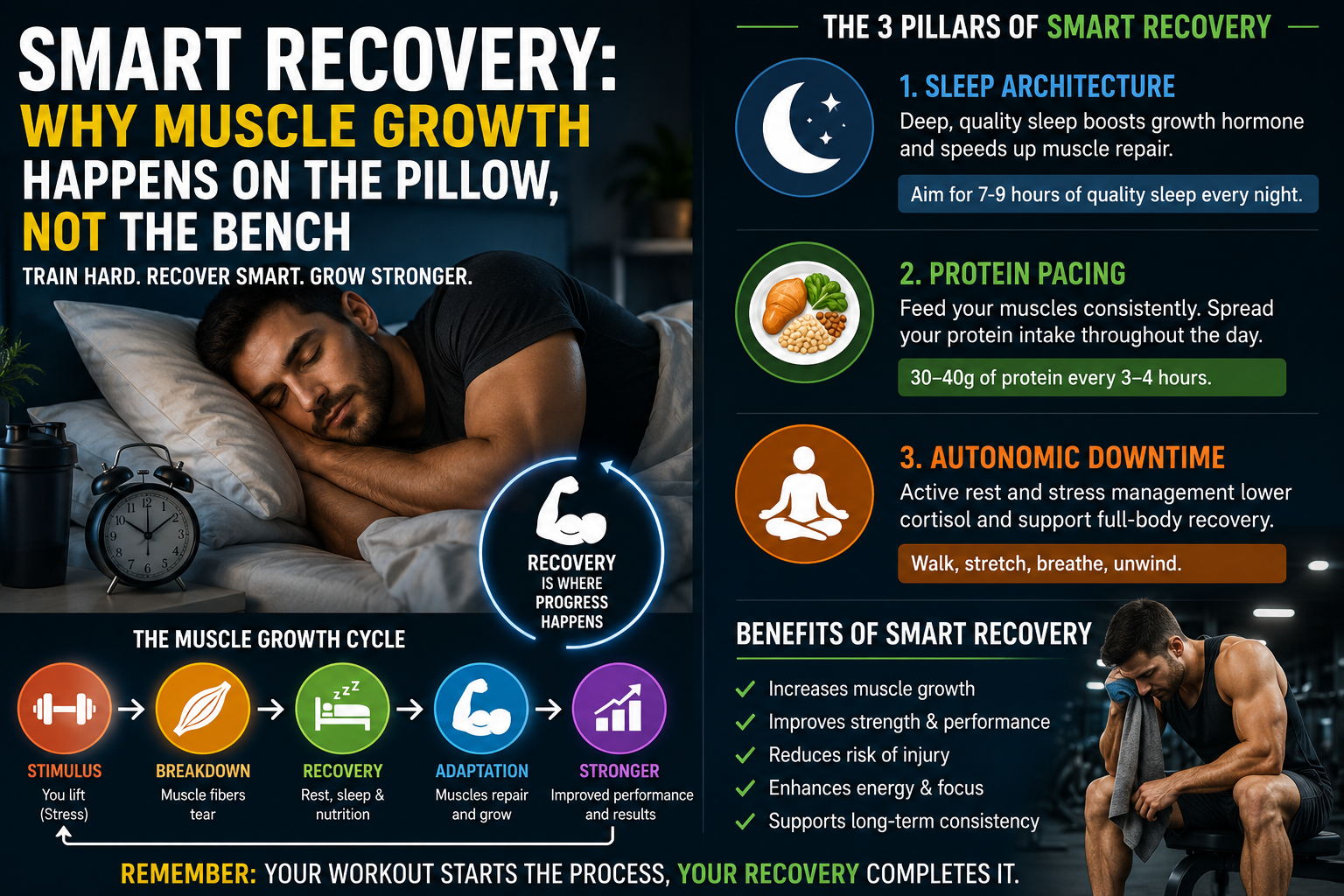
Smart Recovery is one of the most important parts of building muscle, improving strength, and maintaining long-term fitness. Many people spend hours lifting weights and increasing training intensity but give far less attention to what happens after the workout. The truth is that exercise provides the stimulus for adaptation, while Smart Recovery gives the body the time and resources it needs to repair, rebuild, and become stronger.
Training creates temporary stress on muscles and other body systems. During recovery, the body repairs damaged muscle proteins, restores energy stores, adapts to training demands, and prepares for the next session. This is why an effective fitness program is not simply about training harder. It is about balancing Smart Recovery, nutrition, sleep, and training so that the body can consistently adapt.
What Is Smart Recovery?
Smart Recovery means deliberately managing the time between workouts so your body can recover and adapt before you place another major training demand on it. Recovery does not mean doing nothing. It can include quality sleep, adequate nutrition, hydration, rest days, light movement, mobility work, and appropriate adjustments to training intensity.
When recovery is properly planned, your body has a better opportunity to respond positively to exercise. When recovery is repeatedly ignored, fatigue can accumulate and performance may decline.
This makes Smart Recovery an essential part of both muscle growth and sustainable strength training.
Smart Recovery and Muscle Growth
Lifting weights does not simply “tear muscles apart” and automatically make them grow. Resistance training creates mechanical tension and other signals that stimulate muscle adaptation. The body then responds by increasing muscle protein synthesis and making structural changes that help it handle future training demands.
This process requires time, energy, amino acids, and adequate recovery.
In simple terms, think of the process as:
Training Stimulus + Nutrition + Smart Recovery = Adaptation
Training provides the challenge. Food provides energy and nutrients. Sleep and recovery provide the environment in which the body can repair and adapt.
This is why adding more workouts is not always the fastest route to better results.
Smart Recovery: The Overtraining and Fatigue Cycle
One difficult training session does not automatically cause overtraining. True overtraining syndrome is a serious condition involving persistent performance decline and other symptoms, while normal training fatigue is much more common.
However, repeatedly increasing training stress without allowing enough recovery can contribute to excessive fatigue and poor performance.
A typical cycle may look like this:
| Training Stage | What Happens | Recovery Need |
|---|---|---|
| Workout | Muscles and systems experience training stress | Moderate |
| Immediate Recovery | Fatigue begins to decrease | High |
| Repair | Muscle proteins and energy stores are restored | High |
| Adaptation | Body becomes better prepared for similar stress | Moderate |
| Next Workout | Another training stimulus is introduced | Depends on readiness |
The goal of Smart Recovery is to give your body enough time to move through these stages before repeatedly adding excessive stress.
Smart Recovery Pillar #1: Quality Sleep
Sleep is arguably the most important recovery habit. During sleep, the body performs numerous biological processes involved in tissue repair, energy regulation, immune function, and nervous-system recovery.
Deep sleep is associated with important hormonal and physiological processes, including pulses of growth hormone. However, it is inaccurate to suggest that simply cutting sleep from eight hours to six automatically removes half of your tissue-repair ability. Recovery is more complicated than a single percentage.
What is clear is that consistently inadequate sleep can negatively affect physical performance, mood, reaction time, appetite regulation, and recovery.
How to Improve Sleep for Smart Recovery
A consistent sleep schedule can make recovery more predictable. Going to bed and waking up at similar times can help support your body’s natural rhythm.
A cool, dark, and quiet bedroom may also improve sleep quality. Limiting stimulating activities before bed and reducing excessive caffeine later in the day can further support restful sleep.
For people following demanding Smart Recovery routines, sleep should be treated as part of the training plan rather than an optional extra.
Smart Recovery Pillar #2: Protein and Nutrition
Muscle repair requires amino acids, which come from dietary protein. Resistance training can increase the body’s demand for protein, particularly when the goal is to build or maintain muscle.
Instead of concentrating almost all protein into one large meal, distributing protein across several meals can be a practical strategy for supporting muscle protein synthesis throughout the day.
A commonly used general target for people who regularly perform resistance training is around 1.6 grams of protein per kilogram of body weight per day, although individual requirements can vary based on body size, age, training volume, goals, and overall diet.
Protein Pacing for Smart Recovery
A balanced approach might include protein at breakfast, lunch, dinner, and one or more snacks. Foods such as eggs, dairy products, fish, poultry, lean meat, beans, lentils, tofu, and other protein-rich foods can contribute to daily intake.
The exact amount per meal does not need to be identical. What matters most is meeting your overall nutritional needs consistently.
Smart Recovery works best when protein is combined with sufficient calories, carbohydrates, healthy fats, vitamins, minerals, and fluids.
Smart Recovery Pillar #3: Active Recovery
Recovery does not always require complete inactivity. Light movement can be useful between demanding training sessions.
Walking, gentle cycling, easy mobility exercises, and low-intensity movement can help you stay active without adding another major training stress.
The key is intensity. An active recovery session should feel easier than a normal workout. If your “recovery workout” leaves you exhausted, it may no longer be functioning as recovery.
Active Recovery and Smart Recovery
A simple active recovery day might include a relaxed walk followed by gentle mobility exercises. The objective is to maintain movement while allowing the body to recover from harder sessions.
This approach can be especially useful for people who dislike sitting completely still on rest days.
Smart Recovery Pillar #4: Hydration and Electrolytes
Water plays an important role in numerous physiological processes, including temperature regulation, circulation, and physical performance.
During exercise, especially in hot environments or during prolonged training, fluid losses through sweat can become significant. Replacing fluids helps support normal physical function and recovery.
For most everyday workouts, drinking according to thirst and maintaining normal hydration is a reasonable starting point. Longer or very sweaty training sessions may require more deliberate fluid and electrolyte replacement.
Hydration is therefore another simple but often overlooked component of Smart Recovery.
Smart Recovery Pillar #5: Training Volume and Rest Days
Recovery is not only something you do after training. It should influence how your entire training schedule is designed.
Training the same muscle groups intensely every day may not provide enough time for adaptation. A better strategy can involve alternating demanding sessions with easier days or targeting different muscle groups across the week.
For example, someone might perform a challenging full-body strength session on Monday, lighter movement on Tuesday, another strength session on Wednesday, active recovery on Thursday, and a final strength session on Friday.
The exact schedule depends on training experience and goals.
Smart Recovery and the Nervous System
Muscle recovery is only part of the picture. Exercise also challenges the nervous system.
Heavy lifting, high-intensity intervals, demanding sports, and long workouts can create significant overall fatigue. If every training session is performed at maximum intensity, the body may struggle to maintain performance.
This is where Smart Recovery becomes particularly valuable.
Instead of treating every workout as a test, consider using different levels of intensity throughout the week. Some sessions can be challenging, while others can focus on technique, mobility, or easier conditioning.
This creates a more sustainable training rhythm.
Smart Recovery: Signs You May Need More Rest
Occasional soreness or tiredness after exercise is normal. However, persistent changes may indicate that your current training and recovery balance needs attention.
Signs that you may need to reduce training stress can include consistently declining performance, unusual or persistent fatigue, poor sleep, irritability, reduced motivation, prolonged muscle soreness, or repeated minor injuries.
These symptoms do not automatically mean you are overtrained. They can have many causes, including insufficient food, stress, illness, inadequate sleep, or an overly demanding training schedule.
If symptoms are persistent or severe, professional medical or sports-health advice is appropriate.
Smart Recovery Weekly Blueprint
A practical recovery-focused schedule can help balance exercise and rest without making fitness complicated.
| Day | Training Focus | Recovery Strategy |
|---|---|---|
| Monday | Strength Training | Protein-rich meals + quality sleep |
| Tuesday | Light Cardio | Walking + mobility |
| Wednesday | Strength Training | Hydration + adequate nutrition |
| Thursday | Active Recovery | Gentle movement + relaxation |
| Friday | Strength Training | Protein + sleep |
| Saturday | Optional Activity | Keep intensity moderate |
| Sunday | Rest | Full recovery and preparation |
This is only an example. Your ideal schedule should depend on your fitness level, training goals, lifestyle, and ability to recover.
Smart Recovery Progress Chart
The relationship between training and recovery can be understood through a simple progression model:
Training Stress → Fatigue → Recovery → Repair → Adaptation → Improved Performance
If training stress continues without sufficient recovery, the cycle can instead become:
Training Stress → Fatigue → More Training → Accumulated Fatigue → Performance Decline
The objective of Smart Recovery is not to avoid training stress. It is to manage it intelligently.
Smart Recovery Is More Than Muscle Rest
Many people think recovery means waiting until muscle soreness disappears. While soreness can be one sign of training stress, recovery is much broader.
Your muscles, nervous system, energy systems, connective tissues, and psychological state all contribute to how ready you are for another workout.
You may have little muscle soreness but still feel unusually fatigued after several demanding training sessions. Conversely, mild soreness does not necessarily mean you must completely avoid movement.
This is why recovery should be based on the complete picture rather than one symptom.
The Role of Deloading in Smart Recovery
A deload is a planned period in which training volume or intensity is temporarily reduced. It can be useful for people who follow structured, demanding training programs.
For example, after several weeks of progressive training, someone might reduce the number of sets or use lighter weights for a short period.
Deloading does not mean losing progress. It can provide a break from accumulated training stress and allow you to return to harder training with better readiness.
For advanced lifters, deloading can become an important part of a long-term Smart Recovery strategy.
Smart Recovery and Long-Term Muscle Growth
Muscle growth is not created by a single workout. It is the result of repeated cycles of training, recovery, nutrition, and adaptation.
If you consistently train but fail to recover, your ability to perform high-quality workouts may decline. If you consistently recover but never provide enough training stimulus, there may be little reason for the body to adapt.
The balance is what matters.
A sustainable muscle-building program therefore needs both progressive resistance training and Smart Recovery. The workout challenges the body, while recovery helps prepare it for the next challenge.
How to Build Your Own Smart Recovery Routine
Start by looking at your weekly training schedule rather than focusing on individual workouts. Ask whether you have enough time between demanding sessions and whether your sleep and nutrition support your goals.
Next, monitor your performance. If your lifts, endurance, or exercise quality are improving over time, your training and recovery balance may be working well.
If performance repeatedly declines, fatigue remains high, or motivation disappears, consider reducing training volume temporarily and improving sleep, nutrition, hydration, and stress management.
The goal is not perfect recovery every day. The goal is creating a system that allows you to train consistently for months and years.
Smart Recovery: The Missing Half of Fitness
Building muscle and strength requires more than spending time under a barbell. Exercise provides the stimulus, but adaptation depends on what happens after the workout.
Smart Recovery brings together sleep, nutrition, hydration, active recovery, rest days, appropriate training volume, and stress management. These elements help create the conditions needed for the body to respond to training.
The most effective fitness routine is not necessarily the one with the most workouts. It is the one that provides an appropriate training stimulus while giving the body enough opportunity to adapt.
When you stop treating recovery as wasted time and start treating it as part of the training process, your entire approach to fitness can change. Train with purpose, recover intelligently, eat adequately, sleep well, and give your body the time it needs to become stronger.
Smart Recovery is not a break from progress—it is a fundamental part of progress.