SEO Number: 5
As people live longer, fitness is becoming less about appearance and more about maintaining functional strength, mobility, balance, and independence. The Functional Strength Blueprint focuses on exercises that train the body to perform everyday movements safely and efficiently. Instead of concentrating only on muscle size or body fat, functional strength workouts teach your muscles, joints, and nervous system to work together through natural movement patterns.
A strong body is not simply one that can lift heavy weights. It is a body that can squat down, stand up, bend, push, pull, carry, walk, and move with confidence. The goal of the Functional Strength Blueprint is to build physical abilities that remain useful not only today but throughout the decades ahead.
What Is the Functional Strength Blueprint?
The Functional Strength Blueprint is a training approach built around practical movement rather than isolated muscle development. Traditional gym routines may focus heavily on individual muscles, but functional training emphasizes how different muscles and joints cooperate during real-world activities.
For example, picking up a box from the floor requires more than strong legs. Your hips, hamstrings, glutes, core, back, and grip must coordinate to complete the movement safely. Similarly, carrying groceries requires leg strength, shoulder stability, grip strength, posture, and balance.
This is why functional strength workouts often use compound exercises that involve several joints and muscle groups at the same time. These exercises can improve movement efficiency while helping people maintain strength and independence as they age.
The Five Primal Movements in the Functional Strength Blueprint
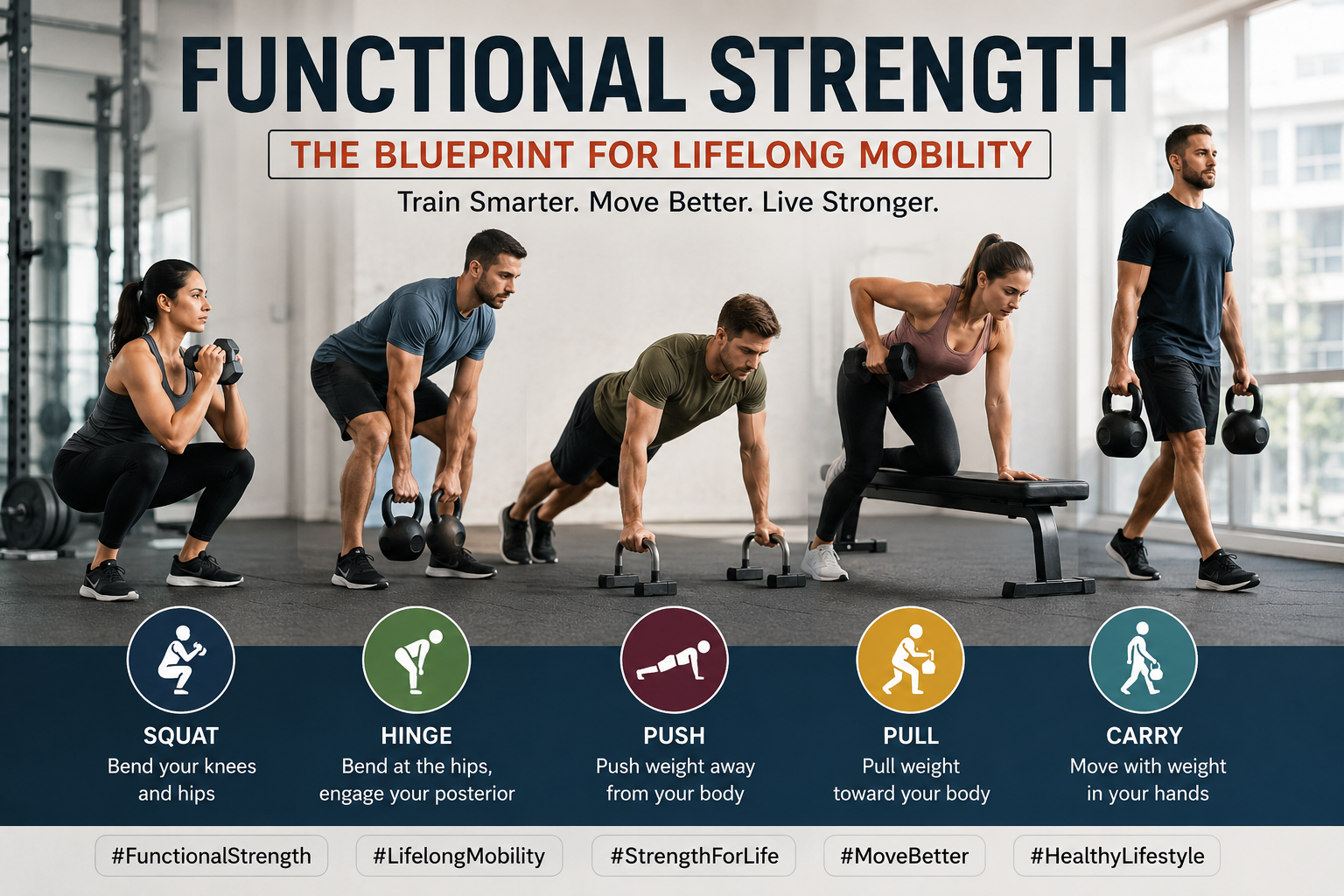
The foundation of the Functional Strength Blueprint is built around five fundamental movement patterns: the squat, hinge, push, pull, and carry. These movements appear repeatedly in everyday life, whether you are exercising, working around the house, playing with children, or traveling.
Training all five patterns creates a more balanced approach to fitness and helps prevent your routine from becoming overly focused on one area of the body.
1. Squat Pattern for Functional Strength
The squat is one of the most important movements for lower-body independence. Sitting into a chair, standing from a low seat, picking something up, and climbing stairs all require some form of squat pattern.
A good functional strength workout can include goblet squats, bodyweight squats, split squats, and controlled chair squats. The emphasis should be on maintaining good posture, controlling the movement, and developing strength through a comfortable range of motion.
As people get older, the ability to lower and raise the body safely becomes increasingly valuable. Building squat strength can therefore contribute to everyday mobility and confidence.
2. Hinge Pattern for Functional Strength
The hinge pattern teaches the body how to bend from the hips while keeping the spine controlled. It is essential for lifting objects from the ground without placing unnecessary stress on the lower back.
Romanian deadlifts, kettlebell deadlifts, and hip-hinge drills are useful examples of hinge-based functional strength exercises. These movements emphasize the glutes and hamstrings while teaching the body to coordinate the hips and trunk.
A strong hinge can make everyday activities such as lifting luggage, picking up groceries, or moving household objects more manageable.
3. Push Pattern in Functional Strength Workouts
Pushing is another essential human movement. We push doors open, move furniture, lift objects overhead, and push ourselves away from the floor.
Push-ups, dumbbell presses, incline push-ups, and overhead presses can all contribute to a balanced functional strength workout. Beginners can start with easier variations and gradually increase resistance as their technique improves.
The goal is not simply to press the heaviest possible weight. Instead, the Functional Strength Blueprint emphasizes controlled movement, joint stability, and coordination between the upper body and core.
4. Pull Pattern for Functional Strength
Pulling movements strengthen muscles across the upper back, shoulders, arms, and trunk. They also help balance pushing movements in a well-rounded training program.
Rows, resistance-band pulls, assisted pull-ups, and cable exercises can develop practical pulling strength. These movements can help with everyday tasks such as opening a heavy door, moving furniture, or pulling an object toward you.
Including both pushing and pulling exercises creates a more complete functional strength training approach rather than focusing only on muscles that are easy to see in the mirror.
5. Carry Pattern for Lifelong Mobility
The carry pattern is one of the simplest yet most practical elements of the Functional Strength Blueprint. Walking while holding weight challenges the grip, shoulders, core, hips, and legs simultaneously.
Farmer carries, suitcase carries, and loaded walks can develop strength while teaching the body to remain stable under movement. Carrying groceries, luggage, boxes, or other objects in daily life becomes easier when the body is accustomed to managing external loads.
The carry also adds a valuable real-world element to functional strength workouts because strength is not only about lifting something—it is also about controlling it while moving.
Building a Functional Strength Workout Routine
A successful Functional Strength Blueprint does not require an extremely complicated gym program. The most important factor is consistency and movement quality.
A balanced session could begin with a short warm-up involving controlled bodyweight movements and mobility exercises. The main workout can then combine one squat exercise, one hinge exercise, one push exercise, one pull exercise, and one carry exercise.
For example, a beginner might perform bodyweight squats, light Romanian deadlifts, incline push-ups, dumbbell rows, and farmer carries. As strength and technique improve, resistance can gradually increase.
The key principle is progression without sacrificing form. Adding weight is useful, but performing a movement correctly is more important than lifting heavier for the sake of numbers.
Functional Strength Blueprint: Sample Weekly Structure
| Day | Training Focus | Example Exercises | Main Goal |
|---|---|---|---|
| Monday | Lower Body | Goblet Squat, Romanian Deadlift | Leg and hip strength |
| Tuesday | Upper Body | Push-Ups, Dumbbell Rows | Pushing and pulling strength |
| Wednesday | Mobility | Walking, Mobility Drills | Recovery and movement quality |
| Thursday | Full Body | Squats, Rows, Presses, Carries | Functional strength |
| Friday | Lower + Core | Split Squats, Hip Hinge, Carries | Stability and balance |
| Saturday | Active Movement | Walking, Hiking, Light Cycling | General mobility |
| Sunday | Recovery | Gentle Stretching and Walking | Recovery |
This type of structure can be adjusted according to fitness level, age, available equipment, and individual goals. The purpose is to make functional strength training sustainable rather than exhausting.
Why Compound Exercises Matter
Compound exercises are central to the Functional Strength Blueprint because they allow several muscles and joints to work together. A squat, for example, involves the hips, knees, ankles, core, and multiple lower-body muscles.
This is different from relying exclusively on isolation machines. Isolation exercises can still have a place in a fitness routine, but they should not completely replace movements that challenge the body as a coordinated system.
Goblet squats can replace an overly machine-dependent leg routine, while dumbbell rows can provide a more practical pulling movement than focusing exclusively on biceps curls.
The objective is not to eliminate traditional strength exercises but to make sure the training program develops abilities that transfer into everyday life.
Functional Strength and Lifelong Mobility
Strength and mobility are closely connected. Strong muscles help stabilize joints, while adequate mobility allows those joints to move through useful ranges of motion.
The Functional Strength Blueprint combines these concepts by encouraging controlled movements through appropriate ranges. Someone may have strong muscles but still struggle with movement if they lack balance, coordination, or mobility.
For lifelong physical independence, the goal should therefore be more than simply increasing strength. A useful program should also develop stability, coordination, balance, posture, and movement confidence.
Training for Independence as You Age
One of the biggest advantages of functional strength workouts is their connection to everyday independence. Aging naturally brings changes in muscle mass, balance, recovery, and physical capacity. Regular strength training can help people maintain their ability to perform daily tasks.
Being able to rise from a chair, climb stairs, carry groceries, lift a suitcase, or get down to the floor represents a form of physical independence that is easy to overlook when fitness is measured only through appearance.
The Functional Strength Blueprint shifts attention toward these practical abilities. Instead of asking only, “How much can I lift?” a functional approach also asks, “Can I move well, control my body, and handle everyday physical demands?”
Movement Quality Comes Before Heavy Weight
A common mistake in strength training is treating heavier weights as the primary measure of progress. While gradually increasing resistance can be valuable, poor technique can reduce the quality of an exercise and increase unnecessary stress on the body.
The Functional Strength Blueprint prioritizes movement quality first. A controlled squat with appropriate depth and stable posture is more valuable than a heavier squat performed with poor technique.
The same principle applies to deadlifts, rows, presses, and carries. Learn the movement, develop control, and then gradually increase resistance when appropriate.
How to Make Functional Strength Training Sustainable
Long-term fitness depends on consistency. A training plan that is extremely difficult to maintain is unlikely to support lifelong mobility.
For many people, two or three focused strength sessions each week can provide a practical starting point. Walking and other forms of regular physical activity can complement those sessions.
It is also important to adjust training according to your current ability. Beginners may start with bodyweight exercises and light resistance, while experienced individuals can use heavier loads and more advanced variations.
The best functional strength workout is ultimately one that you can perform consistently, recover from properly, and progress safely over time.
The Functional Strength Blueprint for a Stronger Future
The modern approach to fitness is increasingly moving beyond appearance. Building a capable body means developing strength that can be used outside the gym.
The Functional Strength Blueprint provides a simple framework by focusing on the squat, hinge, push, pull, and carry patterns. These movements train the body as an integrated system and can support strength, coordination, stability, and everyday mobility.
Whether you are a beginner starting with bodyweight exercises or an experienced lifter using challenging resistance, the principles remain the same: move well, train consistently, progress gradually, and build strength that has a purpose.
A body that can move confidently today is valuable. A body that can continue moving confidently decades from now is even more valuable. That is the real purpose of functional strength training—not simply looking fit, but remaining capable, mobile, and independent throughout life.