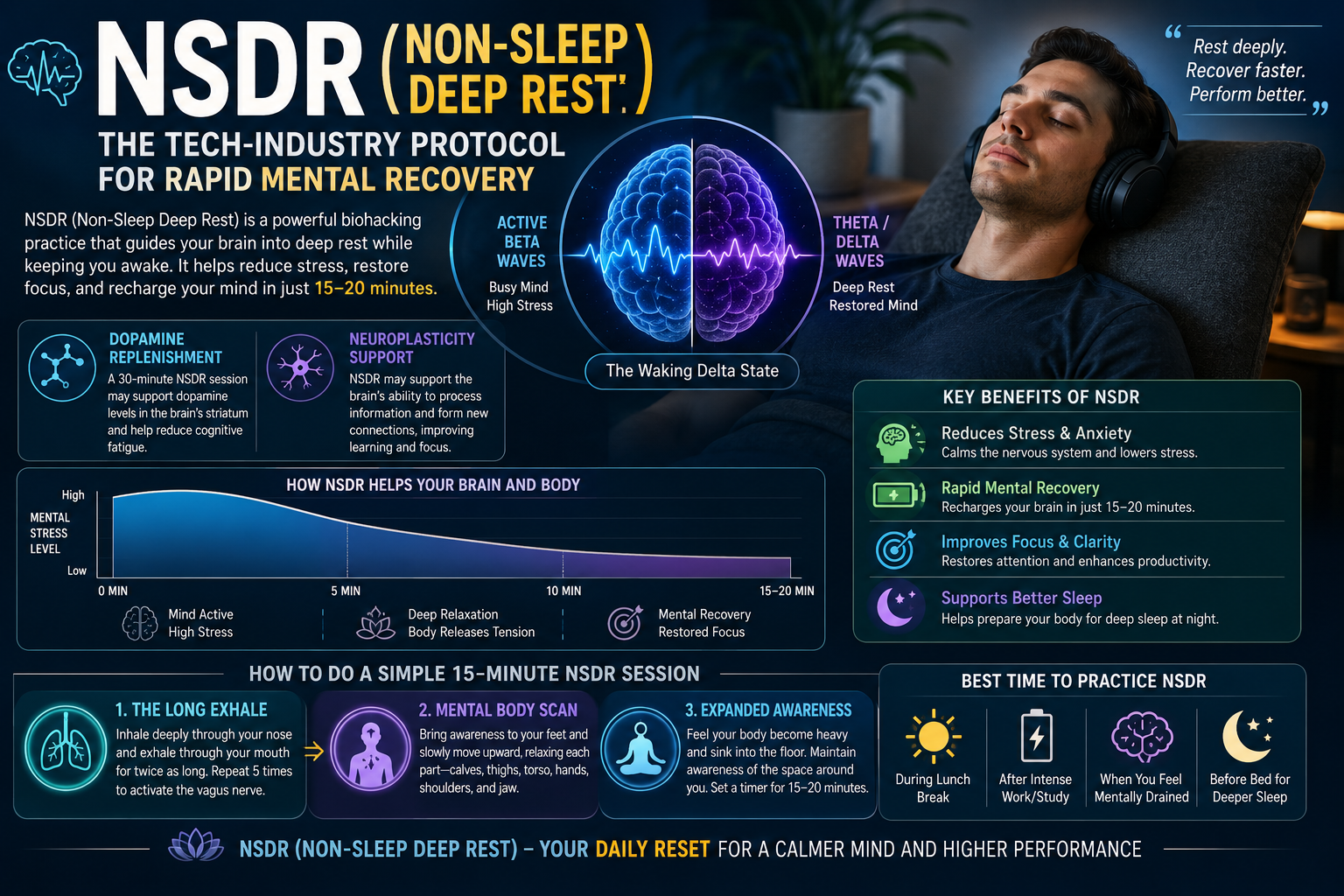
In high-pressure industries where cognitive performance is critical and deadlines are unrelenting, NSDR (Non-Sleep Deep Rest) has emerged as an interesting approach to mental recovery and relaxation. The concept has gained attention in technology and performance-focused communities because it offers a structured way to rest without necessarily falling completely asleep. NSDR (Non-Sleep Deep Rest) generally refers to guided practices designed to promote deep physical relaxation while maintaining some level of awareness.
The practice is associated with techniques such as Yoga Nidra, guided relaxation, focused breathing, body scanning, and certain forms of hypnosis or meditation. Rather than trying to force the brain to become completely inactive, NSDR encourages the body to enter a deeply relaxed state while attention remains gently directed toward breathing, bodily sensations, or a guided voice.
For people dealing with long periods of concentration, demanding work, studying, or mental fatigue, NSDR (Non-Sleep Deep Rest) may provide a practical opportunity to pause and recover during the day. It should not be considered a replacement for adequate nighttime sleep, but it can be used as a complementary relaxation practice.
NSDR (Non-Sleep Deep Rest) and the Science of Deep Relaxation
The human brain constantly changes its activity depending on what we are doing. Focused work, physical activity, relaxation, meditation, and sleep are associated with different patterns of brain activity and physiological arousal.
During demanding cognitive tasks, attention and alertness are actively engaged. After hours of concentrated work, people can experience mental fatigue, reduced attention, irritability, and difficulty maintaining productivity.
NSDR (Non-Sleep Deep Rest) attempts to create a transition away from this highly engaged state.
Through slow breathing, body awareness, and guided attention, NSDR can encourage relaxation of both the mind and body. Instead of continuing to push through mental exhaustion, a person temporarily reduces external stimulation and gives the nervous system an opportunity to settle.
This is one reason NSDR (Non-Sleep Deep Rest) has become popular among people interested in productivity, neuroscience, meditation, and performance recovery.
How NSDR (Non-Sleep Deep Rest) May Affect the Brain
NSDR is sometimes described using the language of brain waves, including theta and delta activity. However, it is important not to assume that every NSDR session produces the same brain state as deep sleep.
Sleep and wakefulness are complex physiological conditions, and guided relaxation is not identical to naturally occurring sleep.
The more useful way to understand NSDR (Non-Sleep Deep Rest) is as a structured relaxation practice that may reduce mental and physical arousal.
When the body becomes still and breathing becomes slower, attention can move away from demanding external tasks. This may make it easier to release muscle tension and reduce the feeling of being mentally overloaded.
The experience can feel similar to being between wakefulness and sleep, especially during longer sessions.
NSDR (Non-Sleep Deep Rest) and Mental Recovery
One of the most interesting potential applications of NSDR (Non-Sleep Deep Rest) is mental recovery.
Imagine spending several hours writing, coding, studying, analyzing financial information, designing projects, or attending meetings. Even if your body has barely moved, your brain may feel exhausted.
Taking a short period of structured rest can provide a psychological break from continuous concentration.
Rather than scrolling through social media or switching from one demanding task to another, NSDR creates a deliberate period in which there is little need to respond to information.
That distinction is important.
Passive digital entertainment can still expose the brain to constant stimulation. NSDR (Non-Sleep Deep Rest) is designed around reducing stimulation instead.
NSDR (Non-Sleep Deep Rest) and Dopamine Research
The original article highlights dopamine replenishment as one possible mechanism behind NSDR and references research reporting substantial changes in dopamine-related activity following a session.
Dopamine is involved in motivation, reward, attention, movement, and several other neurological functions. However, it is important to avoid interpreting dopamine as a simple “energy chemical” that can be instantly refilled through one relaxation session.
The relationship between dopamine and recovery is much more complex.
A more reasonable interpretation is that deep relaxation may support recovery from prolonged cognitive effort and help a person feel mentally refreshed. Research into meditation, relaxation, sleep, and brain function continues to explore how these practices influence neurological processes.
Therefore, NSDR (Non-Sleep Deep Rest) should be viewed as a promising relaxation strategy rather than a guaranteed method for producing a specific percentage increase in dopamine.
NSDR (Non-Sleep Deep Rest) and Neuroplasticity
Neuroplasticity refers to the brain’s ability to change and adapt in response to experience, learning, and environmental demands.
Learning a new skill requires more than simply consuming information. The brain must process, organize, and integrate what has been learned.
Rest plays an important role in this broader process.
This is another reason NSDR (Non-Sleep Deep Rest) is attracting attention among students, researchers, professionals, and people interested in cognitive performance.
A short relaxation session may create a mental break after demanding learning or concentration. Although NSDR should not be presented as a guaranteed neuroplasticity accelerator, incorporating intentional rest into a learning routine can be a useful strategy for managing mental fatigue.
The Powerful Role of Breathing in NSDR (Non-Sleep Deep Rest)
Breathing is one of the simplest components of NSDR (Non-Sleep Deep Rest).
When people are stressed or intensely focused, breathing may become faster or shallower without them consciously noticing. Deliberately slowing the breath can encourage a more relaxed state.
One simple approach is to breathe comfortably through the nose and allow the exhale to be somewhat longer than the inhale.
There is no need to force extremely deep breaths. The objective is comfort and relaxation rather than creating dizziness or discomfort.
As breathing becomes slower and attention moves away from external distractions, the body can begin transitioning toward a calmer state.
NSDR (Non-Sleep Deep Rest) and the Body Scan
The body scan is another important component of NSDR (Non-Sleep Deep Rest).
During a body scan, attention is gradually moved through different areas of the body. You might begin with the feet and then move upward through the legs, hips, abdomen, chest, hands, arms, shoulders, neck, and face.
The goal is not to force every muscle to relax.
Instead, the practice encourages you to notice physical sensations without trying to change them immediately.
Over time, this can make you more aware of where you are holding tension.
For someone who spends hours sitting at a desk, for example, the body scan may reveal tension in the jaw, shoulders, forehead, hands, or lower back.
NSDR (Non-Sleep Deep Rest): A Simple 15-Minute Practice
A short NSDR (Non-Sleep Deep Rest) session does not require expensive equipment.
Find a quiet and comfortable place where you can lie down or sit in a supported position. Reduce unnecessary distractions and allow your eyes to close naturally.
Begin by focusing on your breathing. Take several comfortable breaths and allow the exhale to become slightly longer than the inhale.
Next, bring your attention toward your feet. Notice how they feel against the floor or surface beneath you. Gradually move your awareness upward through your legs, torso, arms, shoulders, neck, and face.
As you move through the body, consciously allow areas of tension to soften.
After the body scan, expand your awareness. Instead of focusing on one particular body part, notice the entire body resting at once.
You do not need to completely stop thinking. If thoughts appear, simply notice them and return your attention to the sensation of resting.
After approximately 10 to 20 minutes, gradually bring your attention back toward your surroundings.
This simple practice can become a practical form of NSDR (Non-Sleep Deep Rest) during a demanding workday.
NSDR (Non-Sleep Deep Rest) Daily Recovery Table
| NSDR Element | Main Purpose | Possible Experience |
|---|---|---|
| Slow breathing | Encourage relaxation | Calmer breathing and reduced tension |
| Body scan | Increase body awareness | Greater awareness of physical tension |
| Reduced stimulation | Create mental separation from work | Less cognitive overload |
| Guided attention | Keep the mind gently focused | Fewer distracting thoughts |
| Stillness | Support physical rest | Sense of heaviness and relaxation |
| Expanded awareness | Encourage deeper relaxation | Calm and spacious mental state |
| Gradual return | Transition back to activity | Refreshed and more focused feeling |
The experience can vary considerably between individuals. Some people may feel deeply relaxed, while others may become sleepy or simply feel calmer.
A Simple NSDR (Non-Sleep Deep Rest) Recovery Graph
The following conceptual graph illustrates how mental stimulation may change during a short NSDR session:
Mental StimulationHigh | ████████████████████ | █████████████████ | █████████████ | █████████ | █████Low | ███ |________________________________ Start 5 min 10 min 15–20 min NSDR Session
This is a conceptual illustration, not a clinical measurement. Individual responses to NSDR (Non-Sleep Deep Rest) can differ depending on stress, fatigue, environment, experience, and the type of guided practice being used.
NSDR (Non-Sleep Deep Rest) for Work and Productivity
Modern work often rewards continuous availability.
Emails arrive throughout the day. Messages appear on multiple platforms. Meetings interrupt focused work, while notifications compete for attention.
This constant switching can create a feeling that you are working all day without actually feeling mentally recovered.
NSDR (Non-Sleep Deep Rest) offers a different approach.
Instead of using every break to consume more information, you can use a portion of your break to reduce information intake completely.
A 15- or 20-minute relaxation session may fit naturally between demanding work blocks.
The purpose is not necessarily to increase productivity immediately. The larger goal is to create a deliberate recovery period that separates one demanding phase of the day from the next.
NSDR (Non-Sleep Deep Rest) for Students and Learning
Students can also potentially benefit from intentional periods of rest.
Studying for several hours without breaks does not guarantee better learning. Attention can decline as mental fatigue increases.
A short period of NSDR (Non-Sleep Deep Rest) can provide a structured interruption between study sessions.
For example, someone could complete a demanding study block, take a short NSDR session, and then return to learning.
The practice should complement adequate nighttime sleep rather than replace it. Sleep remains essential for memory, cognitive function, emotional regulation, and physical recovery.
NSDR (Non-Sleep Deep Rest) vs. Sleep
NSDR and sleep are not the same thing.
Sleep involves complex cycles and physiological processes that cannot simply be reproduced by lying still with your eyes closed.
During sleep, the brain moves through multiple stages, including non-REM and REM sleep. These stages perform important functions that are not fully replicated by relaxation practices.
The role of NSDR (Non-Sleep Deep Rest) is therefore better understood as complementary recovery.
If you are severely sleep deprived, an NSDR session should not be considered a substitute for getting enough actual sleep.
Instead, NSDR can potentially provide an additional relaxation tool during periods when you are awake but mentally exhausted.
NSDR (Non-Sleep Deep Rest) and the Future of Mental Recovery
As workplaces become increasingly dependent on technology and cognitive performance, structured recovery may become more important.
People are spending more time processing information, attending virtual meetings, responding to messages, and switching between digital tasks.
The future of productivity may therefore involve not only improving concentration but also improving recovery.
NSDR (Non-Sleep Deep Rest) fits into this broader trend because it requires relatively little equipment and can be practiced in a short period.
Technology may also make guided NSDR sessions easier to access through meditation platforms, headphones, smart devices, and personalized audio programs.
The key will be using technology to create less stimulation rather than simply adding another digital distraction.
How to Make NSDR (Non-Sleep Deep Rest) Part of Your Routine
The best time to practice NSDR (Non-Sleep Deep Rest) depends on your schedule and personal response.
Some people may prefer a midday session after several hours of concentrated work. Others may find it useful during an afternoon energy dip or after completing a mentally demanding task.
Consistency may be more useful than searching for a perfect time.
Creating a quiet environment can also improve the experience. Put your phone on silent, reduce unnecessary noise, choose a comfortable position, and give yourself permission to temporarily stop solving problems.
The objective is simple: stop demanding constant performance from your brain for a short period.
The Limitations of NSDR (Non-Sleep Deep Rest)
Despite the growing interest in NSDR (Non-Sleep Deep Rest), it should not be presented as a miracle recovery technology.
Research into specific NSDR protocols is still developing, and different practices can produce different experiences.
Some claims about exact changes in neurotransmitters or brain waves may be based on limited research and should not be generalized to every NSDR session.
The most defensible benefit is that structured relaxation can provide a period of reduced stimulation and may help people feel calmer or mentally refreshed.
If someone has persistent exhaustion, severe daytime sleepiness, chronic insomnia, or other concerning symptoms, an NSDR practice should not replace professional evaluation.
NSDR (Non-Sleep Deep Rest): A Powerful Modern Recovery Tool
The growing interest in NSDR (Non-Sleep Deep Rest) reflects a larger change in how people think about productivity.
For years, productivity was often associated with working longer hours and minimizing breaks. Today, there is increasing recognition that attention is not unlimited and that recovery is an important part of sustained performance.
NSDR provides a structured way to step away from continuous stimulation.
Through breathing, body awareness, stillness, and guided attention, the practice encourages the body and mind to move toward a deeply relaxed state.
Its greatest value may not be a dramatic neurological transformation after one session. Instead, its value may come from creating a repeatable recovery habit that helps people manage the mental demands of modern life.
Conclusion: NSDR (Non-Sleep Deep Rest) for Modern Mental Recovery
NSDR (Non-Sleep Deep Rest) has become an increasingly interesting approach to relaxation and mental recovery, particularly among people working in demanding, technology-focused environments.
The practice combines elements of guided relaxation, breathing, body scanning, focused awareness, and stillness to create a period of deep rest without requiring conventional sleep.
It may be useful for people experiencing temporary mental fatigue, especially when they need a structured break from continuous concentration. At the same time, NSDR should complement rather than replace adequate nighttime sleep.
The most powerful idea behind NSDR (Non-Sleep Deep Rest) is simple: recovery does not always have to mean going to sleep. Sometimes the brain and body can benefit from intentionally stepping away from stimulation, relaxing deeply, and allowing attention to reset.
In a world where constant notifications and demanding workloads are becoming normal, creating even a short period of intentional rest could become an important part of a sustainable approach to mental performance and wellbeing.