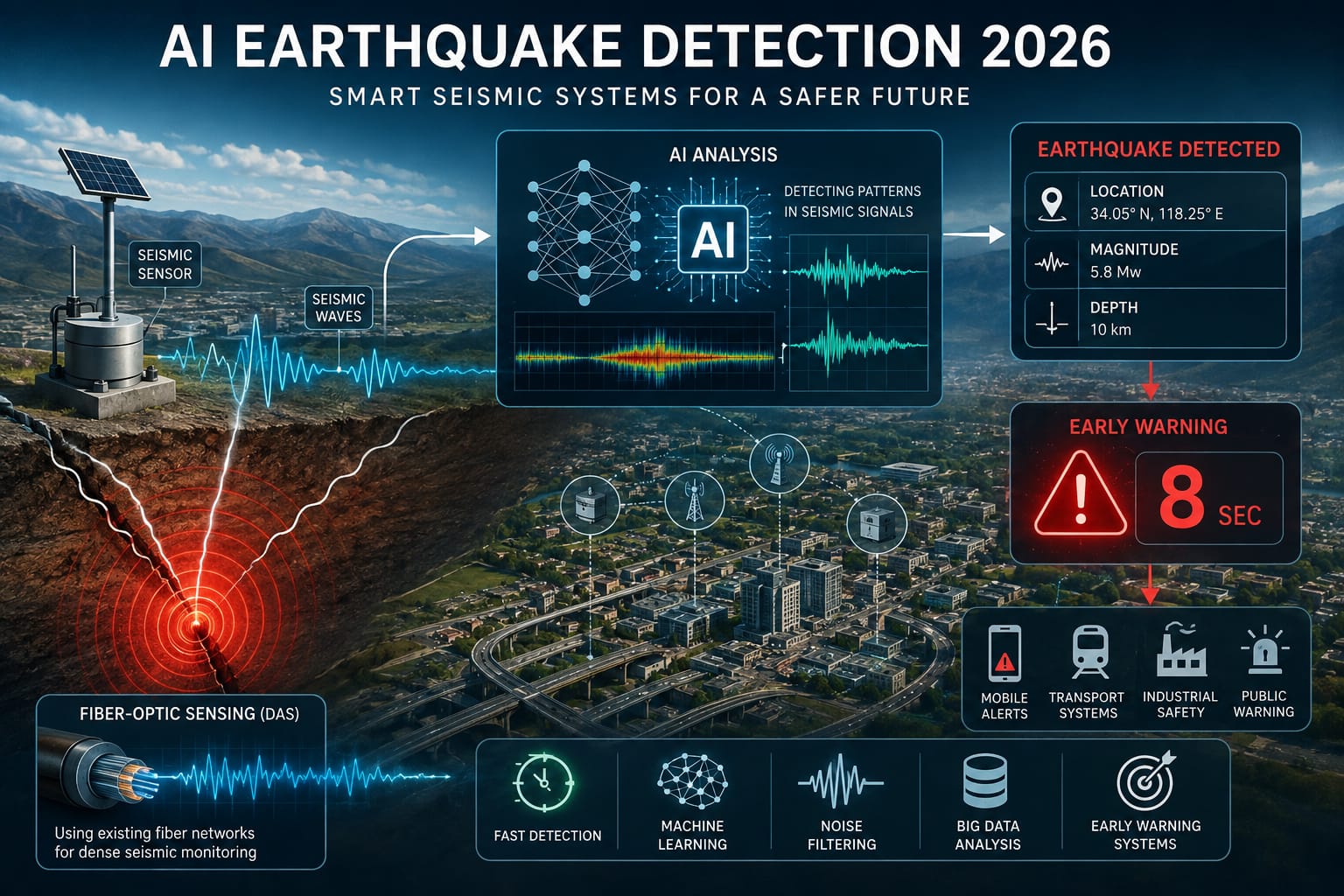
AI Earthquake Detection 2026 is becoming an exciting area of research as artificial intelligence helps scientists analyze seismic signals faster and identify earthquakes in real time. Earthquakes can happen suddenly, leaving communities with very little time to respond. While AI cannot reliably predict exactly when and where an earthquake will happen, it can help detect seismic activity, identify earthquake waves, estimate important earthquake characteristics, and support early-warning systems. Recent research has demonstrated machine-learning methods that can analyze the first few seconds of seismic signals, while newer work is also exploring fiber-optic sensing and generative AI for earthquake-related forecasting.
The goal of AI Earthquake Detection 2026 is therefore not to promise perfect earthquake prediction. Instead, the technology focuses on making detection and warning systems faster, smarter, and more responsive. When every second matters, even a short improvement in detection can provide valuable time for protective actions.
╭────────────────────────────────────────╮
│ AI EARTHQUAKE DETECTION 2026 │
│ TABLE OF CONTENTS │
╰────────────────────────────────────────╯01 → What Is AI Earthquake Detection 2026?
02 → How AI Earthquake Detection 2026 Works
03 → AI Seismic Signal Detection
04 → AI Earthquake Detection 2026 and P-Waves
05 → AI Earthquake Early Warning Systems
06 → AI Earthquake Magnitude Detection
07 → AI Seismic Noise Detection
08 → AI Earthquake Detection 2026 and Fiber-Optic Sensors
09 → Benefits of AI Earthquake Detection 2026
10 → Challenges and Negative Risks of AI Earthquake Detection
11 → Future of AI Earthquake Detection 2026
12 → Final Thoughts╰────────────────────────────────────────╯
What Is AI Earthquake Detection 2026?
AI Earthquake Detection 2026 refers to the use of artificial intelligence and machine learning to analyze seismic data and identify earthquake signals.
Traditional earthquake monitoring relies on seismometers and other sensors that record ground motion. These instruments generate waveforms that contain information about vibrations beneath and around the Earth’s surface.
AI can examine these waveforms and learn to distinguish earthquake signals from background noise. This is useful because seismic monitoring stations continuously record many signals that are not earthquakes.
Machine-learning models can be trained using large collections of seismic recordings. Once trained, they can process new signals and identify patterns associated with earthquakes.
Why AI Earthquake Detection 2026 Is Important
The biggest advantage of AI Earthquake Detection 2026 is speed.
An earthquake early-warning system does not need to predict an earthquake hours before it occurs to be useful. It can detect an earthquake shortly after it begins and send warnings before stronger seismic waves reach more distant locations.
Researchers have demonstrated machine-learning systems capable of working with only a few seconds of seismic information. One published system, for example, used the first three seconds of P-wave recordings from a single station for earthquake detection and source characterization.
How AI Earthquake Detection 2026 Works
The basic process begins with seismic sensors.
Seismometers continuously record ground movement. The data can then be transferred to an AI system, where algorithms analyze the waveform.
A simplified process looks like this:
Ground Motion
↓
Seismic Sensors
↓
Waveform Data
↓
AI Analysis
↓
Earthquake Detection
↓
Magnitude & Location Estimate
↓
Early Warning
AI Earthquake Detection 2026 Sketch
          EARTHQUAKE
               │
               ▼
      ┌─────────────────┐
      │  SEISMIC WAVES  │
      └────────┬────────┘
               │
               ▼
      ┌─────────────────┐
      │ SMART SENSORS   │
      │  & SEISMOMETERS │
      └────────┬────────┘
               │
               ▼
      ┌─────────────────┐
      │   AI ANALYSIS   │
      │ Machine Learning│
      └────────┬────────┘
               │
        ┌──────┴──────┐
        ▼             ▼
 ┌────────────┐ ┌──────────────┐
 │ Magnitude  │ │ Earthquake   │
 │ Detection  │ │ Location     │
 └──────┬─────┘ └──────┬───────┘
        │              │
        └──────┬───────┘
               ▼
      ┌─────────────────┐
      │ EARLY WARNING   │
      └────────┬────────┘
               │
               ▼
           SMART ALERT
Figure: AI Earthquake Detection 2026 uses seismic sensors and artificial intelligence to analyze earthquake signals and support faster early-warning decisions.
AI Earthquake Detection 2026 and Machine Learning
Machine learning is particularly useful because earthquakes can produce complex signals.
Instead of relying entirely on fixed rules, an AI model can learn from many examples of seismic activity.
Some research systems use neural networks, while others use ensemble machine-learning models. A 2026 study reported a machine-learning approach that classified moderate-to-large earthquakes from strain measurements within the first four seconds after P-wave arrival.
This is one reason AI is becoming a powerful tool for modern seismology.
AI Seismic Signal Detection
One of the most important tasks in AI Earthquake Detection 2026 is separating genuine seismic activity from noise.
Seismic sensors do not only record earthquakes. They can also capture traffic, construction, industrial activity, weather-related vibrations, ocean movement, and instrument noise.
This creates a difficult problem.
If an AI system treats every unusual vibration as an earthquake, it could produce false alarms. If it ignores a real earthquake signal, it could miss an important event.
Smart Earthquake Signal Recognition
AI can learn the difference between earthquake waveforms and other signals by studying large datasets.
Deep-learning models can examine waveform characteristics and identify patterns that may correspond to different seismic phases.
Research on neural networks has shown that AI can support real-time earthquake early warning by analyzing seismic waveforms directly.
This is one reason AI is becoming a powerful tool for modern seismology.
AI Earthquake Detection 2026 and P-Waves
P-waves are particularly important for earthquake early warning.
They are among the first seismic waves to arrive after an earthquake begins. More damaging waves may arrive later, depending on the location.
AI can analyze the early P-wave signal and use it to estimate information about the earthquake.
Why P-Wave Detection Matters
Imagine an earthquake occurring far away from a city.
The earthquake begins near the fault. Seismic waves travel outward. A monitoring station detects an early wave and an AI system quickly analyzes the signal.
If the system confirms an earthquake and estimates its characteristics, an alert can potentially be issued before stronger shaking reaches the city.
This does not provide unlimited warning time. The available time depends heavily on distance, network design, signal quality, and the earthquake itself.
AI Earthquake Early Warning Systems
AI Earthquake Detection 2026 can become an important component of earthquake early-warning systems.
Early-warning systems are designed to detect an earthquake after it begins and provide information before strong shaking arrives at a particular location.
This is very different from predicting an earthquake before it starts.
How AI Can Support Early Warning
AI can help with several stages of the process.
It can detect seismic activity, identify P-wave arrivals, estimate magnitude, estimate location, and help determine whether an alert should be issued.
This creates a positive opportunity for faster warning systems, especially when every second can help people perform protective actions.
AI Earthquake Magnitude Detection
Another promising application is rapid magnitude estimation.
The magnitude of an earthquake is important because it helps indicate the potential scale of the event.
AI models can examine early seismic signals and estimate earthquake magnitude before the complete waveform is available.
Faster Magnitude Estimates
Traditional earthquake analysis can improve as more seismic information becomes available.
AI can help make an early estimate and update that estimate as additional data arrives.
This kind of rapid classification could support future warning systems.
AI Seismic Noise Detection
Seismic noise is one of the biggest challenges for earthquake monitoring.
A monitoring station may receive thousands of small signals that have nothing to do with dangerous earthquakes.
AI can help classify these signals.
Positive Impact of AI Noise Filtering
Better noise detection can potentially reduce unnecessary alerts.
AI models can learn patterns from previous seismic records and identify which signals are more likely to represent earthquakes.
The combination of AI and efficient algorithms could be particularly useful for low-cost monitoring stations.
AI Earthquake Detection 2026 and Fiber-Optic Sensors
One of the most interesting developments in AI Earthquake Detection 2026 involves fiber-optic cables.
Distributed Acoustic Sensing, or DAS, can repurpose fiber-optic cables as dense sensing arrays.
Instead of relying only on traditional seismic stations, researchers can use vibrations detected along accessible fiber-optic cables.
Smart Fiber-Optic Earthquake Detection
This approach could potentially provide more detailed spatial coverage in areas where installing many traditional seismic stations is difficult or expensive.
Machine-learning analysis of strain signals has shown potential for distinguishing larger earthquakes from smaller ones within the first seconds of P-wave arrival.
This is a promising development because existing fiber infrastructure could potentially become part of future earthquake monitoring networks.
Benefits of AI Earthquake Detection 2026
The advantages of AI Earthquake Detection 2026 mainly involve speed, automation, data analysis, and improved monitoring.
Faster Earthquake Detection
AI can process seismic waveforms rapidly and identify important patterns shortly after an earthquake begins.
Smarter Early Warnings
Faster detection can provide additional time for warning systems to notify people and automated infrastructure.
Even a few seconds can potentially support actions such as stopping elevators, slowing trains, closing industrial processes, or encouraging people to move into safer positions.
Better Seismic Data Analysis
Modern seismic networks produce enormous amounts of data. AI can analyze these datasets much faster than manual review.
Wider Monitoring Opportunities
Technologies such as distributed acoustic sensing could expand earthquake monitoring using existing fiber-optic infrastructure.
Improved Research
AI can help researchers examine historical earthquake records and discover patterns across large datasets.
This could support better understanding of earthquake behavior and seismic activity.
Challenges and Negative Risks of AI Earthquake Detection
Although AI Earthquake Detection 2026 offers exciting possibilities, it also has important limitations.
AI should not be presented as a magic system that can perfectly predict earthquakes.
False Earthquake Alerts
A major negative risk is a false alarm.
If an AI model mistakes noise for an earthquake, it could create unnecessary warnings.
Too many false alerts could reduce public trust in an early-warning system.
Missed Earthquake Signals
The opposite problem can also occur.
An AI model may fail to recognize an unusual earthquake waveform, especially if the event differs significantly from the data used to train the model.
Limited Earthquake Prediction
Perhaps the most important limitation is that earthquake detection is not the same as earthquake prediction.
AI can detect seismic activity after an earthquake begins, but this does not mean it can reliably tell people exactly when an earthquake will occur in the future.
Reliable earthquake prediction remains a difficult scientific problem.
Data and Regional Differences
An AI model trained in one region may not perform equally well somewhere else.
Different geology, sensor networks, background noise, and earthquake characteristics can affect model performance.
Researchers are therefore working on models designed to generalize across different regions.
Future of AI Earthquake Detection 2026
The future of AI Earthquake Detection 2026 could involve more sensors, faster algorithms, edge computing, fiber-optic networks, and advanced AI models.
AI Earthquake Detection 2026 With Edge Computing
Edge computing allows data to be processed closer to the sensor.
Instead of sending every waveform to a central server, an edge device could analyze seismic information locally and transmit only important results.
This could reduce communication delays and make monitoring systems more efficient.
AI Earthquake Detection 2026 and Generative AI
Generative AI is also beginning to appear in earthquake-related research.
Generative models can potentially help researchers study aftershock patterns and other complex earthquake-related scenarios.
These systems are different from simple earthquake detectors. They attempt to model complex patterns and uncertainty after seismic events.
AI and Tsunami Warning
Earthquakes beneath or near the ocean can generate tsunamis.
AI systems may eventually combine seismic information with ocean measurements, coastal sensors, satellite data, and geological information.
This could support broader disaster-warning systems.
Why AI Earthquake Detection 2026 Could Save Valuable Time
The strongest argument for AI Earthquake Detection 2026 is not that it can stop earthquakes.
It cannot.
Its value comes from helping people understand an earthquake quickly after it begins.
A faster warning can create a short but potentially useful window for protective actions.
For example, automated systems could potentially stop elevators at safe floors, slow transportation systems, pause sensitive industrial equipment, or send alerts to connected devices.
The exact benefits depend on the warning system, infrastructure, distance from the earthquake, and available response time.
AI Earthquake Detection 2026 and the Future of Safer Communities
The long-term goal is to build smarter disaster-response networks.
Future systems could combine seismic sensors, fiber-optic cables, smartphones, GPS measurements, satellite observations, weather information, and AI models.
Instead of relying on one data source, AI could analyze multiple streams simultaneously.
This could create a more complete picture of an earthquake and its possible effects.
The positive vision is a connected warning network that detects seismic activity quickly and distributes useful information before stronger shaking arrives.
However, these systems must remain carefully tested because inaccurate warnings can create serious consequences.
Final Thoughts
AI Earthquake Detection 2026 represents a promising development in the use of artificial intelligence for natural-disaster monitoring.
AI can help detect seismic signals, identify P-waves, estimate earthquake characteristics, filter noise, support early-warning systems, and analyze huge amounts of seismic data.
The technology is not a perfect earthquake prediction tool. False alarms, missed signals, regional differences, data quality, and model reliability remain important challenges.
The most realistic future is therefore not AI replacing seismologists. It is AI working alongside scientists, sensors, emergency systems, and human decision-makers to make earthquake detection faster and more intelligent.
As AI technology continues to improve, AI Earthquake Detection 2026 could become an important part of next-generation early-warning and disaster-response systems, giving communities a better chance to react when dangerous seismic activity begins.