For thousands of years, humans have looked at the night sky with curiosity. People watched the Moon, stars, and planets and wondered what existed beyond Earth. For most of human history, traveling into space was only possible for specially trained astronauts. Ordinary people could only imagine what it would feel like to leave Earth and see the planet from above.
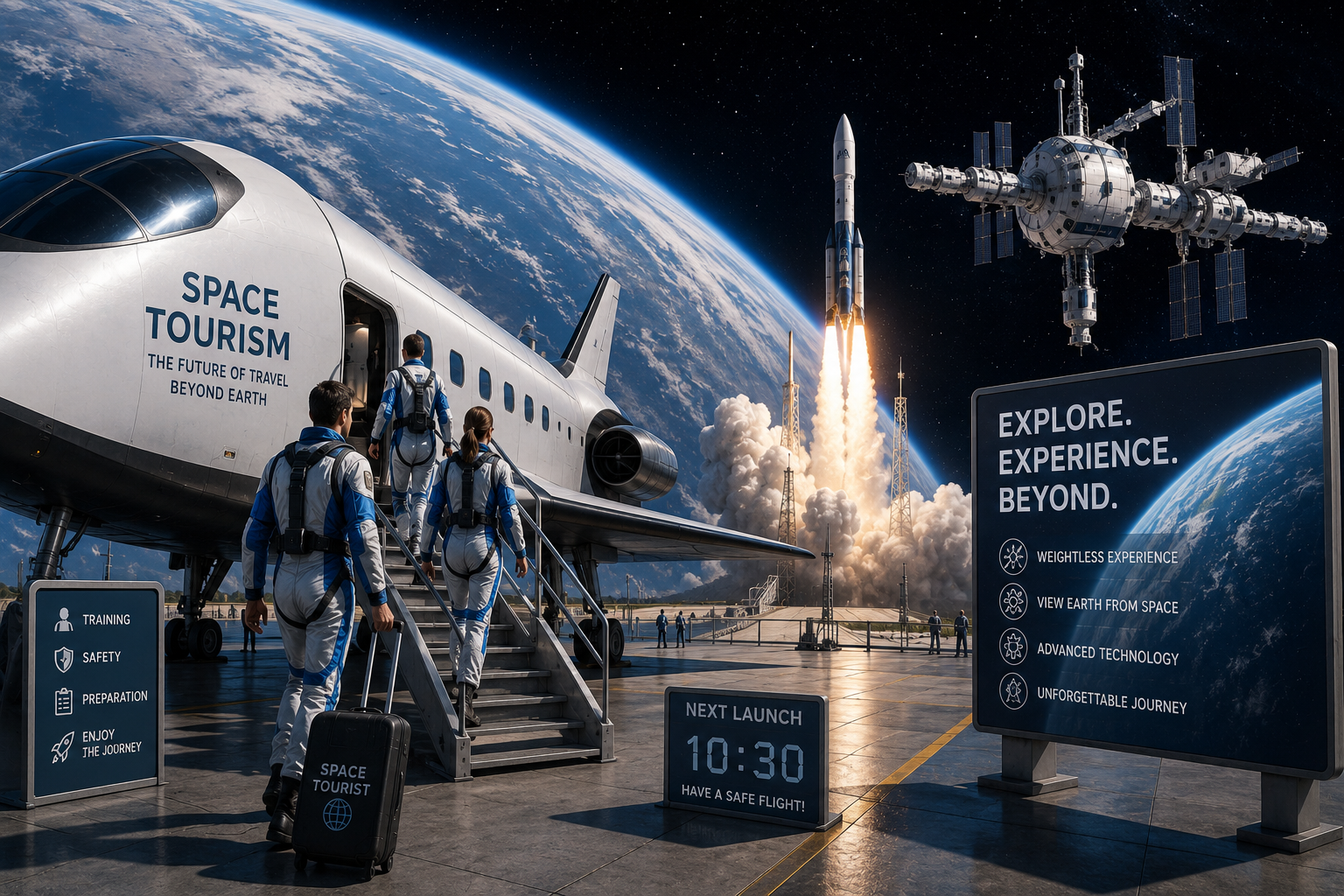
Today, space tourism is slowly becoming a real possibility for people who are not professional astronauts. Private companies are developing spacecraft and technologies designed to carry paying passengers beyond Earth. Although space travel remains extremely expensive and is currently available to only a small number of people, the industry continues to attract worldwide attention.
Space tourism is more than an unusual holiday. It represents a major development in travel, technology, science, and commercial spaceflight. At the same time, it raises important questions about safety, cost, environmental effects, health, and access.
What Is Space Tourism?
Space tourism refers to traveling into space mainly for personal experience, adventure, or entertainment rather than working as a professional astronaut. A space tourist may travel on a commercial spacecraft, experience weightlessness, observe Earth from a high altitude, and see the darkness of space above the atmosphere.
The experience can differ depending on the mission. Some commercial journeys are designed as short suborbital flights, while future commercial space travel could include longer orbital missions. The basic idea is to make space an eventual destination for travelers in the same way that people today travel to different countries and continents.
How Did Space Tourism Begin?
For many decades, space exploration was mainly controlled by national governments and space agencies. Astronauts were carefully selected and trained for scientific, military, and national missions. Private citizens had very few opportunities to participate directly in spaceflight.
The situation gradually changed as private companies became more involved in space technology. Companies began developing rockets, spacecraft, launch systems, and other equipment for commercial purposes. Early privately funded space missions demonstrated that human spaceflight did not necessarily have to remain limited to government programs.
This development created the foundation for the modern space tourism industry, where private individuals can potentially pay for an experience beyond Earth.
Why Do People Want to Travel Into Space?
People are attracted to space tourism for many different reasons. Some want to experience something that very few humans have ever experienced. Others are fascinated by astronomy, science, technology, and the mystery of space.
One of the biggest attractions is the opportunity to see Earth from above. From space, the planet can appear as one connected world rather than a collection of separate countries. For wealthy travelers, spaceflight can also represent a unique form of adventure that cannot be matched by traditional tourism.
For many people, however, the strongest motivation is simple curiosity. The chance to see space with their own eyes has been a dream for generations.
What Does a Space Tourist Experience?
The experience depends on the spacecraft and mission. During a suborbital journey, passengers can travel to the edge of space and experience a short period of weightlessness. They can also observe Earth from a very high altitude and see the dark sky above the atmosphere.
Passengers may experience strong acceleration during launch and other physical sensations as the spacecraft moves through different stages of the journey. An orbital mission would offer a much longer experience, potentially allowing travelers to remain in space for several days.
Unlike traditional tourism, space travel requires passengers to adapt to an environment that is completely different from Earth. Even a short journey can require preparation and training.
Suborbital and Orbital Space Tourism
There are two major forms of space tourism discussed in the development of commercial human spaceflight: suborbital and orbital tourism.
| Type | Main Experience | Duration | Main Challenge |
|---|---|---|---|
| Suborbital tourism | High-altitude flight and short weightlessness | Relatively short | Launch and landing safety |
| Orbital tourism | Extended stay in orbit | Longer missions | Life support, cost, and complex technology |
Suborbital spacecraft travel to the edge of space and return to Earth without completing a full orbit. This makes the journey shorter and comparatively less complex than an orbital mission.
Orbital tourism requires a spacecraft to travel fast enough to remain around Earth. It needs more energy, advanced systems, stronger life-support technology, and detailed mission planning. Future orbital space tourism could include private space stations or specially designed habitats for visitors.
Training for Space Tourists
Space tourists cannot simply arrive at a launch site and immediately board a spacecraft. Some level of preparation is required before a commercial spaceflight.
Training can teach passengers how to respond during launch, weightlessness, and landing. They may also learn basic safety procedures and what to do if an unexpected situation occurs.
Physical preparation is important because spaceflight can place demands on the human body. The amount of training required depends on the mission. A short commercial flight may require less preparation than a longer orbital journey.
The Cost of Space Tourism
One of the biggest challenges facing the space tourism industry is cost. Commercial spaceflight is extremely expensive compared with ordinary travel. Tickets and mission expenses can reach very high amounts, meaning that space travel is currently available mainly to extremely wealthy individuals.
The high cost comes from the complexity of spacecraft and launch systems. Rockets require advanced materials, engineering, fuel systems, testing, trained personnel, and strict safety procedures.
Reusable spacecraft could play an important role in reducing future costs. If companies can safely reuse launch systems and improve their technology, the cost per passenger may gradually decrease. However, affordable space tourism is likely to remain a long-term goal rather than an immediate reality.
Safety Concerns
Safety is one of the most important issues in commercial space travel. Spaceflight is naturally more challenging than most forms of transportation because spacecraft operate in an extreme environment.
A spacecraft must successfully launch, travel through the atmosphere, operate in space, and return safely. Passengers may experience high acceleration, vibration, temperature changes, and other physical conditions.
Because of these risks, companies involved in space tourism need extensive testing and strong safety procedures. As the industry grows, passenger protection will remain one of its most important responsibilities.
Technology Behind Space Tourism
Modern space tourism depends on many advanced technologies. Powerful rocket engines, reusable spacecraft, navigation systems, communication equipment, life-support systems, heat protection, computer-controlled flight systems, lightweight materials, and specialized spacesuits all contribute to successful missions.
Reusable technology is particularly important because it could make repeated launches more practical and potentially reduce costs. The development of commercial spacecraft may also create technological improvements that can benefit other industries.
Benefits of Space Tourism
The benefits of space tourism may extend beyond entertainment. Private companies investing in commercial spacecraft can encourage innovation and create demand for advanced engineering and technology.
The industry can also create employment opportunities for engineers, scientists, technicians, software developers, pilots, and other professionals. As the industry expands, additional businesses may develop around training, insurance, spacecraft manufacturing, communication, and accommodation.
Another potential benefit is increased public interest in science. When people see private citizens traveling into space, younger generations may become more interested in astronomy, physics, engineering, and computer science.
Space Tourism and Scientific Research
Commercial spacecraft could also support scientific research. Future space travel missions may carry experiments or scientific equipment alongside passengers.
Researchers could potentially study how materials, plants, biological systems, and other subjects behave in microgravity. If commercial launches become more frequent, scientists could gain more opportunities to conduct experiments in space.
This creates an interesting connection between tourism and research. A single mission could potentially provide recreational experiences for passengers while also supporting scientific work.
Space Tourism and the Economy
The space tourism industry could become part of a much larger commercial space economy. Growing demand may create opportunities for spacecraft manufacturing, launch services, training centers, insurance providers, communication companies, and future space accommodation.
New businesses could eventually offer specialized travel packages, food services, entertainment, training programs, and orbital accommodation.
If commercial spaceflight becomes more successful, private investment could increase. This could encourage companies to develop new technologies and create additional opportunities throughout the wider space industry.
Environmental Concerns
Although space tourism offers exciting possibilities, it also creates environmental concerns. Rocket launches consume fuel and produce emissions. If the number of launches increases significantly, questions about their effects on the atmosphere and climate could become more important.
The production of spacecraft and launch vehicles also requires significant resources. Future companies may therefore need to focus on efficient fuel systems, reusable spacecraft, cleaner technologies, and responsible launch practices.
The development of space tourism should consider not only what happens beyond Earth but also its effects on the planet.
Space Tourism and Human Health
The human body is designed for life on Earth, so spaceflight can create physical challenges. During longer missions, weightlessness can affect muscles, bones, balance, and other body systems.
Short commercial flights may have different effects from extended stays in orbit. Travelers can also experience motion sickness, stress, and physical discomfort.
As commercial space travel develops, researchers will continue studying how different spaceflight conditions affect passengers. Understanding these effects will be important for making future tourism safer.
Space Hotels and Future Travel
One of the most exciting ideas for the future is the development of space hotels. These facilities could allow travelers to stay in orbit for longer periods rather than returning to Earth after a short flight.
A future space hotel might provide specially designed sleeping areas, large windows for observing Earth, prepared meals, entertainment, and recreational activities. Visitors could potentially combine tourism with educational or scientific experiences.
Building and operating such facilities would be extremely expensive and technically challenging. Nevertheless, the idea demonstrates how the future of space tourism could expand beyond short flights.
Could Space Tourism Become Affordable?
The future cost of space tourism is difficult to predict. If spacecraft become more reusable, reliable, and efficient, the cost per passenger could decrease.
Many technologies become more accessible as production increases and systems improve. Spaceflight, however, involves unique challenges that make it different from ordinary transportation.
For this reason, space travel will probably remain more expensive than traditional tourism for a long time. Affordable space tourism may eventually become possible, but it could take decades of technological and economic development.
Educational Value of Space Tourism
Space tourism can also have educational value. People who experience space may return with a stronger interest in astronomy, science, and technology.
Travelers can share their experiences through schools, interviews, documentaries, and social media. Seeing Earth from space can also encourage people to think about the atmosphere and the importance of protecting the planet.
The industry could inspire students to explore careers in science, technology, engineering, and mathematics. In this way, commercial spaceflight may influence education even for people who never personally travel into space.
Ethical Questions
The growth of space tourism also creates ethical questions. One concern is whether spending enormous amounts of money on recreational space travel is appropriate while many people on Earth face serious economic and social problems.
Another issue is access. If only extremely wealthy individuals can experience space, the benefits of the industry may remain limited to a small group.
Environmental responsibility is another important consideration. These concerns do not necessarily mean that space tourism should stop. Instead, they show why the industry should develop responsibly and consider its wider effects on society and the environment.
The Future of Space Tourism
The future of space tourism remains uncertain, but the possibilities are exciting. More companies may enter the market, spacecraft may become more advanced, and commercial missions could gradually expand from short flights to longer orbital journeys.
In the more distant future, tourists may even be able to travel toward the Moon. Such possibilities will depend on improvements in safety, technology, infrastructure, and cost.
The development of commercial space travel is likely to happen gradually rather than suddenly. Each successful mission can provide information that helps companies improve future spacecraft and passenger experiences.
Space Tourism and Human Exploration
Human beings have always wanted to explore places beyond their immediate surroundings. People crossed oceans, traveled across continents, and eventually developed aircraft that allowed them to travel around the world.
Space tourism represents another stage in this long history of exploration. It could eventually allow people outside traditional astronaut programs to experience the environment beyond Earth.
The idea of leaving the planet may still seem extraordinary, but the development of commercial spaceflight is slowly turning an old dream into a possible travel experience.
Conclusion
Space tourism is one of the most fascinating developments in modern travel and space technology. It is creating a future in which private citizens may experience the environment beyond Earth rather than leaving space exploration entirely to professional astronauts.
The industry is still young and extremely expensive, but it has already attracted significant interest. Advances in reusable spacecraft, engineering, computer systems, and commercial launch technology may help shape the future of space travel.
At the same time, important issues such as safety, cost, environmental impact, health risks, and unequal access must be carefully considered. The future success of the space tourism industry will depend on how responsibly companies, scientists, engineers, and governments approach these challenges.
For now, traveling into space remains a luxury available to very few people. However, the history of human exploration shows that ideas that once seemed impossible can eventually become reality. Space tourism is not simply about visiting somewhere new; it represents humanity’s continuing desire to explore, learn, and experience the world beyond our planet.