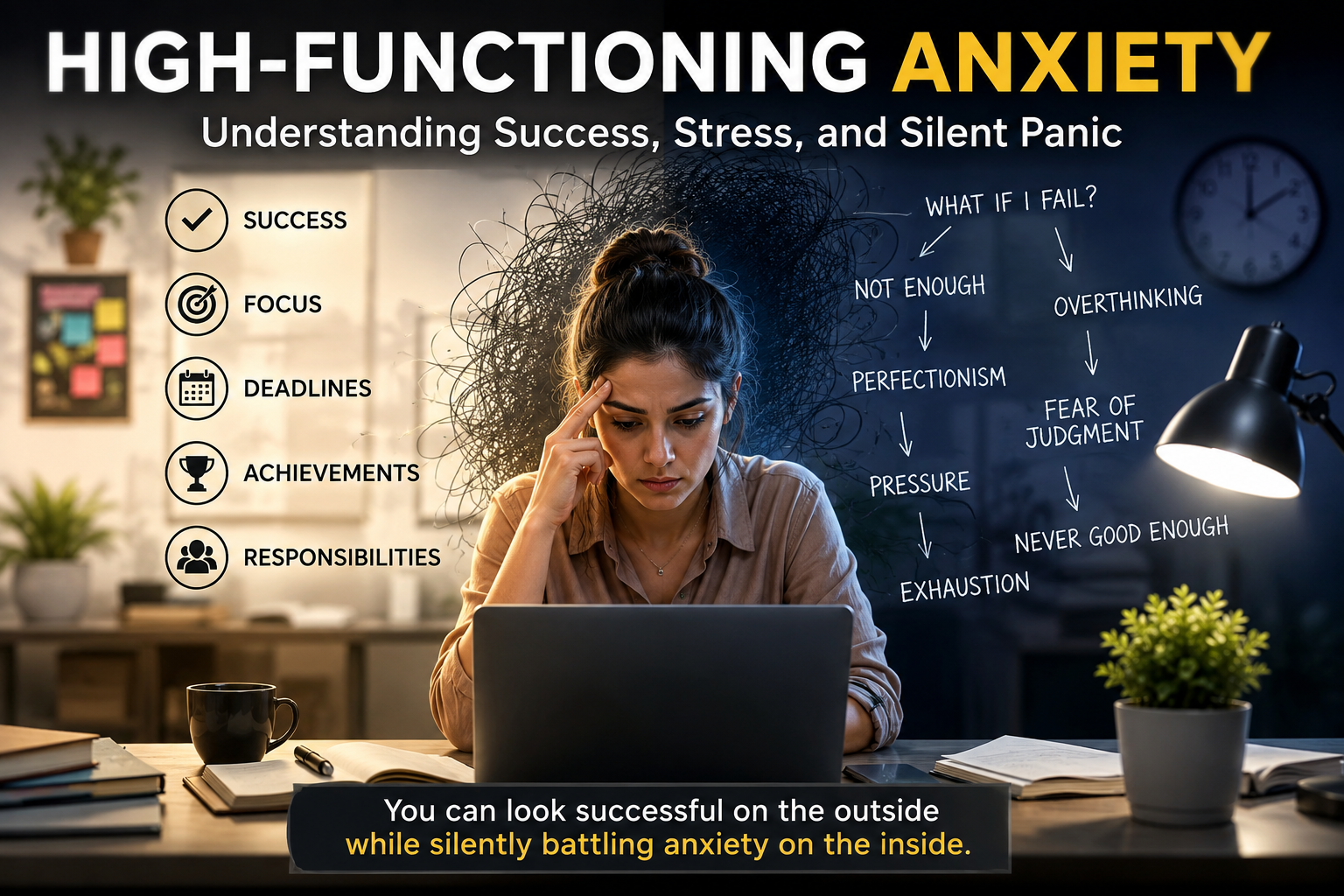
High-Functioning Anxiety is a term often used to describe people who appear successful, organized, productive, and confident while privately experiencing persistent worry, self-doubt, and emotional pressure. From the outside, someone with high-functioning anxiety may seem to have everything under control. They meet deadlines, maintain relationships, complete responsibilities, and continue achieving their goals. However, behind this productive appearance, anxiety may be constantly influencing their thoughts and behavior.
Unlike anxiety that is immediately visible through avoidance or obvious distress, high-functioning anxiety can remain hidden because the person continues performing well. Their productivity may actually become a way of managing fear. They may work harder because they are afraid of failure, prepare excessively because they fear making mistakes, or stay constantly busy because slowing down makes uncomfortable thoughts more noticeable.
What Is High-Functioning Anxiety?
High-Functioning Anxiety is not a formal clinical diagnosis by itself. Instead, the phrase is commonly used to describe people who experience significant anxiety while continuing to function effectively in their daily responsibilities.
A person with high-functioning anxiety may attend work or school, maintain friendships, complete projects, and appear highly responsible. At the same time, their internal experience may include constant overthinking, fear of disappointing others, perfectionism, difficulty relaxing, and an intense need to stay in control.
This contrast between external success and internal distress is what makes high-functioning anxiety particularly difficult to recognize. Someone may receive praise for being dependable while privately feeling exhausted by the pressure required to maintain that image.
High-Functioning Anxiety and the Hidden Cycle of Productivity
One of the defining patterns of high-functioning anxiety is the connection between anxiety and productivity. A person may believe that worrying helps them stay prepared. They may repeatedly check their work, plan every possible outcome, or respond immediately to every message because they are afraid that something will go wrong.
Over time, this behavior can create a cycle. Anxiety creates fear, fear creates increased effort, increased effort produces successful results, and success temporarily reduces anxiety. Because the person experiences a reward from this process, the brain can begin to associate anxiety with achievement.
The problem is that the person may eventually believe that relaxing means becoming careless. They may think that if they stop worrying, their performance will decline. As a result, anxiety becomes more than an emotional experience; it becomes a perceived requirement for success.
Why High-Functioning Anxiety Can Look Like Success
High-functioning anxiety can be difficult to identify because many anxiety-driven behaviors are socially rewarded. Being punctual, organized, ambitious, prepared, and responsible are generally positive qualities.
The difficulty appears when these behaviors are controlled primarily by fear rather than personal choice. Someone may work late not because they genuinely want to but because they are terrified of making a mistake. Another person may repeatedly revise a simple email because they fear being judged.
In these situations, achievement may look healthy from the outside while feeling exhausting on the inside.
Common Signs of High-Functioning Anxiety
The signs of high-functioning anxiety can vary from person to person. Some people experience constant mental planning, while others become highly perfectionistic or excessively concerned about how others perceive them.
A person may find it difficult to stop thinking about unfinished tasks even after completing their responsibilities. They may replay conversations in their mind, worry about future situations, or assume that a small mistake could have serious consequences.
Another common pattern is difficulty saying no. Someone with high-functioning anxiety may accept additional responsibilities because they are afraid of disappointing others. Although they appear helpful and dependable, continually taking on more responsibilities can increase emotional exhaustion.
Physical tension can also accompany persistent anxiety. Stress may contribute to muscle tension, headaches, sleep difficulties, restlessness, or other physical sensations. These symptoms can be especially noticeable when the mind is constantly operating in a state of anticipation.
High-Functioning Anxiety, Perfectionism, and Fear of Failure
Perfectionism and high-functioning anxiety often overlap. A person may believe that mistakes are unacceptable or that their value depends on their performance.
This mindset can create unrealistic standards. A routine task may take significantly longer because the person feels compelled to make every detail perfect. Even after completing something successfully, they may focus on what could have been better rather than recognizing what they accomplished.
Fear of failure can also become fear of judgment. Instead of asking, “What result do I want?” the person may constantly ask, “What will other people think if I get this wrong?”
This shift can make achievement emotionally expensive.
The Difference Between Healthy Motivation and High-Functioning Anxiety
Motivation and anxiety can sometimes produce similar behavior, but the internal experience is different. Healthy motivation generally allows flexibility. A motivated person can work hard while also taking breaks, accepting mistakes, and changing plans when circumstances require it.
With high-functioning anxiety, productivity may feel compulsory. The person may believe that stopping is unsafe, mistakes are unacceptable, or rest must be earned.
| Healthy Motivation | High-Functioning Anxiety |
|---|---|
| Driven by goals and personal values | Often driven by fear |
| Allows rest and recovery | Rest may create guilt |
| Mistakes are viewed as learning opportunities | Mistakes may feel threatening |
| Flexible when plans change | Strong need for control |
| Success can feel satisfying | Success may bring only temporary relief |
| Self-worth is broader than achievement | Self-worth may become tied to performance |
The difference is not simply how productive someone appears. It is the emotional reason behind the productivity and the cost that comes with it.
The Long-Term Effects of High-Functioning Anxiety
Although high-functioning anxiety may help someone remain productive in the short term, relying on constant stress as motivation can become exhausting over time.
One major consequence is difficulty relaxing. A person may finally have free time but feel uncomfortable using it. Instead of enjoying a weekend, they may think about unfinished work or search for another task to complete.
Another consequence is emotional exhaustion. When the mind spends much of the day monitoring potential problems, there may be little mental energy left for creativity, relationships, hobbies, or genuine rest.
Persistent stress can also affect physical well-being. Anxiety can be associated with muscle tension, sleep problems, fatigue, headaches, and other stress-related symptoms. Persistent or concerning physical symptoms should be discussed with an appropriate healthcare professional.
High-Functioning Anxiety and the Inability to Rest
For many people experiencing high-functioning anxiety, rest can feel like a productivity failure. A quiet afternoon may create thoughts such as, “I should be doing something useful.”
This can make relaxation difficult even when the person desperately needs it. The result is a cycle in which the individual remains busy to avoid anxiety, becomes exhausted from constant activity, and then experiences more anxiety because they are exhausted.
Learning that rest is a legitimate part of a healthy life can be an important shift.
High-Functioning Anxiety and the Fear of Imperfection
Perfectionism can make ordinary mistakes feel much more serious than they actually are. A person might spend excessive time checking a document, rewriting a message, or preparing for a conversation because they want to eliminate every possibility of error.
One useful concept is intentional imperfection. This does not mean deliberately producing poor-quality work. Instead, it means gradually learning that not everything needs to be optimized.
For example, someone might send a message after checking it once rather than five times. Another person might leave a small household task unfinished until the next day. These experiences can help challenge the belief that everything must be completed immediately and perfectly.
Understanding the High-Functioning Anxiety Cycle
The following graph illustrates how anxiety can become connected to productivity and temporary relief.
High-Functioning Anxiety Cycle

Fear of Failure       ██████████
Overthinking          █████████
Overworking           █████████
Temporary Success     ████████
Temporary Relief      ██████
New Fear              ██████████
This is a conceptual illustration rather than a clinical measurement. The cycle shows why anxiety-driven productivity can become self-reinforcing. Completing a task may temporarily reduce fear, but the underlying belief that constant pressure is necessary can remain.
How to Manage High-Functioning Anxiety
Managing high-functioning anxiety often begins with recognizing the difference between productive effort and fear-driven behavior. Instead of asking only whether something needs to be done, it can be helpful to ask why it feels impossible to stop.
A person might notice that they are checking an email repeatedly because they want it to be clear or because they are afraid of being judged. Understanding the motivation behind the behavior can create space for healthier choices.
Setting realistic boundaries can also be valuable. This may involve limiting unnecessary checking, creating periods without work-related notifications, or allowing time for activities that have no productivity goal.
Another important step is learning to tolerate uncertainty. Anxiety often seeks complete certainty, but everyday life rarely provides it. Gradually accepting that some outcomes cannot be controlled can reduce the need for constant preparation.
Moving From Fear-Driven Productivity to Purpose-Driven Living
The goal is not to eliminate ambition. People with high-functioning anxiety can remain ambitious, successful, organized, and hardworking while developing a healthier relationship with achievement.
The important shift is moving from “I must succeed so that I am safe or worthy” toward “I choose to work toward this because it matters to me.”
Purpose-driven productivity allows room for mistakes, recovery, relationships, creativity, and rest. It recognizes that personal value is larger than professional performance or academic achievement.
Building a Healthier Relationship With Success
A healthier approach to success involves recognizing accomplishments without using them as the only measure of self-worth. A person can be proud of their work while also accepting that mistakes are normal.
It can also help to create boundaries around perfectionism. Not every task requires maximum effort. Learning to identify what genuinely deserves detailed attention and what can simply be completed can reduce unnecessary pressure.
If anxiety is persistent, overwhelming, interferes with daily life, or causes significant distress, speaking with a qualified mental health professional can provide individualized support. Self-help strategies can be useful, but they are not a substitute for professional care when anxiety becomes difficult to manage.
Final Thoughts on High-Functioning Anxiety
High-Functioning Anxiety can create a complicated relationship between success and fear. A person may look confident and highly productive while privately experiencing overthinking, perfectionism, constant pressure, and difficulty relaxing.
The solution is not necessarily to stop achieving. Instead, it is to understand whether achievement is being powered by personal values or by fear. When productivity no longer depends on constant anxiety, success can become more sustainable and meaningful.
Learning to accept imperfection, tolerate uncertainty, establish boundaries, and make room for genuine rest can gradually change the relationship with anxiety. Most importantly, a person’s worth does not depend on how much they accomplish in a single day.
Success should be something you pursue—not something you need in order to feel safe, valuable, or enough.
High-Functioning Anxiety: Understanding Success, Stress, and Silent Panic
High-Functioning Anxiety is a term often used to describe people who appear successful, organized, productive, and confident while privately experiencing persistent worry, self-doubt, and emotional pressure. From the outside, someone with high-functioning anxiety may seem to have everything under control. They meet deadlines, maintain relationships, complete responsibilities, and continue achieving their goals. However, behind this productive appearance, anxiety may be constantly influencing their thoughts and behavior.
Unlike anxiety that is immediately visible through avoidance or obvious distress, high-functioning anxiety can remain hidden because the person continues performing well. Their productivity may actually become a way of managing fear. They may work harder because they are afraid of failure, prepare excessively because they fear making mistakes, or stay constantly busy because slowing down makes uncomfortable thoughts more noticeable.
What Is High-Functioning Anxiety?
High-Functioning Anxiety is not a formal clinical diagnosis by itself. Instead, the phrase is commonly used to describe people who experience significant anxiety while continuing to function effectively in their daily responsibilities.
A person with high-functioning anxiety may attend work or school, maintain friendships, complete projects, and appear highly responsible. At the same time, their internal experience may include constant overthinking, fear of disappointing others, perfectionism, difficulty relaxing, and an intense need to stay in control.
This contrast between external success and internal distress is what makes high-functioning anxiety particularly difficult to recognize. Someone may receive praise for being dependable while privately feeling exhausted by the pressure required to maintain that image.
High-Functioning Anxiety and the Hidden Cycle of Productivity
One of the defining patterns of high-functioning anxiety is the connection between anxiety and productivity. A person may believe that worrying helps them stay prepared. They may repeatedly check their work, plan every possible outcome, or respond immediately to every message because they are afraid that something will go wrong.
Over time, this behavior can create a cycle. Anxiety creates fear, fear creates increased effort, increased effort produces successful results, and success temporarily reduces anxiety. Because the person experiences a reward from this process, the brain can begin to associate anxiety with achievement.
The problem is that the person may eventually believe that relaxing means becoming careless. They may think that if they stop worrying, their performance will decline. As a result, anxiety becomes more than an emotional experience; it becomes a perceived requirement for success.
Why High-Functioning Anxiety Can Look Like Success
High-functioning anxiety can be difficult to identify because many anxiety-driven behaviors are socially rewarded. Being punctual, organized, ambitious, prepared, and responsible are generally positive qualities.
The difficulty appears when these behaviors are controlled primarily by fear rather than personal choice. Someone may work late not because they genuinely want to but because they are terrified of making a mistake. Another person may repeatedly revise a simple email because they fear being judged.
In these situations, achievement may look healthy from the outside while feeling exhausting on the inside.
Common Signs of High-Functioning Anxiety
The signs of high-functioning anxiety can vary from person to person. Some people experience constant mental planning, while others become highly perfectionistic or excessively concerned about how others perceive them.
A person may find it difficult to stop thinking about unfinished tasks even after completing their responsibilities. They may replay conversations in their mind, worry about future situations, or assume that a small mistake could have serious consequences.
Another common pattern is difficulty saying no. Someone with high-functioning anxiety may accept additional responsibilities because they are afraid of disappointing others. Although they appear helpful and dependable, continually taking on more responsibilities can increase emotional exhaustion.
Physical tension can also accompany persistent anxiety. Stress may contribute to muscle tension, headaches, sleep difficulties, restlessness, or other physical sensations. These symptoms can be especially noticeable when the mind is constantly operating in a state of anticipation.
High-Functioning Anxiety, Perfectionism, and Fear of Failure
Perfectionism and high-functioning anxiety often overlap. A person may believe that mistakes are unacceptable or that their value depends on their performance.
This mindset can create unrealistic standards. A routine task may take significantly longer because the person feels compelled to make every detail perfect. Even after completing something successfully, they may focus on what could have been better rather than recognizing what they accomplished.
Fear of failure can also become fear of judgment. Instead of asking, “What result do I want?” the person may constantly ask, “What will other people think if I get this wrong?”
This shift can make achievement emotionally expensive.
The Difference Between Healthy Motivation and High-Functioning Anxiety
Motivation and anxiety can sometimes produce similar behavior, but the internal experience is different. Healthy motivation generally allows flexibility. A motivated person can work hard while also taking breaks, accepting mistakes, and changing plans when circumstances require it.
With high-functioning anxiety, productivity may feel compulsory. The person may believe that stopping is unsafe, mistakes are unacceptable, or rest must be earned.
| Healthy Motivation | High-Functioning Anxiety |
|---|---|
| Driven by goals and personal values | Often driven by fear |
| Allows rest and recovery | Rest may create guilt |
| Mistakes are viewed as learning opportunities | Mistakes may feel threatening |
| Flexible when plans change | Strong need for control |
| Success can feel satisfying | Success may bring only temporary relief |
| Self-worth is broader than achievement | Self-worth may become tied to performance |
The difference is not simply how productive someone appears. It is the emotional reason behind the productivity and the cost that comes with it.
The Long-Term Effects of High-Functioning Anxiety
Although high-functioning anxiety may help someone remain productive in the short term, relying on constant stress as motivation can become exhausting over time.
One major consequence is difficulty relaxing. A person may finally have free time but feel uncomfortable using it. Instead of enjoying a weekend, they may think about unfinished work or search for another task to complete.
Another consequence is emotional exhaustion. When the mind spends much of the day monitoring potential problems, there may be little mental energy left for creativity, relationships, hobbies, or genuine rest.
Persistent stress can also affect physical well-being. Anxiety can be associated with muscle tension, sleep problems, fatigue, headaches, and other stress-related symptoms. Persistent or concerning physical symptoms should be discussed with an appropriate healthcare professional.
High-Functioning Anxiety and the Inability to Rest
For many people experiencing high-functioning anxiety, rest can feel like a productivity failure. A quiet afternoon may create thoughts such as, “I should be doing something useful.”
This can make relaxation difficult even when the person desperately needs it. The result is a cycle in which the individual remains busy to avoid anxiety, becomes exhausted from constant activity, and then experiences more anxiety because they are exhausted.
Learning that rest is a legitimate part of a healthy life can be an important shift.
High-Functioning Anxiety and the Fear of Imperfection
Perfectionism can make ordinary mistakes feel much more serious than they actually are. A person might spend excessive time checking a document, rewriting a message, or preparing for a conversation because they want to eliminate every possibility of error.
One useful concept is intentional imperfection. This does not mean deliberately producing poor-quality work. Instead, it means gradually learning that not everything needs to be optimized.
For example, someone might send a message after checking it once rather than five times. Another person might leave a small household task unfinished until the next day. These experiences can help challenge the belief that everything must be completed immediately and perfectly.
Understanding the High-Functioning Anxiety Cycle
The following graph illustrates how anxiety can become connected to productivity and temporary relief.
High-Functioning Anxiety Cycle

Fear of Failure       ██████████
Overthinking          █████████
Overworking           █████████
Temporary Success     ████████
Temporary Relief      ██████
New Fear              ██████████
This is a conceptual illustration rather than a clinical measurement. The cycle shows why anxiety-driven productivity can become self-reinforcing. Completing a task may temporarily reduce fear, but the underlying belief that constant pressure is necessary can remain.
How to Manage High-Functioning Anxiety
Managing high-functioning anxiety often begins with recognizing the difference between productive effort and fear-driven behavior. Instead of asking only whether something needs to be done, it can be helpful to ask why it feels impossible to stop.
A person might notice that they are checking an email repeatedly because they want it to be clear or because they are afraid of being judged. Understanding the motivation behind the behavior can create space for healthier choices.
Setting realistic boundaries can also be valuable. This may involve limiting unnecessary checking, creating periods without work-related notifications, or allowing time for activities that have no productivity goal.
Another important step is learning to tolerate uncertainty. Anxiety often seeks complete certainty, but everyday life rarely provides it. Gradually accepting that some outcomes cannot be controlled can reduce the need for constant preparation.
Moving From Fear-Driven Productivity to Purpose-Driven Living
The goal is not to eliminate ambition. People with high-functioning anxiety can remain ambitious, successful, organized, and hardworking while developing a healthier relationship with achievement.
The important shift is moving from “I must succeed so that I am safe or worthy” toward “I choose to work toward this because it matters to me.”
Purpose-driven productivity allows room for mistakes, recovery, relationships, creativity, and rest. It recognizes that personal value is larger than professional performance or academic achievement.
Building a Healthier Relationship With Success
A healthier approach to success involves recognizing accomplishments without using them as the only measure of self-worth. A person can be proud of their work while also accepting that mistakes are normal.
It can also help to create boundaries around perfectionism. Not every task requires maximum effort. Learning to identify what genuinely deserves detailed attention and what can simply be completed can reduce unnecessary pressure.
If anxiety is persistent, overwhelming, interferes with daily life, or causes significant distress, speaking with a qualified mental health professional can provide individualized support. Self-help strategies can be useful, but they are not a substitute for professional care when anxiety becomes difficult to manage.
Final Thoughts on High-Functioning Anxiety
High-Functioning Anxiety can create a complicated relationship between success and fear. A person may look confident and highly productive while privately experiencing overthinking, perfectionism, constant pressure, and difficulty relaxing.
The solution is not necessarily to stop achieving. Instead, it is to understand whether achievement is being powered by personal values or by fear. When productivity no longer depends on constant anxiety, success can become more sustainable and meaningful.
Learning to accept imperfection, tolerate uncertainty, establish boundaries, and make room for genuine rest can gradually change the relationship with anxiety. Most importantly, a person’s worth does not depend on how much they accomplish in a single day.
Success should be something you pursue—not something you need in order to feel safe, valuable, or enough.