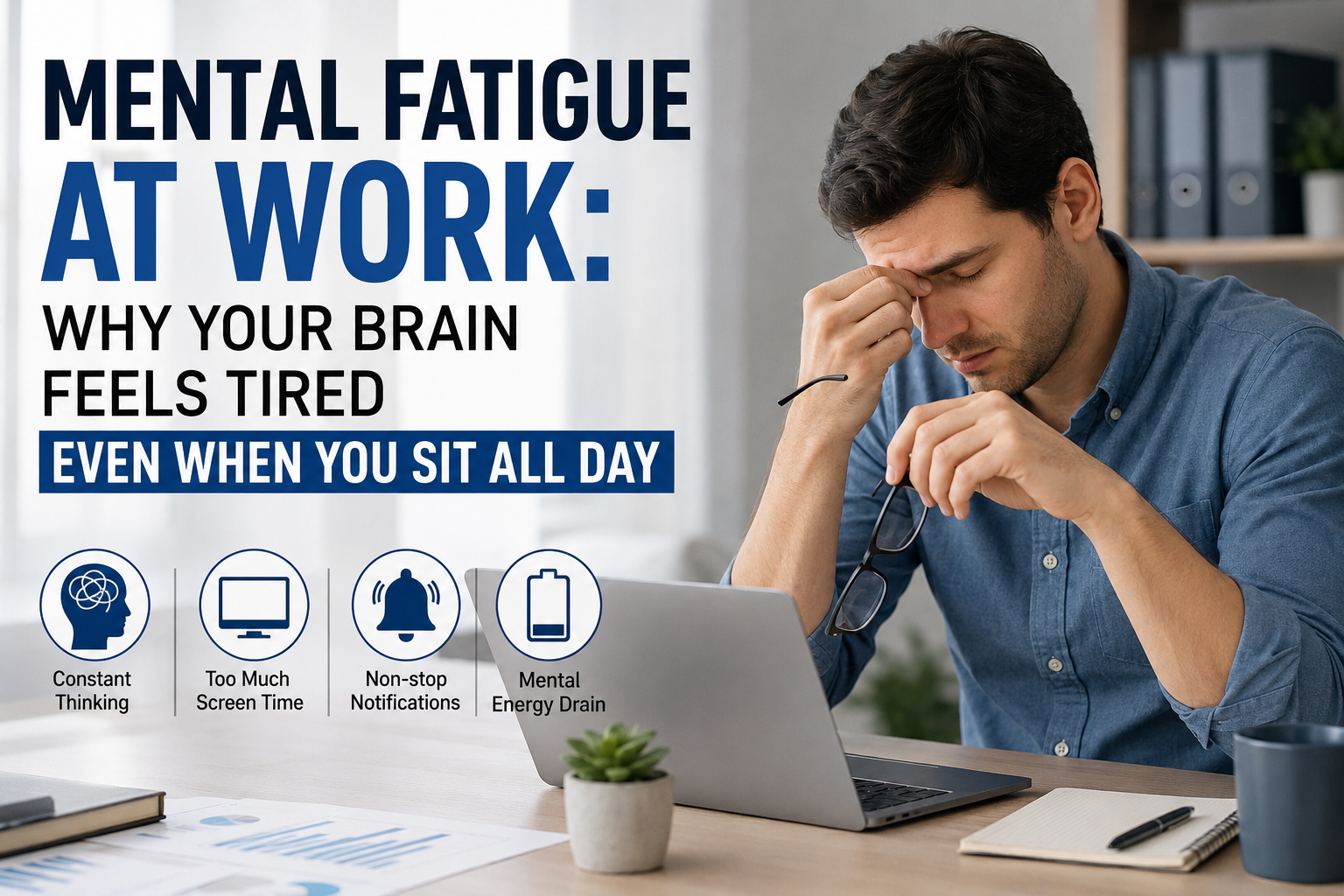
Mental Fatigue at Work can make you feel completely exhausted even when your job involves very little physical activity. Sitting at a desk, attending meetings, answering emails, checking notifications, and working on a computer may not seem physically demanding, but your brain can still be working continuously. By the afternoon, concentration may become harder, simple decisions may take longer, and familiar tasks can suddenly feel more difficult.
What Is Mental Fatigue at Work?
Mental Fatigue at Work happens when prolonged concentration and continuous information processing make it harder to maintain attention and mental energy. Modern office work often requires employees to move quickly between different tasks without receiving enough time to mentally recover.
You might finish a video meeting, respond to an email, switch to a spreadsheet, answer a message, solve a problem, and then return to an unfinished project. Each activity requires attention, and constantly switching between them can make the workday mentally exhausting.
Mental fatigue does not always feel like ordinary sleepiness. It may appear as reduced concentration, slower thinking, forgetfulness, irritability, or a growing desire to avoid complicated tasks.
Why Mental Fatigue at Work Happens at a Desk
The brain remains active even when the body is sitting still. Reading, writing, calculating, planning, problem-solving, making decisions, and communicating with colleagues all require mental effort.
This creates an interesting contrast between physical inactivity and mental activity. You may spend eight hours in the same chair but still finish the day feeling mentally drained.
The important difference is that physical tiredness and Mental Fatigue at Work are not exactly the same experience. Your body may not feel exhausted from physical movement, but your attention and mental energy may have been used continuously throughout the day.
Mental Work Still Requires Energy
Office work involves many small decisions. You may decide which email deserves attention first, which task should be completed next, how to respond to a difficult customer, or which deadline should receive priority.
Each decision may seem small on its own. However, making decisions repeatedly throughout the day can increase your overall mental workload.
This is one reason Mental Fatigue at Work can become more noticeable later in the day. After hours of concentration and decision-making, another complicated choice may feel much harder than it would have in the morning.
Screen Time and Mental Fatigue at Work
Long periods in front of screens can contribute to feelings of mental overload. A typical computer-based workday may involve reading documents, watching presentations, switching between applications, checking notifications, and responding to digital communication.
The issue is not simply the presence of screens. Continuous digital engagement can keep your attention active for long periods without a genuine mental pause.
When your eyes and attention constantly move between emails, websites, messages, and work applications, it can become harder to experience a clear break from information.
Why Notifications Increase Mental Fatigue at Work
Notifications can create repeated interruptions during the workday. An email arrives, a message appears, or a calendar reminder suddenly demands attention.
Even when you do not immediately respond, your brain may still wonder what the notification is about. That small interruption can pull your attention away from the task you were completing.
Reducing unnecessary notifications during focused work can therefore help create a calmer environment and may reduce one source of Mental Fatigue at Work.
Mental Fatigue at Work and the Afternoon Slump
Many people notice that their concentration feels stronger in the morning and weaker later in the day. The afternoon slump can have several possible causes, including sleep quality, stress, workload, food intake, natural alertness patterns, and accumulated mental fatigue.
After several hours of demanding work, you may find yourself rereading the same paragraph, making simple mistakes, checking information repeatedly, or staring at a task without knowing where to begin.
These experiences can be signs that your attention needs a short period of recovery.
How Micro-Breaks Can Reduce Mental Fatigue at Work
One practical way to manage Mental Fatigue at Work is to introduce short micro-breaks throughout the day.
A micro-break is simply a brief pause from a demanding activity. You might stand up, look away from the screen, stretch, walk for a short time, or take a few slow breaths.
Research on workplace micro-breaks suggests that short breaks may reduce fatigue and increase feelings of vigor, although their effects on actual work performance can vary. A micro-break should therefore not be considered a guaranteed productivity solution. Its main purpose is to provide an opportunity for recovery between periods of concentration.
The One-Minute Mental Reset
A one-minute reset can be extremely simple. After completing a demanding task, look away from your screen, relax your shoulders, stand up, and take several comfortable breaths.
You do not need special equipment or a complicated routine. The goal is simply to create a small mental boundary between one task and the next.
For someone experiencing Mental Fatigue at Work, these short pauses can make the working day feel less like one continuous period of concentration.
Movement Breaks and Mental Fatigue at Work
Sitting in the same position for several hours can make the workday feel repetitive. While your body remains relatively still, your brain may continue processing information constantly.
A short movement break can change this pattern. Standing up, walking to get water, gently stretching, or moving around the room can provide a natural transition between tasks.
The goal is not to replace regular exercise. Instead, movement breaks can introduce small periods of physical activity into an otherwise sedentary working routine.
The 20-20-20 Rule for Screen Fatigue
People who spend most of their working day on computers may also benefit from regular visual breaks. The commonly recommended 20-20-20 approach involves looking at something around 20 feet away for approximately 20 seconds after about 20 minutes of close-up screen work.
The idea is to give your eyes a temporary change from continuous close-up focusing. Instead of staring at a document or spreadsheet, you can look through a window or focus on a distant object.
This simple habit can also create a brief psychological break from the information displayed on your screen.
Mental Fatigue at Work and Decision Overload
Decision overload is another important part of Mental Fatigue at Work. Modern workplaces require people to make countless small choices throughout the day.
You may decide which task to prioritize, how to write an email, whether a problem requires immediate attention, which meeting deserves your time, and how to respond to unexpected changes.
The challenge is not necessarily the difficulty of each decision. It is the continuous mental activity required to make one decision after another.
When Simple Decisions Become Difficult
One noticeable sign of Mental Fatigue at Work is when simple decisions suddenly feel unnecessarily complicated.
You might spend several minutes deciding which small task to start first, repeatedly change your priorities, or avoid making a decision altogether.
Sometimes the decision itself is not difficult. Your brain may simply be tired from everything that happened before it.
Taking a short pause can provide enough separation to reconsider what actually needs your attention.
How the Workplace Can Cause Mental Fatigue at Work
Mental Fatigue at Work is not always an individual problem. The working environment can contribute significantly to mental exhaustion.
Constant meetings, unrealistic deadlines, excessive notifications, unclear responsibilities, noisy surroundings, and insufficient recovery time can all make concentration more difficult.
If an employee is dealing with an excessive workload every day, simply recommending more breaks may not solve the underlying problem. A healthier approach combines individual recovery habits with reasonable workloads and supportive workplace practices.
Mental Energy During a Typical Workday
The following graph is an illustrative model rather than a clinical measurement. It shows how perceived mental energy may gradually decline during prolonged work and how short recovery periods may create opportunities for temporary recovery.
Mental Energy

100% |████████████████████
 90% |██████████████████
 80% |████████████████
 70% |██████████████
 60% |████████████
 50% |██████████
 40% |████████

      Morning     Midday     Afternoon

Continuous Work   ↘ Gradual Fatigue
Short Recovery    ↗ Temporary Reset
Energy levels can vary significantly between individuals depending on sleep, workload, stress, work environment, and personal routines.
How to Reduce Mental Fatigue at Work
Reducing Mental Fatigue at Work does not necessarily require completely changing your professional routine. Start by noticing when your concentration normally begins to decline.
If continuous screen use makes you feel overloaded, introduce short visual breaks. If sitting for long periods makes you uncomfortable, add brief movement. If meetings leave you mentally drained, create a quiet transition before starting another demanding task.
If notifications constantly interrupt your attention, consider silencing unnecessary alerts during focused work.
These small adjustments can help create a more sustainable rhythm between concentration and recovery.
Creating a Brain-Friendly Workday
A brain-friendly workday does not mean avoiding challenging tasks. Instead, it means balancing periods of focused effort with opportunities to recover.
Focused work can be followed by a short pause. Long screen sessions can include visual breaks. Meetings can be separated by brief transitions, while highly demanding tasks can sometimes be balanced with less demanding activities.
The goal is not to eliminate mental effort. It is to make that effort more sustainable.
When Mental Fatigue at Work Becomes a Bigger Problem
Occasional mental tiredness after a demanding day is normal. However, persistent exhaustion should not automatically be blamed on ordinary desk work.
If you constantly feel drained, struggle to concentrate, experience significant sleep difficulties, or feel unable to recover between workdays, it may be worth looking more closely at workload, stress, sleep, and overall wellbeing.
Micro-breaks may support recovery, but they cannot solve chronic overwork. Sometimes the better solution is reducing unnecessary workload, improving working conditions, getting adequate rest, or seeking appropriate professional support.
Final Thoughts on Mental Fatigue at Work
Mental Fatigue at Work explains why someone can feel exhausted after spending an entire day sitting at a desk. Physical inactivity does not mean mental inactivity. Emails, meetings, decisions, deadlines, notifications, and continuous concentration can place significant demands on attention.
Short micro-breaks, movement, visual breaks, and quiet moments can create useful opportunities for recovery. The goal is not simply to work less or take breaks for the sake of productivity. It is to create a healthier rhythm between focused work and recovery.
Your body may be sitting still, but your brain has been working all day.