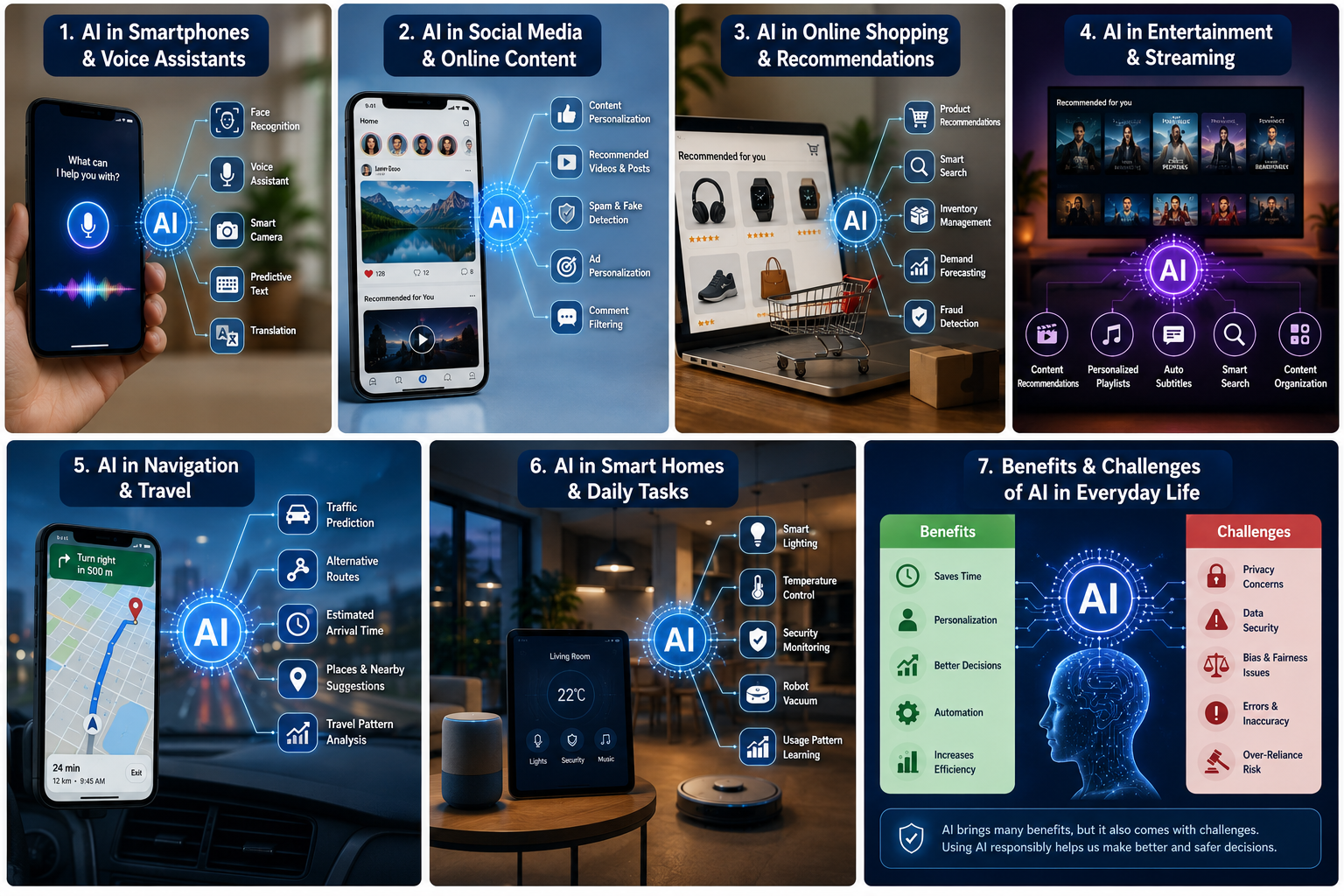
AI in Everyday Life is already much more common than many people realize. From unlocking a smartphone with your face to receiving personalized recommendations on social media, shopping platforms, streaming services, and navigation apps, artificial intelligence quietly works behind the scenes. You may not always notice it, but AI helps make many ordinary activities faster, easier, and more personalized.
You do not need to be a technology expert to use AI. In many cases, you are already using it when you send a voice command, search for a product, check a map, watch a recommended video, or control a smart device.
✦ Table of Contents ✦
┌────────────────────────────────────────────┐
│ 01 — What Is AI in Everyday Life? │
│ 02 — AI in Smartphones & Voice Assistants│
│ 03 — AI in Social Media & Online Content│
│ 04 — AI in Online Shopping & Recommendations │
│ 05 — AI in Entertainment & Streaming │
│ 06 — AI in Navigation & Travel │
│ 07 — AI in Smart Homes & Daily Tasks │
│ 08 — Benefits & Challenges of AI │
│ 09 — AI in Everyday Life: Quick Comparison │
│ 10 — Frequently Asked Questions │
│ 11 — Conclusion │
└────────────────────────────────────────────┘
1. What Is AI in Everyday Life?
Artificial intelligence refers to computer systems that can analyze information, recognize patterns, understand language, make predictions, and perform tasks that normally require some level of human intelligence.
AI in everyday life means these capabilities are built into ordinary products and services that people use regularly. Because many AI systems operate quietly in the background, people often use them without realizing it.
2. AI in Smartphones and Voice Assistants
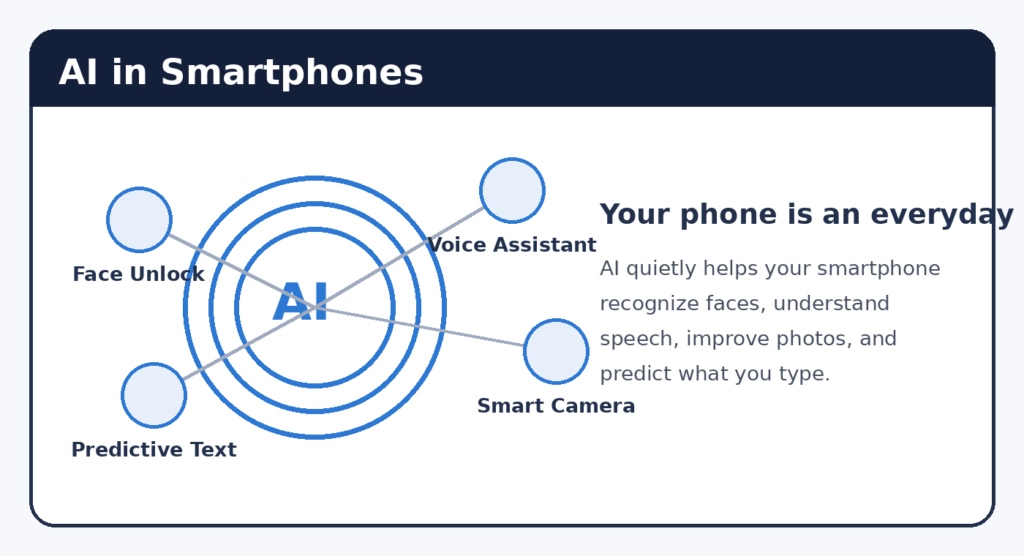
Smartphones are one of the clearest examples of AI in everyday life. Modern phones can use AI for facial recognition, speech recognition, camera enhancement, predictive text, translation, photo organization, and other intelligent features.
When your phone recognizes your face or understands a spoken request, AI-powered software processes patterns and converts them into useful actions. Camera apps can also recognize scenes, faces, and lighting conditions to improve photographs automatically.
3. AI in Social Media and Online Content
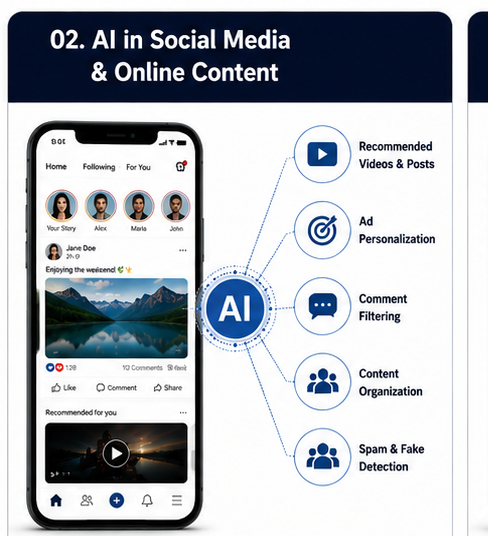
Social media platforms are another major example of AI in everyday life. Recommendation systems can analyze signals such as viewing behavior, likes, searches, shares, and comments to predict which posts or videos may interest you.
This is why two people can open the same social media platform and see completely different content. AI can also help platforms identify spam, suspicious activity, and certain types of harmful content.
4. AI in Online Shopping and Recommendations
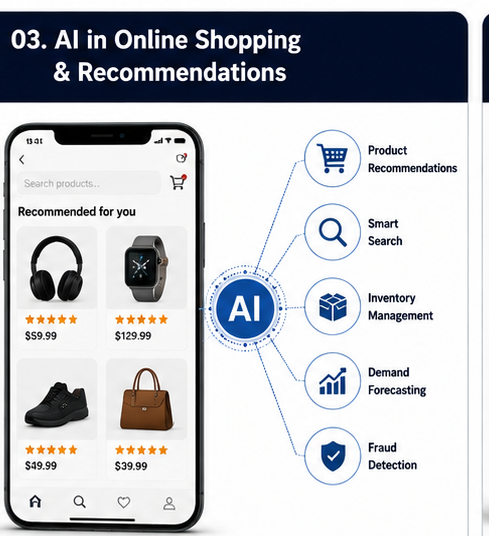
Online shopping is another place where AI in everyday life is easy to notice.
Have you ever seen “Recommended for you” or “You may also like” while shopping online? AI can be working behind those recommendations.
AI systems can analyze searches, browsing behavior, previous purchases, and product interactions to recommend items that may be relevant to a customer.
Businesses can also use AI for inventory management, demand forecasting, customer service, search optimization, and fraud detection.
5. AI in Entertainment and Streaming
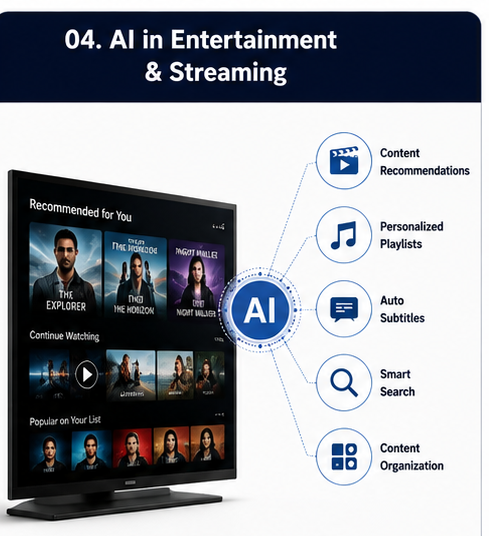
Entertainment is another area where AI in everyday life has become almost invisible.
Streaming services can use AI and machine learning to recommend movies, television shows, songs, podcasts, and videos based on patterns in your previous activity.
If you regularly watch a particular type of content, recommendation systems may identify that pattern and show you similar options.
AI can also support personalized playlists, subtitles, content organization, search, and other features that make entertainment platforms easier to use.
6. AI in Navigation and Travel
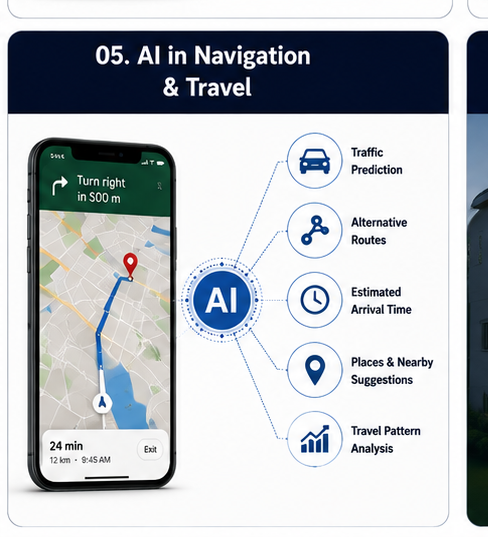
Navigation apps are another excellent example of AI in everyday life.
When you use a map application to find the fastest route, the system can process information about roads, traffic conditions, distances, travel times, and alternative routes.
AI Helps Predict Traffic
If traffic becomes heavier on a particular road, a navigation system can suggest an alternative route. AI-powered systems can also help estimate arrival times and identify patterns in transportation data.
Whether you are going to work, visiting a new location, or taking a long trip, AI can turn complicated transportation information into a simple recommendation.
7. AI in Smart Homes and Daily Tasks
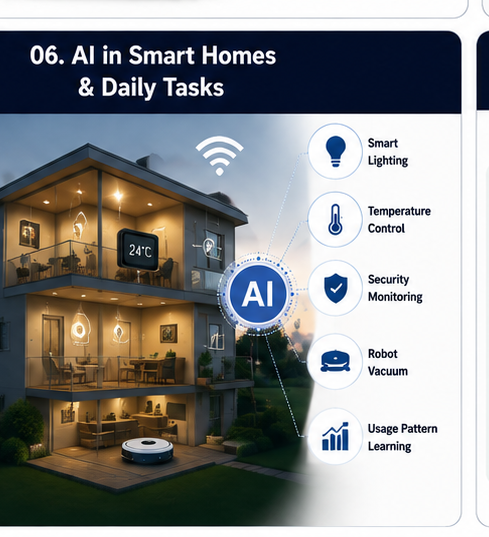
AI is increasingly becoming part of modern homes.
Smart speakers, connected lights, thermostats, security systems, and robot vacuum cleaners can use AI to automate routine activities.
Some smart devices can learn patterns of use and adjust settings accordingly. Robot vacuum cleaners can also use sensors and intelligent navigation to understand their surroundings and plan cleaning routes.
The result is a home environment that can become more convenient without requiring constant manual control.
8. Benefits and Challenges of AI in Everyday Life
The growing use of AI in everyday life brings several useful benefits.
AI can save time by automating repetitive tasks, personalize digital experiences, improve navigation, organize information, and make many services easier to use.
For businesses, AI can help improve customer support, analyze large amounts of data, forecast demand, and automate certain processes.
Privacy Is an Important Consideration
AI-powered services often depend on data, making privacy an important consideration. Users should understand what information an application collects and how that information may be used.
AI can also make mistakes. Important decisions involving money, safety, privacy, or other serious matters should not be based blindly on an automated recommendation.
9. AI in Everyday Life: Quick Comparison
| Area | How AI Is Used | Everyday Example |
|---|---|---|
| Smartphones | Face recognition, voice assistants, camera enhancement | Face unlock |
| Social Media | Content personalization and recommendations | Personalized feeds |
| Shopping | Product recommendations and smart search | Suggested products |
| Entertainment | Content recommendations | Movies and music |
| Navigation | Traffic prediction and route optimization | Faster routes |
| Smart Homes | Automation and pattern learning | Smart lights |
AI Applications in Everyday Life
The graph below provides an illustrative comparison of common areas where people encounter AI. It is a visual guide, not a claim about exact global adoption percentages.
10. Frequently Asked Questions About AI in Everyday Life
Is AI already part of our everyday lives?
Yes. AI is already built into many smartphones, social media platforms, shopping systems, navigation applications, streaming services, and smart devices.
What is a common example of AI in everyday life?
Face recognition, voice assistants, predictive text, camera enhancement, and personalized recommendations are common examples.
How does AI help with online shopping?
AI can improve product search, recommend products, personalize results, forecast demand, and help detect unusual transactions.
Does social media use AI?
Yes. AI can personalize feeds, recommend content, improve advertising relevance, and detect spam or suspicious activity.
Can AI make everyday life easier?
Yes. AI can automate routine tasks, provide recommendations, organize information, and help people complete everyday activities more efficiently.
Is using AI completely safe?
AI can be useful, but users should consider privacy, security, accuracy, and data collection before relying on a particular service.
Will AI become more important in everyday life?
AI is likely to become increasingly integrated into ordinary products and services as the technology develops.
11. Conclusion
AI in everyday life is no longer a futuristic concept. It is already helping people communicate, shop, travel, relax, manage devices, and complete everyday tasks.
From facial recognition and personalized social media feeds to smarter shopping recommendations, navigation systems, entertainment platforms, and connected homes, AI often works quietly in the background.
The biggest change may not be one dramatic invention. Instead, AI is gradually becoming part of hundreds of ordinary tools that people already use.
Understanding where AI helps, where caution is needed, and how our data is used can help us make smarter decisions about technology.