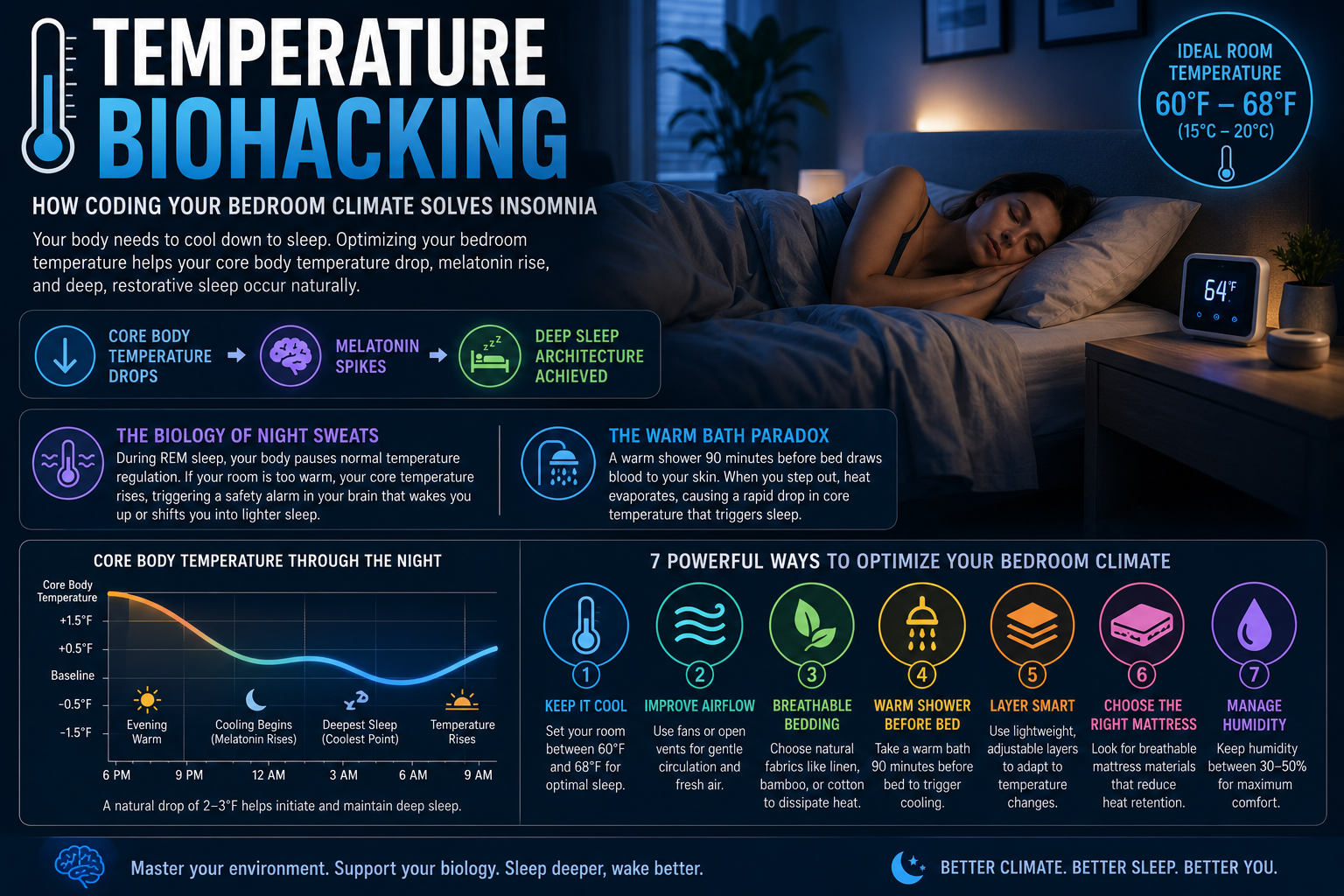
You may have already optimized your bedroom with blackout curtains, eye masks, and white noise machines to eliminate common sleep disturbances. Yet, if you still wake up tossing and turning at 2:00 AM, the missing factor could be Temperature Biohacking. The temperature of your bedroom and your body’s ability to regulate heat can have an important influence on sleep comfort and the natural transition into nighttime rest.
Your body does not maintain exactly the same temperature throughout the entire day. Core body temperature follows a daily rhythm, generally becoming lower during the nighttime period. As bedtime approaches, the body naturally begins releasing heat through the skin, helping prepare the nervous system for sleep.
This is why Temperature Biohacking has become an interesting strategy for people looking to create a more sleep-friendly bedroom environment. Instead of relying only on supplements or complicated gadgets, adjusting your thermal environment can provide a simple and practical way to support better sleep.
Temperature Biohacking and the Science of Sleep
Sleep is closely connected with thermoregulation, the body’s ability to control its internal temperature.
Before and during sleep, the body changes how it distributes heat. Blood flow toward the skin can increase, allowing heat to move away from the body’s core. This natural process is part of the transition toward nighttime rest.
Temperature Biohacking focuses on supporting this process through the bedroom environment, clothing, bedding, airflow, and pre-bed routines.
When the environment is excessively warm, the body may have greater difficulty releasing heat. On the other hand, an environment that is uncomfortably cold can also interfere with relaxation.
The goal is therefore not simply to make the room as cold as possible. The goal is to create a comfortable thermal environment that supports the body’s natural nighttime temperature changes.
Temperature Biohacking: Why Bedroom Temperature Matters
Your bedroom temperature can influence how comfortable you feel throughout the night.
A room that feels pleasant when you first get into bed may become too warm later as bedding traps body heat. This can lead to sweating, restlessness, frequent position changes, or nighttime awakenings.
For people experimenting with Temperature Biohacking, the bedroom should therefore be considered as an entire thermal system.
The room temperature, mattress, sheets, blankets, sleepwear, humidity, and airflow all interact with one another.
This means that simply changing the thermostat may not solve the problem if your mattress or bedding retains too much heat.
Temperature Biohacking and the Natural Cooling Process
The body normally experiences a decline in core temperature around the period when sleep begins. This does not mean that everyone’s temperature drops by exactly the same amount.
Individual physiology, age, health, activity, environment, and sleep schedule can influence the process.
A more useful approach to Temperature Biohacking is to support natural heat loss rather than trying to force a specific temperature change.
A bedroom that is moderately cool, comfortable, and well ventilated may help create an environment in which the body can release excess heat more effectively.
Temperature Biohacking: The Ideal Bedroom Temperature
There is no single bedroom temperature that is perfect for every person.
Many sleep recommendations commonly place a comfortable bedroom range around 60°F to 68°F (15°C to 20°C), but individual preferences can vary considerably.
Some people sleep comfortably at the warmer end of this range, while others prefer a cooler environment.
For Temperature Biohacking, the best strategy is to start with a moderately cool room and adjust it based on your actual sleep experience.
If you wake up sweating or feeling overheated, the room may be too warm, your bedding may be trapping excessive heat, or both.
If you wake up cold, your environment may be too cool or your bedding may not provide adequate insulation.
The ideal temperature is therefore the one that allows you to remain comfortably asleep without excessive heat or cold.
Temperature Biohacking and the Warm Bath Effect
One of the most interesting parts of Temperature Biohacking is that warming the body before bed can sometimes help the body cool afterward.
A warm bath or shower before bedtime may increase blood flow toward the skin. After leaving the warm environment, heat can then dissipate from the body.
This cooling process may help support the transition toward sleep.
The effect is not because the body remains hot throughout the night. Instead, the important part is the subsequent heat loss.
Powerful Temperature Biohacking Before Bed
A warm shower or bath can become a relaxing part of a nighttime routine.
Rather than taking an extremely hot shower, use comfortably warm water and allow enough time afterward for your body to cool naturally.
The exact timing does not need to be identical for everyone. Some people may find a warm shower useful about an hour or so before bedtime, while others may prefer a slightly different schedule.
The broader principle is simple: warm first, then allow natural cooling.
Temperature Biohacking With Breathable Bedding
Bedding can have a surprisingly large effect on nighttime temperature.
Synthetic materials can sometimes trap heat and moisture, particularly when combined with thick mattresses, heavy blankets, and warm sleepwear.
Natural and breathable materials such as cotton and linen can allow more airflow and help manage moisture.
Bamboo-based fabrics may also feel breathable to some sleepers, although the actual performance depends on how the material is manufactured and blended.
For effective Temperature Biohacking, the objective is not necessarily to purchase the most expensive bedding. It is to choose materials that help you remain comfortable throughout the night.
Temperature Biohacking and Bedding Layers
Layering can make thermal management easier because you can remove or add a blanket without changing the entire bedroom environment.
This can be especially useful when temperatures fluctuate during the night.
| Bedroom Element | Cooler Sleep Strategy | Main Benefit |
|---|---|---|
| Room temperature | Moderately cool | Supports comfortable nighttime cooling |
| Sheets | Breathable fabric | Allows heat and moisture to escape |
| Blanket | Adjustable layers | Easier temperature control |
| Sleepwear | Lightweight fabric | Reduces heat retention |
| Airflow | Gentle ventilation | Helps prevent stagnant warm air |
| Mattress | Breathable construction | May reduce heat buildup |
This approach makes Temperature Biohacking more flexible because you can adjust individual components instead of relying entirely on your thermostat.
Temperature Biohacking and Humidity
Temperature is only one part of the thermal environment.
Humidity also influences how comfortable a room feels. When humidity is high, sweat evaporates less efficiently, which can make the environment feel warmer and more uncomfortable.
In a very dry environment, however, excessive dryness can create other comfort issues.
This means Temperature Biohacking should consider both temperature and humidity rather than focusing on one number.
A comfortable bedroom should feel cool without becoming unpleasantly dry or humid.
Temperature Biohacking and Airflow
Air movement can also influence how warm or cool you feel.
A ceiling fan, standing fan, or gentle ventilation can improve airflow around the body and help prevent heat from accumulating around the bed.
The purpose does not necessarily have to be making the room dramatically colder.
Even gentle air movement can make a room feel more comfortable by improving circulation.
For people using Temperature Biohacking, airflow can therefore be a low-cost environmental adjustment worth experimenting with.
Temperature Biohacking and Your Mattress
Your mattress can act as a major thermal surface.
Some mattresses retain more heat than others because of their materials and construction. Memory foam, for example, can feel warmer to some sleepers because of its ability to conform closely to the body.
Other mattress designs may allow more airflow.
If you frequently wake up feeling hot despite keeping the bedroom cool, the mattress could be contributing to the problem.
This is why successful Temperature Biohacking should evaluate the complete sleep setup rather than focusing only on the thermostat.
Temperature Biohacking and Sleep Architecture
Sleep consists of multiple stages, including non-REM and REM sleep. These stages follow a repeating pattern throughout the night.
Environmental discomfort can cause awakenings or changes in sleep continuity, which may interfere with the overall experience of restorative sleep.
Temperature alone does not determine sleep architecture, but creating a comfortable thermal environment can help reduce one potential source of nighttime disturbance.
This is an important distinction.
Temperature Biohacking should not be presented as a guaranteed method for increasing deep sleep by a specific percentage. Instead, it is a strategy for supporting the environmental conditions in which normal sleep can occur.
Temperature Biohacking: A Simple Nighttime Thermal Graph
The body’s temperature pattern can be represented conceptually like this:
Core TemperatureHigh | █████████ | █████████████ | ███████████████ | █████████████ | █████████Low |██████ |________________________________ Morning Evening Night Early Morning Natural nighttime cooling
This graph is a simplified illustration rather than a clinical measurement. Individual circadian temperature patterns vary.
The important concept is that the body normally follows a daily temperature rhythm, and the sleep environment can either support or interfere with comfortable heat loss.
Temperature Biohacking and Night Sweats
Night sweating can have many causes.
A warm bedroom, heavy bedding, excessive sleepwear, exercise close to bedtime, alcohol, medications, hormonal changes, illness, and other factors can all contribute.
If overheating happens regularly despite a comfortable sleeping environment, it should not automatically be blamed on bedroom temperature.
Persistent or unexplained night sweats may require discussion with a healthcare professional.
For ordinary environmental overheating, however, Temperature Biohacking can begin with simple changes such as lighter bedding, better airflow, and a cooler room.
Temperature Biohacking for Different Seasons
Your ideal sleep environment may change throughout the year.
During summer, heat and humidity can make it difficult for the body to release warmth. Air conditioning, fans, breathable sheets, and lighter blankets may become useful.
During winter, the challenge can be finding a balance between staying warm and avoiding excessive heat.
Instead of keeping the entire room extremely warm, layering blankets and wearing comfortable sleepwear can provide more flexible temperature control.
This makes seasonal adjustment an important part of Temperature Biohacking.
The Powerful Bedroom Climate Strategy
A successful bedroom climate strategy does not need to be complicated.
Start by making the room comfortably cool. Then evaluate your bedding, mattress, sleepwear, and airflow.
If you still wake up feeling hot, change one variable at a time.
For example, you could first reduce the room temperature slightly. If that does not help, try lighter bedding. If overheating continues, examine whether your mattress or sleepwear is retaining heat.
Changing one variable at a time makes it easier to understand what actually works for you.
Temperature Biohacking: Your 7-Step Sleep Environment Table
| Step | Thermal Adjustment | Why It May Help |
|---|---|---|
| 1 | Keep the bedroom comfortably cool | Supports nighttime comfort |
| 2 | Use breathable sheets | Helps manage heat and moisture |
| 3 | Adjust blanket layers | Allows flexible temperature control |
| 4 | Improve gentle airflow | Reduces heat buildup |
| 5 | Try a warm shower before bed | Supports post-shower heat loss |
| 6 | Review your mattress | Identifies possible heat retention |
| 7 | Adjust seasonally | Keeps your environment comfortable year-round |
These steps are not strict rules. They are practical experiments that can help you identify which changes make the biggest difference to your sleep comfort.
Temperature Biohacking and the Future of Sleep Technology
Sleep technology is becoming increasingly sophisticated.
Modern cooling mattresses, temperature-controlled mattress covers, smart thermostats, wearable sensors, and automated bedroom systems can monitor or adjust environmental conditions.
Some technologies can potentially change temperature throughout the night instead of maintaining one fixed setting.
This could make Temperature Biohacking increasingly personalized.
Instead of manually adjusting the thermostat before bed, future systems may respond automatically to environmental conditions and individual sleep patterns.
However, advanced technology is not always necessary.
A comfortable room, breathable bedding, suitable sleepwear, and good airflow can already provide many of the basic environmental benefits people are looking for.
Temperature Biohacking Without Overcomplicating Sleep
The biggest mistake with sleep optimization is turning bedtime into another performance task.
You do not need to measure every temperature fluctuation or purchase expensive equipment to improve your sleep environment.
The most useful approach is to identify obvious sources of discomfort and address them gradually.
If you are consistently too hot, cool the room.
If your bedding traps heat, switch to more breathable materials.
If your mattress feels excessively warm, investigate whether its construction contributes to heat retention.
If the air feels stagnant, improve ventilation.
This practical approach makes Temperature Biohacking accessible rather than complicated.
Conclusion: Temperature Biohacking for Better Sleep
Temperature Biohacking highlights an often-overlooked part of sleep optimization: the relationship between your body’s natural temperature rhythm and the environment in which you sleep.
Your body naturally changes temperature throughout the day, and nighttime heat loss is part of the transition toward sleep. A bedroom that is excessively warm, poorly ventilated, or covered in heat-trapping bedding may make it harder to remain comfortable throughout the night.
The most powerful strategy is not necessarily creating an extremely cold bedroom. Instead, it is finding a comfortable thermal environment that allows your body to regulate heat naturally.
A moderately cool room, breathable bedding, adjustable layers, gentle airflow, and a warm shower before bed can all become useful components of a personalized sleep environment.
Temperature Biohacking: 7 Powerful Ways to Optimize Your Bedroom for Better Sleep is ultimately about working with your body’s natural biology rather than fighting against it. By making thoughtful changes to your bedroom climate, you can create a more comfortable and consistent environment designed to support better nighttime rest.