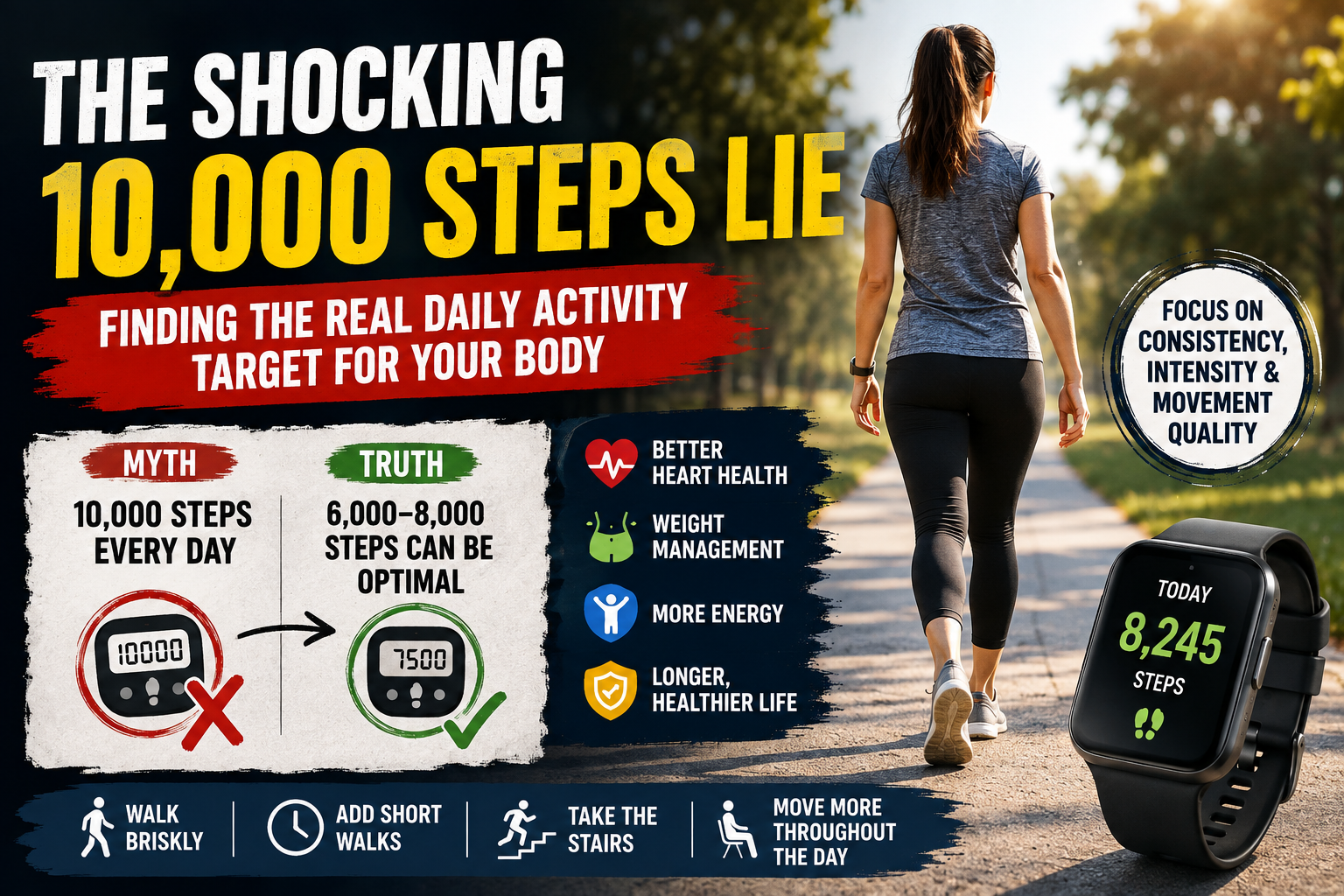
For years, people have believed that exactly 10,000 steps a day is the magic number for better health, weight management, and longevity. But The 10,000 Steps Lie challenges this popular fitness rule and asks a more important question: does everyone really need to reach the same step count every day? Your age, fitness level, lifestyle, walking speed, health goals, and daily activity all influence how much movement your body actually needs.
The idea of reaching 10,000 steps has become deeply connected with modern fitness culture. Smartphones, smartwatches, and fitness trackers display daily step counts as if reaching a specific number automatically means you have had a healthy day. While walking is undoubtedly one of the easiest and most accessible forms of physical activity, the obsession with one fixed number can make people overlook the bigger picture of daily movement.
The Shocking 10,000 Steps Lie and Where the Number Came From
The history behind The 10,000 Steps Lie is surprisingly interesting. The popular 10,000-step target did not originally come from a universal medical requirement stating that every person must walk exactly 10,000 steps each day.
The number became popular in Japan during the 1960s through the promotion of a pedometer known as Manpo-kei, which essentially means “10,000-step meter.” The simple and memorable target eventually became associated with health and fitness around the world.
Its simplicity helped make the idea successful. Instead of asking people to understand complicated exercise guidelines, the concept gave them one easy goal: reach 10,000 steps.
That simplicity is one reason the target remains popular today. However, a convenient fitness target should not automatically be confused with a biological requirement.
Why The 10,000 Steps Lie Became So Popular
The appeal of The 10,000 Steps Lie is partly psychological. People like measurable goals. A number gives you something concrete to achieve, track, and improve.
When your smartwatch shows 6,000 steps, you immediately know that you have movement left to complete. When it reaches 10,000, you receive a sense of accomplishment.
This can be useful because step tracking may encourage people to move more. Someone who normally spends most of the day sitting might become more active simply because they want to increase their daily step count.
The problem appears when the number becomes more important than the activity itself.
A person who walks 8,000 purposeful steps every day may be doing an excellent amount of physical activity, while another person who reaches 10,000 steps through slow movement may not necessarily have the same cardiovascular fitness. The quality, intensity, consistency, and overall pattern of movement matter too.
What Research Says About The 10,000 Steps Lie
Research into daily step counts has increasingly challenged the idea that 10,000 is a universal minimum. Large observational studies have found meaningful health associations at step counts below 10,000, although the exact relationship varies between populations and outcomes.
This does not mean that 10,000 steps are bad. Walking 10,000 steps can be an excellent goal for someone who enjoys walking and can comfortably achieve it. The important point is that there is nothing magical about crossing from 9,999 to 10,000.
The benefits of physical activity tend to develop across a range of activity levels rather than appearing suddenly at one specific number.
This is one of the most important lessons behind The 10,000 Steps Lie. Instead of asking, “Have I reached 10,000?” it may be more useful to ask, “Am I moving more consistently than I was before?”
The Real Meaning Behind The 10,000 Steps Lie
The real problem with the 10,000-step concept is not walking. Walking is excellent exercise. The problem is treating a single number as though it applies equally to every human body.
A young athlete, an office worker, an older adult, and someone recovering from inactivity may have completely different appropriate activity targets.
Your ideal daily movement level should take your current fitness, physical limitations, lifestyle, and personal goals into account.
For someone who currently takes 2,500 steps a day, moving toward 4,000 or 5,000 steps could represent a meaningful improvement. Someone already walking 8,000 steps may benefit more from adding periods of brisk walking than from forcing themselves to reach an arbitrary extra 2,000 steps.
The 10,000 Steps Lie and Walking Intensity
One of the most overlooked aspects of daily walking is intensity.
Walking slowly around your house and walking briskly through a park are both forms of movement, but they place different demands on the cardiovascular system.
Brisk walking can increase your heart rate and breathing while still allowing you to maintain a conversation. This type of activity can provide a stronger cardiovascular stimulus than extremely slow walking.
That does not mean slow walking has no value. Light movement can help reduce sedentary time, support circulation, and keep your body active throughout the day.
The larger lesson is that The 10,000 Steps Lie should not encourage people to ignore intensity. A balanced activity routine can include casual movement, purposeful walking, and more challenging exercise depending on individual ability.
How The 10,000 Steps Lie Relates to Weight Management
Walking can contribute to energy expenditure, but weight management is influenced by many factors, including nutrition, total energy intake, body composition, sleep, stress, metabolism, and physical activity.
Increasing your daily movement can be useful because it increases energy expenditure without necessarily requiring a formal gym workout.
This is especially important for people who dislike traditional exercise. Walking can become a sustainable way to remain active without requiring expensive equipment or complicated training programs.
However, chasing 10,000 steps should not become an excuse to ignore other aspects of health. A person can walk thousands of steps every day while maintaining poor nutrition, inadequate sleep, or excessive sedentary time.
The goal should be a complete healthy lifestyle rather than a single number on a smartwatch.
The Shocking Truth About Sedentary Time
One reason daily steps matter is that prolonged sitting can become a major part of modern life. Office work, driving, studying, gaming, streaming, and smartphone use can keep people seated for many hours.
A morning walk does not necessarily eliminate the effects of sitting for the rest of the day. This is why spreading movement throughout the day can be valuable.
Standing up regularly, walking during phone calls, taking the stairs, doing household tasks, and taking short movement breaks can all contribute to a more active lifestyle.
This broader approach makes The 10,000 Steps Lie less about eliminating a specific target and more about understanding the importance of regular movement.
The 10,000 Steps Lie: Finding Your Personal Target
Instead of copying another person’s step goal, consider your current baseline.
If you normally walk very little, a gradual increase may be more realistic than immediately demanding 10,000 steps every day. Your body needs time to adapt to increased physical activity, especially if you have been inactive for a long period.
Someone who already walks regularly may choose a higher target, while another person may focus on improving walking speed, adding hills, or incorporating strength training.
The best target is one you can maintain consistently without creating unnecessary physical or mental stress.
Consistency is more valuable than occasionally reaching a large number and then spending several days inactive.
A Better Way to Think About Daily Movement
A healthier approach is to think of movement as a daily ecosystem rather than a single goal.
Your day could naturally include a morning walk, movement during work, household activities, short walking breaks, and an evening stroll. None of these activities needs to be individually impressive.
Together, they create an active lifestyle.
This approach also makes physical activity easier to maintain because you do not need to dedicate one large block of time to exercise. Small periods of movement can accumulate throughout the day.
For people with busy schedules, this can be especially useful.
The 10,000 Steps Lie and Cardiovascular Health
Regular walking can support cardiovascular health by increasing physical activity and improving aerobic capacity over time. Brisk walking can provide a stronger cardiovascular stimulus than extremely light movement.
However, cardiovascular health benefits from a combination of activities.
Walking can be combined with resistance training, mobility exercises, cycling, swimming, or other forms of aerobic activity. Strength training is particularly important because maintaining muscle mass and strength becomes increasingly valuable as people age.
Therefore, The 10,000 Steps Lie should not be interpreted as “steps do not matter.” Instead, it should encourage a broader understanding of physical fitness.
The 10,000 Steps Lie and Healthy Aging
As people get older, maintaining mobility becomes increasingly important. The ability to walk comfortably, climb stairs, carry groceries, stand from a chair, and move independently can have a major influence on quality of life.
Daily walking can help maintain an active lifestyle, but healthy aging requires more than step accumulation.
Strength, balance, flexibility, coordination, cardiovascular fitness, and recovery all contribute to functional independence.
For older adults, the ideal activity target should also consider physical ability and safety. A gradual increase in activity may be more appropriate than aggressively pursuing a universal step number.
A Simple Daily Movement Framework
| Daily Movement Area | Main Purpose | Practical Approach |
|---|---|---|
| Casual walking | Reduce inactivity | Move regularly throughout the day |
| Brisk walking | Cardiovascular fitness | Add purposeful faster-paced walks |
| Short movement breaks | Reduce prolonged sitting | Stand and move periodically |
| Strength training | Maintain muscle and strength | Include resistance exercise regularly |
| Mobility work | Support movement quality | Use gentle mobility exercises |
| Outdoor activity | General wellness | Walk, hike, or participate in enjoyable activities |
This framework demonstrates why focusing exclusively on one step number can be limiting. A healthy movement routine is multidimensional.
How to Escape The 10,000 Steps Lie
Escaping The 10,000 Steps Lie does not mean throwing away your smartwatch or stopping your daily walks. Instead, it means using step counts as a tool rather than treating them as a medical rule.
Track your current activity level for several days. Once you understand your baseline, gradually increase your movement if appropriate. Pay attention to how your body responds.
You can also focus on walking quality. A comfortable walk can become a brisk walk for part of the journey. An elevator trip can become a staircase trip when appropriate. A phone conversation can become an opportunity to walk instead of sit.
These small decisions can transform your daily activity without making exercise feel like another difficult responsibility.
The Future of Daily Activity
Fitness technology is becoming increasingly sophisticated. Modern wearables can monitor steps, heart rate, active minutes, sleep patterns, and other measurements.
As technology develops, health recommendations may become increasingly personalized. Instead of giving every person the same target, future systems may consider age, fitness level, recovery, cardiovascular response, and lifestyle patterns.
That would represent a major shift away from the simplistic thinking behind The 10,000 Steps Lie.
The future of fitness is unlikely to depend on one universal number. It will increasingly focus on personalized movement and sustainable habits.
Conclusion: The Real Lesson Behind The 10,000 Steps Lie
The most important lesson behind The 10,000 Steps Lie is not that 10,000 steps are unnecessary or useless. The real lesson is that human health cannot be reduced to one number.
Walking regularly is one of the simplest ways to increase physical activity, and reaching 10,000 steps can be a perfectly reasonable personal goal for many people. But you do not need to feel that your day was unsuccessful simply because your tracker stopped at 7,000 or 8,000 steps.
Your body benefits from consistent movement, cardiovascular activity, strength, mobility, and reduced sedentary time.
Instead of obsessing over a perfect number, focus on becoming more active, more consistent, and more physically capable.
That is the real message behind The Shocking 10,000 Steps Lie: health is not about hitting an arbitrary finish line. It is about creating a level of daily movement that your body can sustain for years.