Over the next five years, WordPress AI could transform the way businesses create, manage, and grow their websites. WordPress has traditionally been known as a powerful website and content management platform, but its connection with artificial intelligence is opening a much wider range of possibilities.
This change is already beginning. WordPress 7.0 introduced an AI Client into WordPress core, giving plugins a standardized way to communicate with AI models. WordPress is also developing the Abilities API and other AI-focused tools that can allow AI systems to interact with website functions in structured and permission-aware ways. (WordPress.org)
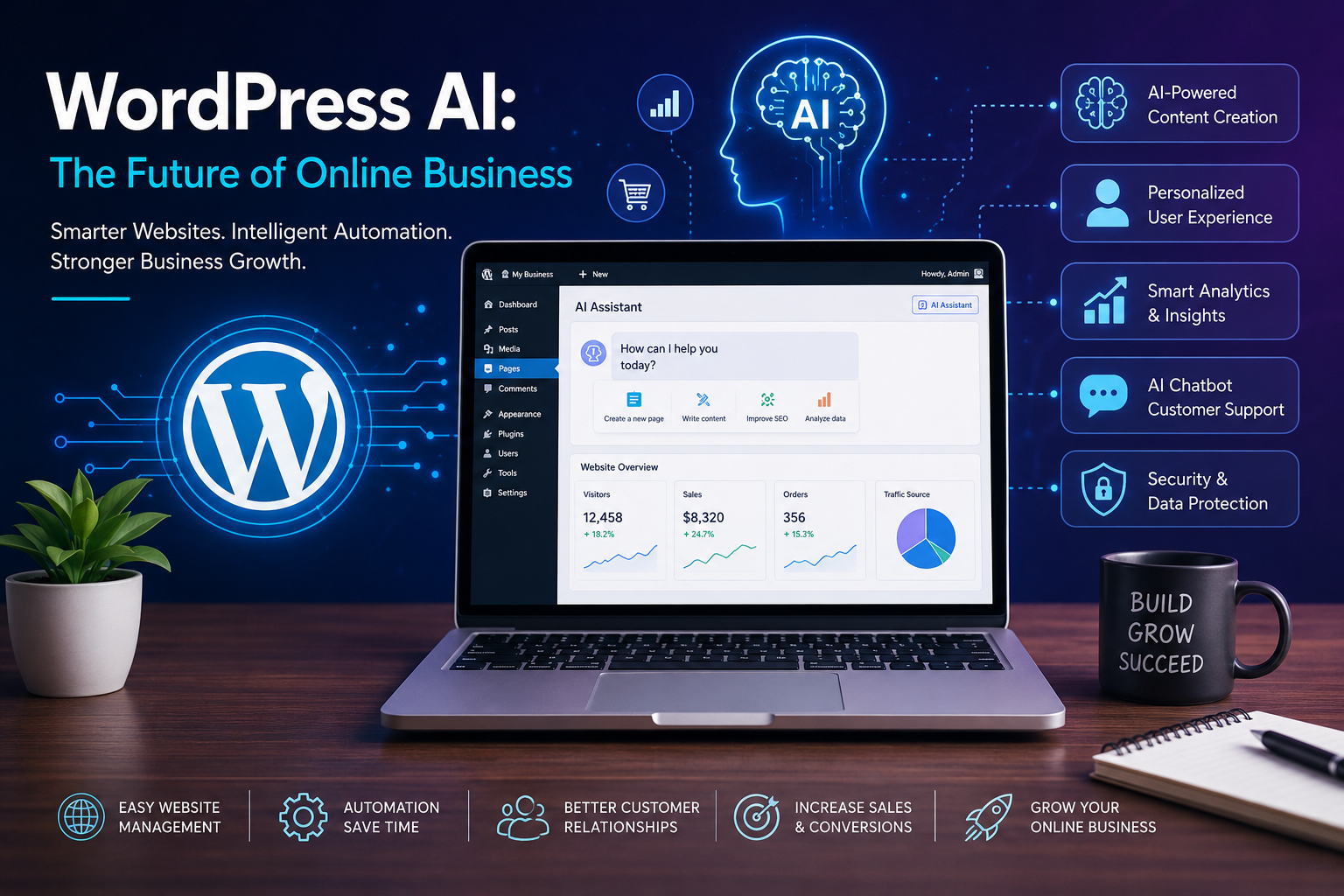
For businesses, this means a WordPress website could gradually become more than a place to publish information. It could become an intelligent business platform that helps create content, understand visitors, automate routine work, improve customer communication, and provide valuable business insights.
AI-Powered WordPress Website Management
One of the biggest advantages of WordPress AI will be easier website management. Many small-business owners understand their products and customers very well but may not have advanced technical knowledge.
In the future, instead of searching through complicated settings, a website owner could simply describe what they want. An AI assistant could potentially help modify content, suggest improvements, create website sections, summarize information, or assist with repetitive administrative tasks.
The WordPress AI project is already experimenting with features such as content summarization, content classification, comment moderation, AI-assisted writing, and access to selected website settings. (Make WordPress)
This could make WordPress more accessible to freelancers, startups, bloggers, agencies, and small businesses.
How WordPress AI Could Change Business Websites
The future business website may work differently from today’s traditional website. Instead of simply displaying pages, it could actively assist visitors and business owners.
| Current WordPress Website | Future WordPress AI Website |
|---|---|
| Mainly displays information | Can actively assist visitors |
| Manual content management | AI-assisted content workflows |
| Standard user experience | More personalized experiences |
| Manual analysis | AI-supported business insights |
| Separate tools for many tasks | Greater integration between tools |
| Basic customer support | Intelligent support assistants |
This does not mean every website will automatically become fully autonomous. Instead, WordPress AI is likely to provide businesses with more powerful tools that combine automation with human control.
Personalized Customer Experiences
Personalization could become one of the most important changes in future websites. Today, many visitors see almost identical pages regardless of their interests or previous interactions.
AI could help websites understand the context of a visitor’s request and provide more relevant information. An online store, for example, could recommend products based on what a customer is viewing. A service company could guide visitors toward the service that best matches their needs.
AI-powered chat assistants could also answer common questions and help visitors find information without forcing them to search through multiple pages.
This could make websites feel more like interactive digital assistants rather than static collections of pages.
AI Content Creation and WordPress SEO
Content creation is another area where WordPress AI could have a major impact. Businesses regularly need blog posts, product descriptions, landing-page content, email ideas, social media material, and other forms of digital communication.
AI can assist with these processes by generating ideas, improving drafts, summarizing existing content, or suggesting different versions of text.
However, businesses should not depend completely on automatically generated content. Human review remains important because websites need accurate information, originality, expertise, and a recognizable brand voice.
SEO is also changing as people increasingly use AI-powered search experiences. WordPress.com has highlighted the importance of making websites clear and understandable not only for traditional search engines but also for AI-driven discovery. (WordPress.com)
Therefore, future SEO may involve creating content that is useful for humans while also making a business’s purpose, expertise, products, and services easy for AI systems to understand.
The Future of Website Design
Website design could also become more intelligent. AI may help businesses create layouts, suggest design improvements, generate images, and adapt website experiences to different requirements.
WordPress 7.0 already includes new AI capabilities alongside improvements to customization and development tools. The WordPress AI ecosystem is also experimenting with AI-assisted media features and image-related workflows. (WordPress.org)
Over time, this could make website creation more conversational. Instead of manually building every section, a business owner could describe the desired result and then adjust the AI-generated design.
Human designers would still be valuable because branding, creativity, usability, and strategic decisions require more than automatic generation.
WordPress AI and Business Automation
Automation could be one of the strongest reasons businesses adopt WordPress AI. A modern business website often depends on many separate systems, including ecommerce platforms, customer relationship tools, analytics, email services, appointment systems, and marketing software.
AI could help connect information from these systems and turn it into useful actions or recommendations.
For example, a business owner could potentially receive a simple explanation of which products are performing well, which pages are losing visitors, or which customer questions appear most frequently.
The WordPress Abilities API is important in this direction because it provides a standardized way for WordPress functionality to become discoverable and usable by AI systems and automation tools. (WordPress Developer Resources)
AI Customer Support
Customer support is another area where WordPress AI could become useful. Businesses receive many repetitive questions about prices, services, delivery, appointments, returns, and basic product information.
An AI assistant could provide immediate answers to common questions and guide customers toward the correct information. This could reduce the workload on support teams.
However, AI should not necessarily handle every customer problem. Complicated complaints, sensitive situations, and unusual requests may still require a human representative.
The best approach could be a combination of AI for routine questions and humans for situations that require judgment or empathy.
Better Business Insights
A website produces valuable information about visitors and customers. Traditionally, business owners may need to examine analytics dashboards and reports to understand what is happening.
Future WordPress AI systems could make this information easier to understand. Instead of presenting only charts and numbers, AI could summarize important patterns in simple language.
For example, an AI assistant might identify that a particular page is receiving traffic but generating few inquiries. It could then suggest possible improvements.
This does not mean AI will always make the correct business decision. Human review will remain necessary, but AI could make large amounts of website information easier to interpret.
WordPress AI and Small Businesses
Small businesses could benefit significantly from these developments. Large companies often have dedicated developers, marketers, designers, analysts, and customer-support teams.
Small businesses may have only one or two people handling many of these responsibilities.
AI could help reduce some of the repetitive workload. A small company might use WordPress AI to assist with content, customer communication, website maintenance, analytics, and marketing tasks.
This could lower some of the technical barriers involved in building a professional online presence.
The Changing Role of Developers and Designers
The growth of AI does not necessarily mean that web professionals will disappear. Instead, their roles may change.
Developers could spend less time on repetitive implementation and more time building advanced integrations, security systems, custom functionality, and business solutions.
Designers could focus more heavily on user experience, branding, creative direction, and strategy.
Writers and marketers could use AI for research and repetitive tasks while concentrating more on storytelling, originality, and audience strategy.
The professionals who understand both their field and AI tools may become especially valuable.
Security and Privacy in WordPress AI
As websites become more intelligent, security and privacy will become even more important. AI systems may need access to website content, settings, customer information, or business data.
That creates an important responsibility for website owners.
AI integrations should be configured carefully, permissions should be controlled, and sensitive information should be protected. WordPress’s AI development is already exploring areas such as connector approvals, encrypted AI provider keys, request logging, and permission-aware abilities. (Make WordPress)
A smart website will only be successful if customers can trust how their information is handled.
Human Creativity Will Still Matter
One of the biggest mistakes businesses could make is assuming that AI can replace every human role.
AI can generate text, analyze information, automate tasks, and provide suggestions. However, a successful business still needs a clear purpose, strong branding, customer understanding, creativity, and good decision-making.
The strongest future websites are likely to combine AI efficiency with human creativity.
AI can help a business work faster, but people will remain responsible for deciding what the business should say, how it should serve customers, and what direction it should take.
What Could WordPress Look Like in Five Years?
The exact future cannot be predicted, but current WordPress development provides some clues. The platform is already moving toward deeper AI integration, AI Clients, standardized abilities, AI assistants, and automation-friendly infrastructure. (Make WordPress)
A possible five-year direction could look like this:
| Area | Possible Future Development |
|---|---|
| Website creation | Conversational AI-assisted building |
| Content | Faster creation, editing, translation, and optimization |
| Customer service | AI assistants for routine questions |
| SEO | Content optimized for search and AI discovery |
| Analytics | AI-generated explanations and recommendations |
| Ecommerce | Smarter product recommendations |
| Administration | AI-assisted website management |
| Development | More AI-accessible WordPress functions |
| Marketing | Greater automation and personalization |
| Security | More intelligent monitoring and controls |
These are potential developments rather than guaranteed outcomes. WordPress itself describes several AI features as experimental or under development, so businesses should distinguish between current capabilities and future possibilities. (Make WordPress)
The Next Generation of WordPress Websites
The biggest change may be that websites become less passive. A traditional website waits for a visitor to click, search, or submit a form. An AI-powered website could potentially understand a visitor’s request and guide them toward the right information.
For businesses, this could create a more active online presence. The website could become a place where customers ask questions, discover products, receive recommendations, book services, and interact with the company.
At the same time, the business owner could use the same platform to understand performance and improve operations.
This is why WordPress AI has the potential to become much more than an AI writing feature. It could become part of a broader business ecosystem.
WordPress AI as the Future of Online Business
The next five years could be an important period for WordPress. The platform is already building the technical foundation for AI-assisted workflows, and the development of AI Clients, the Abilities API, connectors, and AI experiments suggests that artificial intelligence is becoming an increasingly important part of the WordPress ecosystem. (Make WordPress)
For businesses, the opportunity is significant. WordPress AI could make website creation easier, automate repetitive work, improve customer experiences, support content creation, simplify analytics, and connect websites more closely with everyday business operations.
However, the future should not be viewed as AI replacing people. The strongest model is likely to be collaboration between artificial intelligence and human expertise.
A future WordPress website may therefore be more than an online brochure. It could become an intelligent digital partner that helps a business attract visitors, communicate with customers, understand its performance, and grow online.
WordPress AI: The Future of Online Business is ultimately about this transformation—from websites that simply present information to intelligent platforms that actively support businesses and their customers.