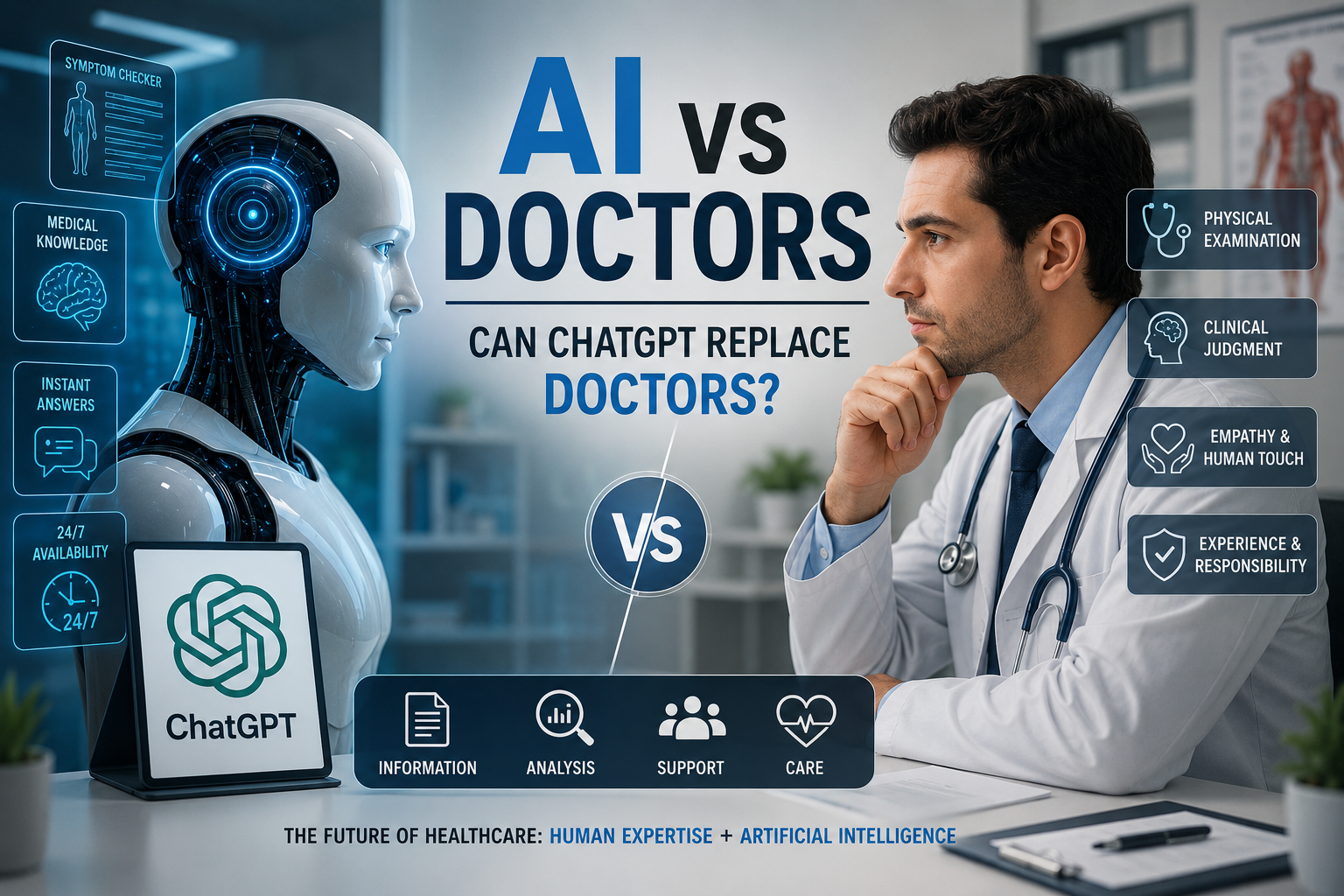
Artificial intelligence has moved from science fiction into everyday life. One of the most visible examples is ChatGPT, a conversational AI system that can answer questions, explain complicated topics, summarize information, and communicate with users in natural language. Because of these abilities, many people have started asking an important question: Can ChatGPT replace doctors in the future?
The AI vs Doctors debate is interesting because both can provide strong information about health, but they work in very different ways. ChatGPT processes patterns in information and produces a response based on the details provided to it. A doctor, on the other hand, combines medical education, clinical experience, physical examination, patient history, diagnostic tests, professional judgment, and human communication.
AI is already becoming part of healthcare. The World Health Organization says AI has potential to support diagnosis, clinical care, research, drug development, and other health services. At the same time, WHO emphasizes that patient safety, privacy, transparency, and human responsibility must remain central when AI is used in medicine.
So, rather than simply asking whether AI is better than a doctor, it is more useful to ask where AI can help and where human medical expertise remains essential.
AI vs Doctors: What Can ChatGPT Do?
One major advantage of ChatGPT is its ability to communicate information quickly. A person can type a health-related question and receive an explanation within seconds. It can explain medical terminology in simpler language, organize information into understandable sections, and help users prepare questions for a medical appointment.
For example, someone who has received a medical report may find certain terms confusing. An AI assistant can explain what those terms generally mean in everyday language. It can also help users understand the difference between common medical concepts or prepare a list of questions they may want to discuss with a healthcare professional.
AI vs Doctors: What Can Doctors Do That ChatGPT Cannot?
AI vs Doctors: Why Human Medical Expertise Matters
Doctors do much more than provide information. They evaluate an actual person.
During a medical consultation, a doctor can observe a patient’s appearance, breathing, movement, speech, skin condition, and other physical signs. Depending on the situation, the doctor may perform a physical examination, request laboratory tests, order imaging, review previous medical records, and combine all of this information before reaching a clinical decision.
This is a major difference in the AI vs Doctors comparison.
A patient might describe chest discomfort as mild, for example, but a doctor can ask follow-up questions, examine the patient, check vital signs, review risk factors, and decide whether immediate testing is necessary. A chatbot depends heavily on what the user tells it and may not have access to the complete clinical picture.
AI vs Doctors: Can ChatGPT Always Give Correct Answers?
AI vs Doctors and the Problem of Wrong Information
One of the biggest concerns about generative AI in healthcare is that an answer can sound convincing without necessarily being correct.
AI systems can produce information that appears logical and professional but contains mistakes. This problem is particularly serious in medicine because a person may act on incorrect information.
The WHO has specifically warned that large language models can generate authoritative-looking answers that may still contain serious errors. It recommends careful evaluation, expert supervision, transparency, and appropriate safeguards before such systems are widely used in healthcare.
This does not mean that every answer produced by ChatGPT is wrong. It means users should understand the difference between useful information and professional medical judgment.
AI vs Doctors: Understanding Individual Patients
AI vs Doctors: Why Every Patient Is Different
Two people can have similar symptoms but completely different medical situations.
Age, medical history, allergies, medications, family history, lifestyle, previous treatments, pregnancy status, and other factors can change what treatment is appropriate.
A doctor can ask questions that were not included in the patient’s original description. The conversation can change depending on the answers. A doctor may also recognize that a seemingly small detail is medically important.
ChatGPT can ask follow-up questions too, but it does not automatically have the same access to the physical and clinical information available during an in-person medical evaluation.
This is one reason a general AI response should not be treated as a personalized diagnosis.
AI vs Doctors: The Importance of Physical Examination
AI vs Doctors: Why Physical Examination Matters
Physical examination is another major advantage of doctors.
Depending on the complaint, a doctor may listen to the heart and lungs, examine the abdomen, check reflexes, evaluate swelling, inspect the skin, measure vital signs, or perform other clinical assessments.
These observations can provide information that cannot be reliably communicated through a short text message.
Even when AI becomes increasingly capable, healthcare will still require ways of collecting accurate information from the physical world. AI may help analyze that information, but collecting and interpreting it safely remains an important part of clinical care.
AI vs Doctors: How AI Could Help Doctors
AI vs Doctors: Working Together in Healthcare
The future of healthcare does not necessarily have to be a competition between humans and machines.
A more realistic possibility is cooperation.
AI could assist doctors by handling repetitive tasks, organizing information, identifying patterns, helping with documentation, supporting medical research, and providing decision-support tools. In some areas, specialized AI systems may help clinicians analyze medical images or other forms of clinical data.
WHO has noted that AI-assisted diagnostics are already being used in some health systems, demonstrating that AI is becoming a practical part of modern healthcare rather than simply a theoretical technology.
The important point is that assistance does not automatically mean replacement.
AI vs Doctors: Can ChatGPT Diagnose Diseases?
AI vs Doctors: Diagnosis and Clinical Judgment
ChatGPT can discuss symptoms and provide general information about possible causes, but that is different from establishing a medical diagnosis.
A diagnosis often requires a combination of history, physical examination, testing, medical knowledge, and clinical judgment.
Recent research has shown that AI performance can vary considerably depending on the medical task. A system may perform well on structured questions but struggle with complex real-world situations.
This distinction is extremely important. Being able to explain a disease is not the same as being able to safely determine whether a particular patient has that disease.
AI vs Doctors: The Human Side of Medicine
AI vs Doctors: Why Human Interaction Still Matters
Medicine is not only about data.
Patients can be frightened, confused, embarrassed, frustrated, or emotionally overwhelmed. Doctors must communicate difficult information, understand patient concerns, discuss treatment choices, and sometimes help families make complicated decisions.
Human interaction can also involve cultural, social, and personal circumstances that are difficult to reduce to a simple question-and-answer exchange.
AI can communicate in a friendly and supportive manner, but communication style should not be confused with professional responsibility or human clinical experience.
AI vs Doctors: Privacy and Patient Data
AI vs Doctors: Why Privacy Matters
Health information is extremely sensitive.
People may share symptoms, medical histories, medication details, laboratory results, or other private information with digital services. This creates important questions about how information is stored, processed, protected, and used.
Healthcare organizations traditionally operate under professional and legal responsibilities regarding patient information. AI-based healthcare systems also need strong privacy and security measures.
Therefore, users should think carefully before entering highly sensitive personal medical information into any online AI service.
AI vs Doctors: Will AI Replace Doctors?
AI vs Doctors: The Future of Medical Care
The idea that AI will completely replace doctors is much less certain than the idea that AI will change how doctors work.
Healthcare is likely to become increasingly technology-assisted. Doctors may use AI tools to review information, identify possible patterns, automate routine documentation, or support certain diagnostic processes.
However, replacing doctors entirely would require AI to safely perform a huge range of tasks: physical examination, diagnosis, treatment planning, communication, ethical decision-making, emergency judgment, accountability, and long-term patient care.
These are not simply information-processing problems.
The more realistic future is likely to involve doctors working with AI rather than doctors competing against AI.
AI vs Doctors: Simple Comparison
| Area | AI | Doctors |
|---|---|---|
| Information access | Very fast | Fast, based on medical resources and experience |
| Communication | Digital conversation | Direct human interaction |
| Physical examination | Not equivalent to an in-person examination | Yes |
| Medical history | Depends on information provided | Can investigate and review records |
| Diagnostic testing | Cannot independently perform clinical tests | Can order and interpret appropriate tests |
| Clinical judgment | Limited and variable | Based on training and clinical experience |
| Emotional understanding | Supportive language | Human empathy and professional communication |
| Accountability | Raises complex questions | Professional accountability |
| Best role | Information and assistance | Diagnosis, treatment, and patient care |
AI vs Doctors: The Best Way to Use ChatGPT
ChatGPT can be useful when used as an information and preparation tool, rather than as a replacement for medical care.
It may help someone understand unfamiliar medical terminology, prepare questions for a doctor, organize symptoms before an appointment, learn general information about a medical condition, or understand general health concepts.
However, users should be particularly cautious when asking AI to make decisions about emergency symptoms, medication changes, treatment plans, or serious medical conditions.
For those situations, professional medical advice is much more appropriate.
AI vs Doctors: The Future of Healthcare
AI vs Doctors: Human Expertise Plus Artificial Intelligence
The debate should not simply be about whether humans or machines will win.
The better question is how technology can make healthcare safer, faster, and more accessible without removing human responsibility.
Imagine a future where a doctor has an AI assistant that can quickly summarize a patient’s medical history, identify potentially relevant information, compare large amounts of medical literature, and highlight unusual patterns. The doctor could then use professional judgment to verify the information and decide what should actually happen.
This approach could reduce routine workload while allowing healthcare professionals to spend more time with patients.
AI vs Doctors: A Partnership Instead of Replacement
The strongest model may be one where AI supports doctors rather than replaces them. AI can provide speed, information processing, and assistance with routine tasks, while doctors remain responsible for diagnosis, treatment, communication, and patient care.
Conclusion: AI vs Doctors
The AI vs Doctors debate is likely to continue as artificial intelligence becomes more advanced. ChatGPT can explain information quickly, assist with certain tasks, support learning, and potentially help healthcare professionals work more efficiently.
But ChatGPT is not the same as a doctor.
A doctor can examine a patient, investigate symptoms, interpret clinical evidence, consider personal circumstances, make professional judgments, communicate difficult information, and take responsibility for medical decisions. AI can support some of these processes, but it should not automatically be treated as a replacement for them.
The future of healthcare will probably not be about choosing between AI and doctors. Instead, it will be about finding safe and responsible ways for both to work together.
AI can provide speed, scale, and information processing. Doctors provide clinical judgment, physical assessment, human understanding, and professional responsibility.
The strongest healthcare system of the future may not be one where AI replaces doctors, but one where doctors use AI wisely while remaining firmly in control of patient care.