Education has always changed with new technology. Classrooms once depended mainly on books, blackboards, and face-to-face teaching. Today, students can also use artificial intelligence to learn, practice, and ask questions at any time. One of the most interesting developments is the rise of AI Personal Tutors.
An AI tutor is a digital learning assistant that can explain topics, answer questions, create practice exercises, and give feedback. Unlike a traditional classroom, an AI tutor can be available whenever a student needs help. This technology could make education more flexible and personalized, but it also raises questions about accuracy, privacy, human teachers, and the role of technology in learning.
What Is an AI Personal Tutor?
An AI personal tutor is software designed to support a student’s learning. It can communicate through text, voice, or other digital interfaces. A student can ask a question in ordinary language instead of searching through a textbook. The system can then provide an explanation based on the information available to it.
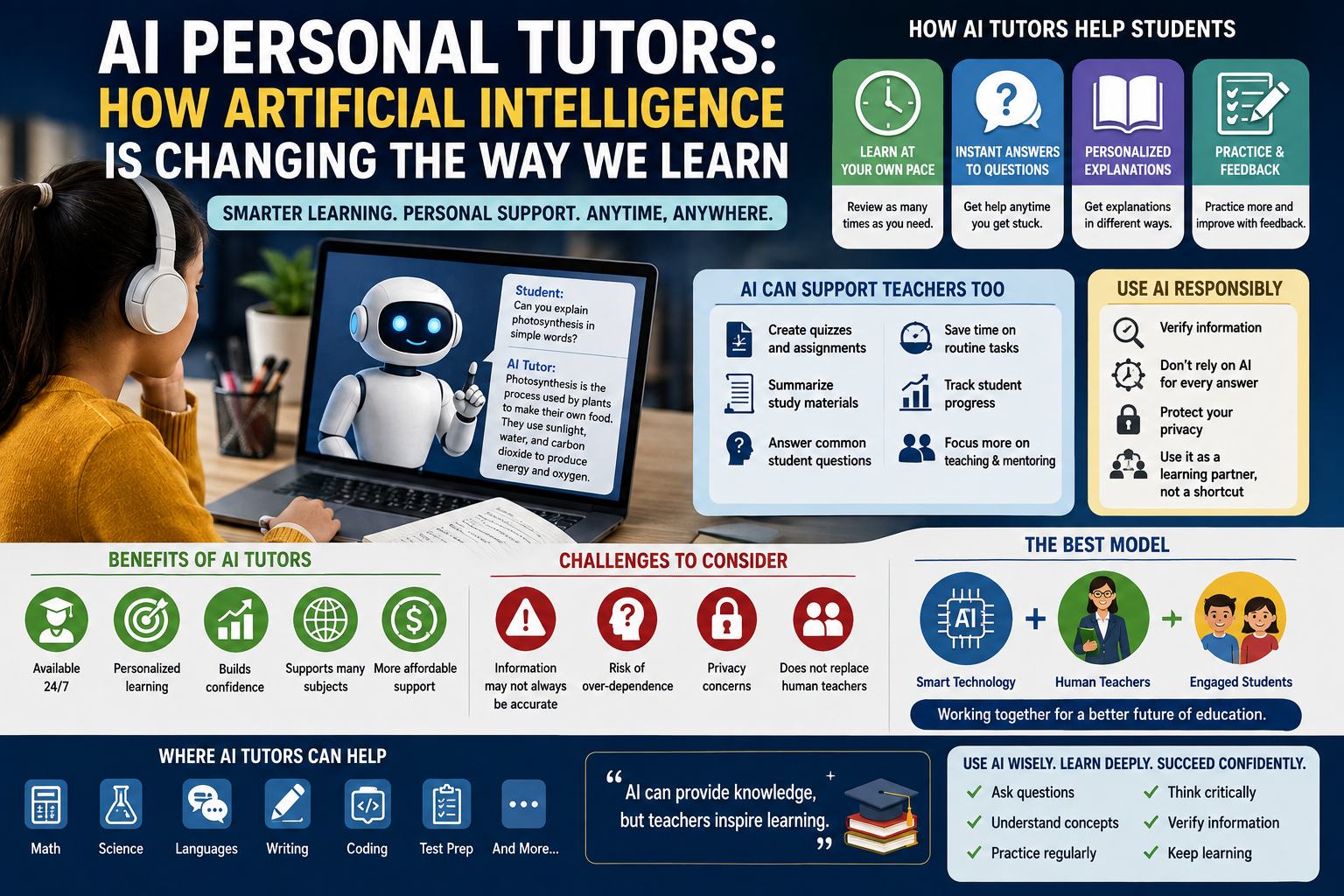
Some AI learning tools can also create quizzes, practice questions, summaries, and study plans. The main idea behind personalized learning is to give students more individualized support. Instead of every learner receiving exactly the same explanation, AI can respond to different questions and learning preferences.
As technology develops, AI Personal Tutors may become increasingly useful for students who want additional support beyond regular classroom lessons. They can act as an extra educational resource without replacing the complete learning experience provided by schools and teachers.
Learning at the Student’s Own Speed
One major advantage of AI tutors is flexibility. Every student learns differently. Some students understand a mathematical concept quickly, while others need several examples before they feel confident AI Personal Tutors.
In a traditional classroom, a teacher may have limited time to repeat the same explanation for every student. An AI tutor can explain the same idea again and again without becoming tired. Students can also stop, ask questions, and continue when they feel ready.
This can be particularly useful for learners who need extra practice. AI in education can give students more control over their study routine and allow them to spend additional time on subjects they find difficult.
The ability to learn at an individual pace can also reduce some of the pressure students experience in traditional classrooms. A learner who needs more time can continue practicing without feeling embarrassed about asking the same question repeatedly.
Instant Answers to Questions
Students often become stuck when studying alone. A small question can sometimes prevent them from completing an entire lesson. An AI tutor can provide an immediate response and help students continue their learning AI Personal Tutors
For example, a student studying science might ask why a chemical reaction happens. A language learner could ask about the meaning of a difficult word. A mathematics student could request another explanation of a formula. Quick assistance can help students continue learning instead of abandoning a difficult topic AI Personal Tutors.
The ability to receive immediate educational support is one reason AI tutors are becoming an important part of modern digital education. AI Personal Tutors can provide students with a convenient way to ask questions whenever they encounter difficulties.
Personalized Explanations
Traditional textbooks normally present information in one standard way. AI tutors can potentially change the explanation according to the student’s request. A student might ask for a simple explanation, an advanced explanation, or an everyday example.
A learner can also request diagrams, examples, practice questions, or step-by-step guidance. This makes the learning experience more interactive because students are not limited to one explanation style.
This is one of the strongest features of personalized education. Students can ask for information in a way that matches their current level of understanding.
For example, a beginner may need a simple explanation with basic examples, while an advanced student may want technical details and challenging questions. This flexibility makes AI Personal Tutors useful for different levels of learners.
AI Can Help With Practice
Understanding a topic is only one part of learning. Students also need practice. AI tutors can generate questions based on a particular subject and provide exercises at different levels of difficulty AI Personal Tutors.
After answering, students can ask for feedback or another set of questions. For language learning, an AI system can help students practice vocabulary and conversation. For mathematics, it can provide additional problems with different levels of difficulty.
Regular practice can help students become more confident. When used correctly, AI learning tools can provide additional opportunities for students to practice without depending completely on classroom time.
Practice can also help students identify their weak areas. Instead of simply reading information, learners can actively test their understanding and work on topics where they need improvement.
Support for Teachers
AI personal tutors do not necessarily have to compete with teachers. They can also become tools that support educators. Teachers spend significant amounts of time preparing exercises, explaining concepts, checking work, and answering repeated questions.
AI tools may help with some of these routine tasks. This could allow teachers to spend more time on discussion, creativity, mentoring, and individual student support. The teacher can remain responsible for important educational decisions while AI provides additional assistance AI Personal Tutors.
This approach could make artificial intelligence in education a supporting technology rather than a replacement for human educators.
In this model, AI Personal Tutors can work alongside teachers. Students receive additional help from technology, while teachers continue to provide guidance, encouragement, and deeper educational support.
Help Outside the Classroom
Learning does not only happen during school or university hours. Students often study in the evening, on weekends, or during holidays. Teachers may not always be available when a question appears.
An AI tutor can provide educational assistance outside normal classroom hours. This makes learning more accessible for students who prefer flexible schedules. It can also be useful for people who are studying independently AI Personal Tutor.
The ability to receive support outside traditional classroom hours could become an important part of the future of learning. Students can use AI Personal Tutors as an additional resource when traditional educational support is not immediately available.
Language Learning
AI tutors can be especially useful for language students. Learners can practice conversations without worrying about making mistakes in front of other people. An AI system can help with vocabulary, grammar, pronunciation exercises, and sentence construction.
Students can also ask for explanations in their preferred language. Regular conversation practice may help learners become more comfortable using a new language.
However, human interaction remains important because real communication includes emotions, culture, tone, and social context. AI can support language learning, but it cannot completely replace real conversations with teachers and other people.
Help for Students With Different Learning Needs
Students do not all have the same educational needs. Some need additional repetition, while others want more challenging material. AI systems may be able to adjust the difficulty of exercises and present information in different formats.
This flexibility could help some students who struggle with traditional teaching methods. A learner can ask for a simpler explanation or request more advanced material when they are ready.
For students with different learning preferences, AI Personal Tutors can provide explanations and practice in ways that may be easier to understand. However, AI should be viewed as additional support rather than a complete solution for every learner. Human teachers and other educational professionals remain important for understanding individual circumstances.
The Problem of Wrong Information
AI tutors are not perfect. An AI system can sometimes provide information that is inaccurate, incomplete, or misleading. The answer may sound confident even when it is incorrect.
This is a serious concern in education because students may accept information without checking it. Teachers, textbooks, academic sources, and reliable educational websites still have an important role.
Students should learn to question and verify information rather than accepting every AI response automatically. AI in education should encourage learning and investigation, not remove the need for careful thinking.
Students Could Become Too Dependent
Another concern is overuse. If students ask AI to solve every problem, they may stop developing their own problem-solving skills.
Learning is not simply about receiving correct answers. Students need to think, make mistakes, compare ideas, and reach conclusions themselves. An AI tutor should therefore be used as a learning partner rather than an answer machine AI Personal Tutors.
The best use of AI for students is to guide them toward understanding. Students should still make an effort to solve problems, write their own ideas, and develop independent skills.
Privacy and Data Concerns
Education often involves personal information. Students may share names, school details, assignments, questions, or other private information with digital platforms. This creates concerns about how educational data is collected, stored, and used.
Schools and parents need to understand the privacy policies of AI services before allowing students to use them. Students should also avoid sharing unnecessary personal information with online systems.
As AI education technology becomes more common, responsible handling of student information will become increasingly important.
The Importance of Human Teachers
AI can provide information, but teaching involves much more than answering questions. Teachers understand their students as people. They can notice when a student is struggling emotionally, losing confidence, or becoming disconnected from the class.
Teachers also encourage teamwork, creativity, communication, and social development. A good teacher can inspire students in ways that software cannot easily reproduce.
For these reasons, AI should support human educators rather than make them unnecessary. The future of education is more likely to involve cooperation between teachers and technology than complete replacement of teachers by AI.
Making Education More Affordable
AI tutoring could potentially make some forms of educational assistance less expensive. A student who cannot afford private tutoring may be able to access digital learning supportAI Personal Tutors.
This could be especially valuable in areas where qualified tutors are difficult to find. Students may be able to receive additional explanations and practice without paying for traditional one-to-one tutoring.
However, access to technology itself is not equal. Students without reliable internet, computers, or smartphones may still be left behind. Therefore, AI alone cannot solve educational inequality.
The Future of AI Tutoring
AI Personal Tutors are likely to become more sophisticated as artificial intelligence develops. Future systems may provide more interactive lessons, voice conversations, personalized exercises, and improved learning feedback.
They may also work alongside school learning platforms and digital textbooks. As artificial intelligence in education develops, students could have access to learning systems that better understand their progress and provide more suitable educational support.
Future AI Personal Tutors may also become better at identifying a student’s weak areas and suggesting targeted practice. This could make study sessions more efficient and help learners focus on subjects where they need the most improvement AI Personal Tutors.
However, technological progress should be accompanied by strong educational standards. Accuracy, privacy, safety, and responsible use should remain priorities.
How Students Should Use AI Tutors
Students can get the most benefit from AI by using it actively. They can ask AI to explain a difficult idea rather than simply provide an answer. They can request practice questions and attempt them independently.
Students can also ask for feedback on their reasoning and compare AI explanations with trusted educational sources. This approach allows learners to use AI as a tool for understanding rather than simply a shortcut.
Students should also complete assignments themselves when their school requires independent work. Responsible use of AI Personal Tutors means using technology to improve learning while continuing to develop personal knowledge and skills.
Conclusion
AI Personal Tutors are changing the way students can access educational support. They can provide explanations, practice questions, feedback, and flexible learning opportunities. Their biggest strength is personalization: students can ask questions at their own pace and request different ways of understanding a topic.
At the same time, AI has limitations. It can make mistakes, create dependency, and raise concerns about privacy and academic honesty. Human teachers remain essential because education is also about motivation, communication, creativity, and personal development.
The future of education is therefore unlikely to be simply AI versus teachers. A better model may be AI working alongside teachers and students. Used responsibly, AI Personal Tutors can become powerful educational assistants while human educators continue to provide the guidance, judgment, and personal connection that technology cannot fully replace.