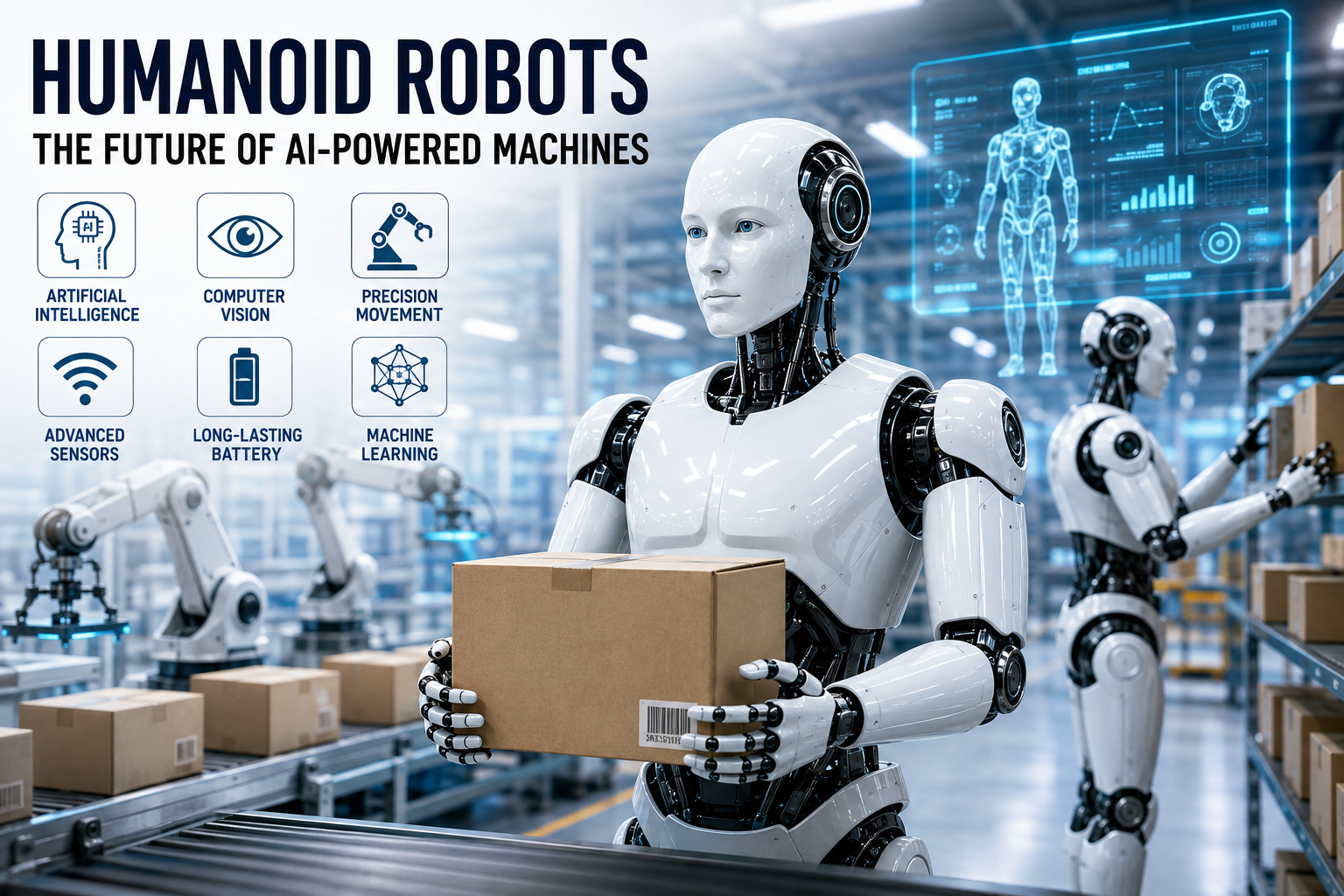
Humanoid robots are quickly becoming one of the most exciting technologies in the world. Designed to resemble the human body and perform tasks in environments built for people, these advanced machines are moving from science fiction into real-world applications. With artificial intelligence, computer vision, sensors, machine learning, and advanced robotics working together, modern humanoid robots can understand their surroundings, recognize objects, learn tasks, and perform physical activities.
China has emerged as one of the major players in the development of humanoid robots. Chinese robotics companies and research institutions are investing heavily in artificial intelligence, robotic hardware, battery technology, sensors, and mass production. This rapid development is making humanoid robots more capable and potentially more affordable.
But what exactly are humanoid robots, how do they work, where are they being used, and what could they mean for the future?
What Are Humanoid Robots?
Humanoid robots are robots designed with a human-like body structure. Most include a head, torso, two arms, two hands, and two legs. Some advanced models also have highly articulated fingers, movable facial components, or other features designed to improve interaction with humans.
The main advantage of a humanoid design is compatibility with the world humans have already built.
Homes, factories, warehouses, offices, hospitals, stairs, doors, tools, shelves, vehicles, and workstations are generally designed for human bodies. Instead of creating completely new environments for robots, humanoid robots can potentially use the same spaces and equipment that people already use.
Modern humanoid robots combine physical hardware with sophisticated software. Their cameras and sensors collect information about the environment, while AI systems process that information and determine what actions should be taken.
How Do Humanoid Robots Work?
A modern humanoid robot is essentially a combination of several advanced technologies.
Artificial Intelligence
Artificial intelligence acts as the robot’s decision-making system. AI can help a robot understand commands, identify objects, recognize environments, and determine how to complete a task.
For example, if a person tells a robot to “pick up the box and place it on the table,” the robot needs to understand the instruction, locate the box, calculate how to reach it, grasp it, move its body safely, and place it correctly.
Computer Vision
Cameras and vision systems allow robots to see their surroundings.
Computer vision can help identify people, objects, obstacles, surfaces, and other environmental features. Some systems can also estimate depth and understand the position of objects in three-dimensional space.
This is particularly important when a robot is operating in a busy factory or warehouse.
Sensors
Humanoid robots use many different sensors to understand their physical environment.
These can include cameras, microphones, force sensors, position sensors, gyroscopes, accelerometers, and other sensing technologies.
Sensors can help robots maintain balance, detect contact, measure movement, and react to changes around them.
Actuators and Motors
Actuators are responsible for movement. Humanoid robots may contain numerous motors and joints that allow them to walk, bend, rotate their arms, move their hands, and manipulate objects.
The challenge is not simply moving a joint. The robot must coordinate many joints simultaneously while maintaining balance and controlling force.
Why Is China Investing So Heavily in Humanoid Robots?
China has become a major center for robotics manufacturing and artificial intelligence development.
One reason is China’s enormous manufacturing ecosystem. Producing sophisticated robots requires motors, batteries, chips, sensors, cameras, mechanical components, precision parts, and software.
China already has extensive capabilities across many of these industries.
Another advantage is manufacturing scale. If humanoid robots eventually become commercially successful, producing them in large quantities could significantly reduce their cost.
Chinese companies are therefore competing to develop robots that can move more naturally, perform useful tasks, operate safely around people, and eventually be manufactured at scale.
Humanoid Robots in Factories
Factories are among the most promising environments for humanoid robots.
Manufacturing facilities often contain repetitive physical tasks. Workers may need to repeatedly move components, inspect products, transport materials, tighten parts, package products, or perform other structured activities.
Humanoid robots could potentially perform some of these tasks continuously while humans focus on supervision, quality control, maintenance, and more complex responsibilities.
A robot that can work alongside humans without requiring major changes to a factory could provide a significant advantage.
Humanoid Robots in Warehouses
Warehouses are another important application.
Modern warehouses require constant movement of products. Workers may need to pick up boxes, move inventory, organize shelves, and transport packages.
Humanoid robots could eventually perform some of these tasks using the same aisles, shelves, carts, and equipment already used by human workers.
Their ability to walk and manipulate objects could make them particularly useful in environments where traditional wheeled robots have limitations.
Humanoid Robots in Homes
Household robots are one of the most exciting long-term possibilities.
Imagine a robot that could help clean rooms, organize objects, carry groceries, load a dishwasher, collect laundry, or assist elderly people with everyday activities.
This is significantly more difficult than factory automation because homes are unpredictable.
A factory can be designed around a specific workflow. A home can contain thousands of different objects, narrow spaces, stairs, pets, children, furniture, and constantly changing conditions.
For this reason, household humanoid robots require extremely advanced perception, reasoning, movement, and safety systems.
Humanoid Robots and Artificial Intelligence
The combination of humanoid robots and AI could be more important than the robot’s physical appearance.
Traditional industrial robots are usually programmed to perform specific repetitive actions.
AI-powered humanoid robots are being developed with a different approach. Instead of manually programming every possible movement, developers are increasingly exploring systems that allow robots to learn from demonstrations, simulations, data, and AI models.
This could eventually allow a robot to learn new tasks more quickly.
For example, rather than programming every movement required to prepare a simple meal, a robot could potentially observe demonstrations and learn the sequence of actions.
Can Humanoid Robots Learn?
Yes, but the meaning of “learning” is important.
Robots can be trained using large datasets, simulations, demonstrations, reinforcement learning, and machine-learning algorithms.
A robot may learn how to recognize objects, walk more efficiently, manipulate different materials, or perform particular tasks.
However, current humanoid robots still have significant limitations. Human intelligence is extremely flexible, and people can adapt to unfamiliar situations with relatively little training.
Creating robots with the same level of general physical intelligence remains a major research challenge.
Humanoid Robots in Healthcare
Healthcare could become another important application.
Humanoid robots could potentially assist medical staff with logistics, transport supplies, deliver items, or support patients with routine activities.
They could also potentially help elderly people who require assistance at home.
However, healthcare robots must meet very high safety and reliability standards. A robot working around patients needs to understand delicate physical interactions and respond appropriately to unexpected situations.
Therefore, widespread medical use will require extensive testing and regulation.
Humanoid Robots and Jobs
One of the biggest questions surrounding humanoid robots is their impact on employment.
If robots become capable of performing physical jobs at competitive costs, some industries could experience major changes.
Jobs involving repetitive physical tasks may be particularly vulnerable to automation.
At the same time, new jobs could emerge around robot manufacturing, maintenance, programming, AI training, safety, fleet management, and system integration.
The impact will probably not be simply “robots replace humans.” In many workplaces, humans and robots may work together.
Advantages of Humanoid Robots
Humanoid robots offer several powerful potential advantages.
Human-compatible design: They can potentially operate in environments designed for people.
Automation: They can perform repetitive physical tasks.
Continuous operation: Robots do not need sleep and can potentially operate for long periods when properly powered and maintained.
Consistency: Robots can perform standardized tasks repeatedly.
Dangerous work: They could potentially operate in environments that are unsafe for humans.
Scalability: If manufacturing costs fall, companies could deploy large fleets of robots.
Challenges Facing Humanoid Robots
Despite impressive demonstrations, humanoid robotics still faces major challenges.
Battery Life
Walking and moving a heavy robot requires significant energy. Battery technology therefore plays a major role in determining how long a robot can operate.
Cost
Advanced motors, sensors, processors, batteries, and mechanical components can be expensive.
Balance
Walking on two legs is considerably more complicated than moving on wheels. Robots need sophisticated control systems to remain stable.
Dexterity
Human hands are incredibly capable. Creating robotic hands that can safely and accurately manipulate thousands of different objects remains difficult.
Safety
Robots working around humans must be able to detect people and react safely to unexpected movements.
AI Reliability
An AI system can make mistakes. For physical robots, mistakes can have physical consequences. Reliable decision-making is therefore critical.
What Will Humanoid Robots Look Like in the Future?
The next generation of humanoid robots is likely to become smaller, faster, smarter, and more efficient.
AI models will improve their ability to understand spoken instructions and visual environments. Better batteries could increase operating time. Improved actuators could produce smoother movement.
Robotic hands may also become increasingly sophisticated.
One of the biggest developments could be the emergence of general-purpose robots capable of learning multiple tasks rather than performing only one specialized job.
Instead of buying a robot designed exclusively for factory work, consumers and businesses may eventually purchase robots capable of learning different tasks through software updates or demonstrations.
The Future of Humanoid Robots in China
China is positioned to play a major role in the global humanoid robotics industry because of its combination of AI research, robotics manufacturing, electronics production, batteries, supply chains, and industrial automation.
The country is investing in both the hardware and software required to build advanced robots.
If companies succeed in lowering manufacturing costs while improving reliability and intelligence, humanoid robots could move beyond laboratories and demonstrations into factories, warehouses, businesses, and eventually homes.
Are Humanoid Robots the Future?
Humanoid robots are not yet ready to completely replace human workers or become fully autonomous household assistants everywhere.
However, the technology is developing rapidly.
The most important change is that robotics is increasingly being combined with artificial intelligence. Robots are no longer limited to simple pre-programmed movements. Researchers are working toward machines that can perceive their environments, understand instructions, learn physical skills, and adapt to different situations.
This combination could eventually create a new generation of general-purpose machines.
The future may not be a world where robots simply replace people. Instead, humans may increasingly work alongside intelligent machines that handle repetitive, physically demanding, or dangerous tasks.
Conclusion
Humanoid robots represent one of the most important developments in modern robotics. Their human-like design allows them to potentially operate in factories, warehouses, homes, hospitals, and other environments without requiring major infrastructure changes.
China has become one of the leading countries in this rapidly developing industry, supported by its manufacturing capabilities, artificial intelligence research, robotics companies, and large technology ecosystem.
Although challenges such as cost, battery life, safety, dexterity, and AI reliability remain, progress is happening quickly.
The most exciting possibility is the creation of general-purpose humanoid robots that can learn new tasks and interact naturally with people. If researchers and manufacturers can overcome today’s technical and economic barriers, humanoid robots could become an important part of everyday life.
What once seemed like science fiction may gradually become a remarkable reality of the future.