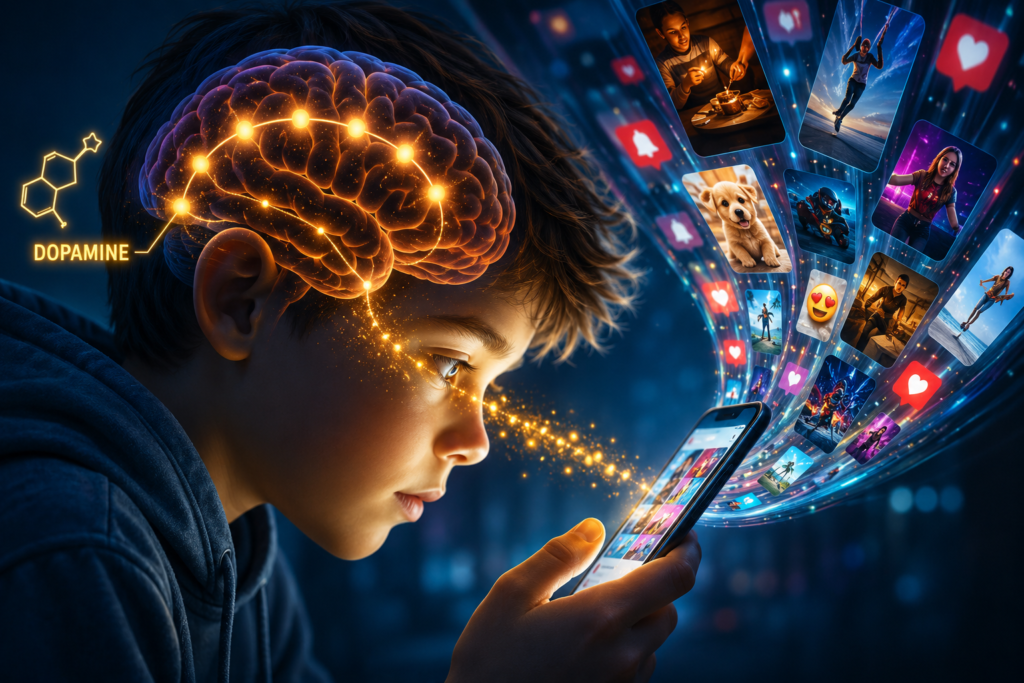
Every time you open a social media app and pull down to refresh your feed, you are operating a digital slot machine. You don’t know what you’re going to get—a funny meme, a piece of shocking news, or a notification from a friend—and that exact unpredictability is what hooks your brain.
At the center of this habit loop is dopamine, a neurotransmitter traditionally associated with pleasure, but more accurately described as the chemical of anticipation and desire. Our brains evolved to release dopamine to reward survival behaviors, like finding food. Today, tech algorithms exploit this ancient pathway, keeping us trapped in an endless loop of craving and consumption.
The Anatomy of the Infinite Scroll
Silicon Valley engineers explicitly designed features like the infinite scroll and variable reward schedules to maximize screen time. When you scroll:
- The Anticipation: Your brain releases a small surge of dopamine before you see the next post, driven by the anticipation of a reward.
- The Delivery: You see something interesting, giving you a temporary high, or you see something boring, prompting you to scroll again to find the “prize.”
- The Baseline Reset: Over time, constant overstimulation raises your brain’s dopamine threshold. Everyday activities begin to feel boring by comparison, leading to chronic distractibility, brain fog, and a shortened attention span.
How to Reclaim Your Focus
Breaking the loop doesn’t require moving to a cabin in the woods; it requires setting hard structural boundaries between your brain and your device.
- Turn on Grayscale Mode: Strip away the bright, red notification badges and vibrant colors. Making your screen visually unappealing instantly reduces the subconscious urge to look at it.
- The 20-Minute Delay Rule: When you feel the overwhelming urge to check your phone, force yourself to wait exactly 20 minutes while doing a manual task. The acute craving usually passes within 5 to 10 minutes.
- Create Physical Friction: Never charge your phone on your nightstand. Put it across the room or in another hallway overnight so your morning routine starts with your own thoughts, not an algorithm’s feed.