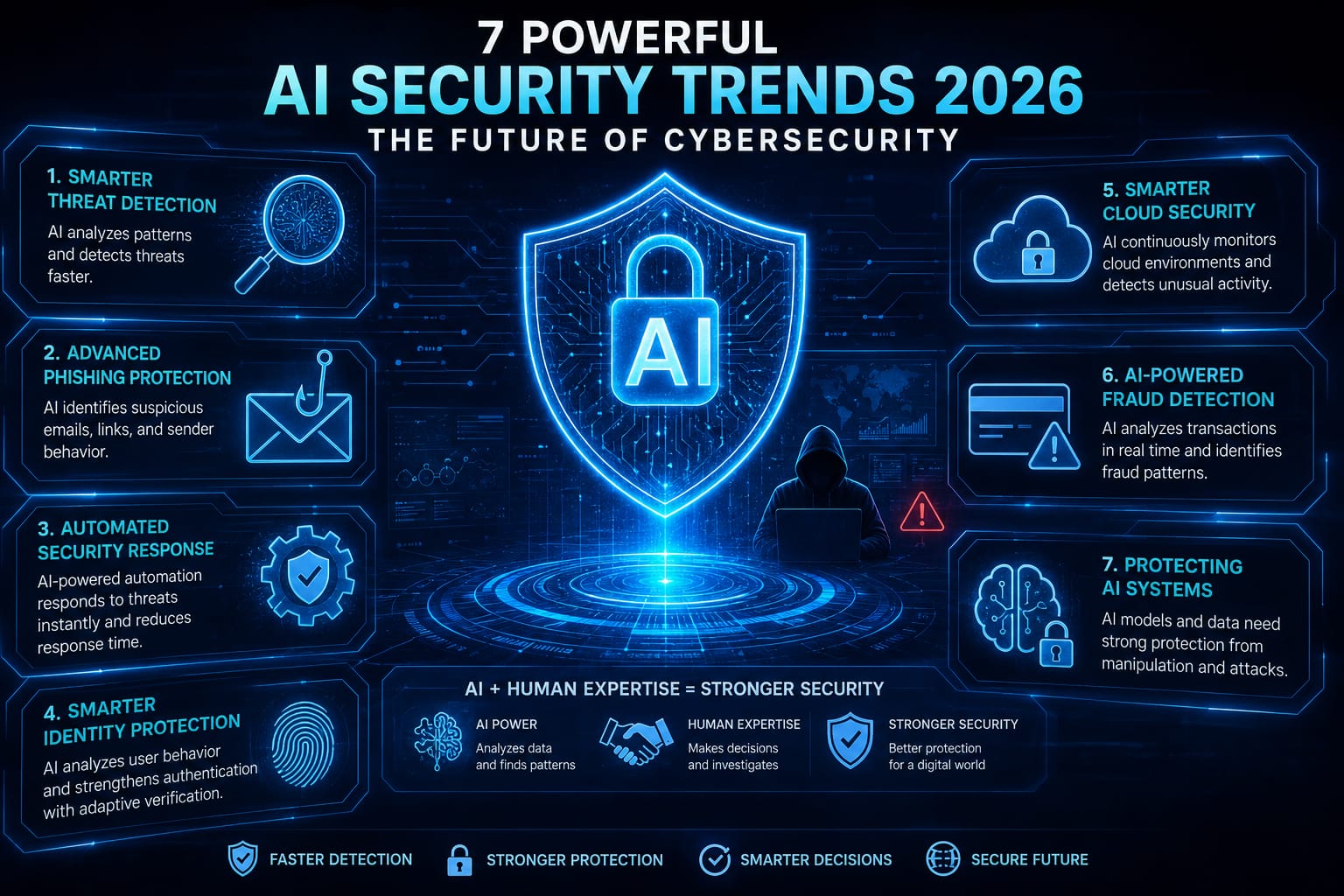
Artificial intelligence is rapidly transforming the digital world, and AI Security Trends 2026 are becoming increasingly important for businesses, organizations, and everyday internet users. As cyberattacks become more sophisticated, cybersecurity teams are turning to artificial intelligence to detect unusual activity, analyze massive amounts of data, identify potential threats, and respond faster. At the same time, attackers are also experimenting with AI to make their activities more convincing and difficult to detect. This makes intelligent cybersecurity one of the most important technology developments shaping the digital environment.
The modern security landscape is changing faster than ever. Traditional cybersecurity tools remain valuable, but organizations now need systems capable of processing enormous amounts of information in real time. Artificial intelligence can recognize patterns, identify unusual behavior, prioritize security alerts, and support professionals during investigations. The result is a cybersecurity environment that is becoming more automated, adaptive, and intelligent.
AI Security Trends 2026: Why Artificial Intelligence Is Changing Cybersecurity
The growth of AI Security Trends 2026 is closely connected to the enormous amount of digital information produced every day. Businesses operate websites, cloud platforms, mobile applications, databases, connected devices, remote networks, and digital services. Each of these systems can generate thousands of security events.
Monitoring all of this information manually is extremely difficult. AI can help security teams process large datasets and identify activity that may require attention. Machine-learning systems can learn patterns of normal behavior and highlight activity that appears unusual.
This does not mean artificial intelligence will completely replace cybersecurity professionals. Instead, AI can function as a powerful assistant that helps security teams analyze information more efficiently and concentrate on the most important threats.
AI Security Trends 2026: From Reactive to Proactive Protection
One of the most important changes in modern cybersecurity is the move from reactive protection toward proactive defense. Traditional systems may respond after suspicious activity has already been detected, while AI-powered systems can potentially recognize warning signs earlier.
By examining behavior across users, devices, applications, and networks, intelligent security systems can identify unusual patterns before they become larger problems. This can give organizations valuable time to investigate and respond.
AI Security Trends 2026: Smarter Threat Detection
Threat detection is expected to remain one of the strongest applications of artificial intelligence. Modern organizations can generate thousands or even millions of security events, making manual analysis unrealistic for large environments.
AI can examine login behavior, network traffic, application activity, device behavior, and other signals to identify patterns that deserve additional attention.
A major advantage is speed. Instead of requiring security professionals to manually examine every event, AI can help prioritize information and direct attention toward potentially important incidents.
AI Security Trends 2026: Faster Detection of Cyber Threats
The speed of modern cyberattacks makes rapid detection extremely valuable. Intelligent monitoring systems can operate continuously and analyze large datasets much faster than manual processes.
This does not eliminate the need for human investigation. Rather, it allows security professionals to spend more time understanding serious incidents instead of reviewing large numbers of routine alerts.
AI Security Trends 2026: Advanced Phishing Protection
Phishing remains one of the most common cybersecurity problems, and artificial intelligence is changing how organizations approach phishing protection.
AI-powered security systems can examine emails, links, sender behavior, message patterns, and other signals to identify potentially suspicious communication. This approach can be more flexible than relying only on lists of known malicious websites or specific keywords.
The challenge is becoming more serious because generative AI can help create convincing messages that appear more natural and professional.
AI Security Trends 2026: Fighting More Convincing Phishing Attacks
Modern phishing protection increasingly depends on behavioral analysis. A security system can potentially examine whether a message is unusual for a particular sender, whether a link behaves suspiciously, or whether the communication resembles patterns associated with previous attacks.
This creates a stronger layer of protection because the system is looking at context rather than relying on a single warning sign.
AI Security Trends 2026: Generative AI and Cybersecurity
Generative AI is creating significant opportunities and challenges for cybersecurity. Security professionals can use AI to summarize alerts, organize technical information, assist with investigations, and simplify complicated security reports.
At the same time, attackers can attempt to misuse similar technologies. They may use AI-generated content to improve social engineering or create more convincing fraudulent communication.
This creates a technological competition in which security teams must continuously improve their defenses.
AI Security Trends 2026: The Double-Edged Power of AI
Artificial intelligence can strengthen cybersecurity, but it does not automatically make every system secure. Organizations still need strong controls, monitoring, access management, and human oversight.
Responsible implementation will become increasingly important as businesses integrate AI into security operations and other critical systems.
AI Security Trends 2026: Automated Security Response
Automation is becoming another important part of modern cybersecurity. When a security system identifies suspicious activity, automated tools can potentially perform predefined defensive actions.
Depending on the environment, these actions could include restricting access, isolating a device, blocking suspicious activity, or notifying a security team.
Automation can be particularly valuable when a security incident occurs outside normal business hours, when a human response may take longer.
AI Security Trends 2026: Faster Incident Response
A rapid response can reduce the potential impact of a cybersecurity incident. Intelligent detection combined with carefully controlled automation can help organizations react more quickly.
However, automated actions should be designed carefully. Human oversight remains essential when an automated decision could affect critical systems, customers, employees, or legitimate users.
AI Security Trends 2026: Smarter Identity Protection
Identity security is becoming increasingly important as organizations rely more heavily on cloud services, remote work, and digital applications.
AI can analyze login behavior and identify patterns that differ significantly from normal activity. An unexpected location, unusual access behavior, or a sudden change in usage patterns could trigger additional security checks.
This creates a more adaptive approach to identity protection.
AI Security Trends 2026: Adaptive Authentication
Traditional authentication often treats every login in a similar way. Intelligent systems can potentially consider multiple contextual signals before determining whether additional verification is appropriate.
This can help organizations strengthen security while reducing unnecessary friction for trusted users.
AI Security Trends 2026: Smarter Cloud Security
Cloud computing has become essential for many organizations, but cloud environments can be complex. Businesses may operate applications, databases, services, and user accounts across multiple environments.
Artificial intelligence can help security teams continuously analyze cloud activity and identify unusual behavior.
As cloud adoption continues to grow, intelligent monitoring can provide organizations with greater visibility across increasingly complicated digital environments.
AI Security Trends 2026: Intelligent Cloud Monitoring
AI-powered cloud monitoring can help identify patterns that may be difficult to detect through manual analysis.
Instead of examining every event individually, security systems can prioritize unusual activity and help professionals focus on areas that require investigation.
This approach can make cloud security more efficient while supporting faster responses to potential threats.
AI Security Trends 2026: AI-Powered Fraud Detection
Financial fraud is another major area where artificial intelligence can provide valuable support. Digital payments generate enormous amounts of transaction data, making continuous manual analysis impractical.
AI can analyze transaction behavior and identify patterns that appear unusual. Financial organizations can then investigate suspicious activity more efficiently.
This technology can potentially help identify fraud while minimizing unnecessary disruption for legitimate customers.
AI Security Trends 2026: Protecting Digital Payments
As online payments continue to expand, security systems need to distinguish between normal and suspicious behavior.
AI can potentially analyze multiple signals simultaneously, creating a more detailed understanding of transaction activity. This can support faster investigation and more adaptive fraud protection.
AI Security Trends 2026: Zero Trust and Continuous Security
Zero Trust is becoming increasingly important in modern cybersecurity. The basic idea is that users and devices should not automatically be trusted simply because they are inside a particular network.
Artificial intelligence can support this approach by continuously analyzing identity, device activity, access behavior, and other contextual information.
AI Security Trends 2026: Continuous Monitoring
Traditional security models may evaluate access at specific moments. AI-powered systems can potentially monitor behavior continuously and identify significant changes.
If user or device activity suddenly becomes unusual, the system can potentially trigger additional security measures.
This makes intelligent monitoring especially useful for dynamic cloud and remote-work environments.
AI Security Trends 2026: Protecting Artificial Intelligence Systems
As organizations become more dependent on AI, protecting AI systems themselves is becoming increasingly important.
Attackers may attempt to manipulate AI applications, exploit weaknesses, access sensitive information, or interfere with AI-powered services.
Organizations therefore need to think about security throughout the AI lifecycle, including data, models, applications, infrastructure, integrations, and user access.
AI Security Trends 2026: Why AI Models Need Strong Protection
AI security cannot be treated as a separate issue from cybersecurity. As AI becomes part of important business operations, weaknesses in AI systems could create wider security problems.
Strong access controls, monitoring, testing, and responsible data management can help organizations reduce these risks.
AI Security Trends 2026: Humans and AI Working Together
Despite rapid advances in artificial intelligence, human expertise will remain essential to cybersecurity.
AI can process information quickly, recognize patterns, and prioritize alerts, but experienced professionals are still needed to understand business context, investigate complicated incidents, make strategic decisions, and manage security programs.
The strongest cybersecurity strategies will therefore combine intelligent technology with human judgment.
AI Security Trends 2026: The Human Advantage
Machines are excellent at processing large amounts of information, while humans can evaluate wider context and make strategic decisions.
This combination creates a more balanced cybersecurity environment. AI handles large-scale analysis while professionals provide oversight, judgment, and accountability.
AI Security Trends 2026: Cybersecurity Comparison
| Security Area | AI Application | Potential Benefit |
|---|---|---|
| Threat Detection | Pattern analysis | Faster identification |
| Phishing Protection | Message analysis | Better threat detection |
| Identity Security | Behavior analysis | Smarter authentication |
| Cloud Security | Continuous monitoring | Greater visibility |
| Fraud Detection | Transaction analysis | Faster investigation |
| Incident Response | Controlled automation | Reduced response time |
| AI Protection | Model monitoring | Stronger AI security |
AI Security Trends 2026: Cybersecurity Potential Graph
The following graph provides a conceptual comparison of areas where artificial intelligence can have a strong role in cybersecurity. It is an illustrative graph rather than official market data.
Threat Detection ████████████████████Phishing Protection ██████████████████Identity Security █████████████████Cloud Security █████████████████Fraud Detection ████████████████Incident Response ███████████████████AI Model Protection ██████████████████
The comparison shows that artificial intelligence can influence almost every major area of modern digital security.
AI Security Trends 2026: What Businesses Should Expect
Businesses should expect cybersecurity to become increasingly automated, adaptive, and data-driven. AI will likely become more deeply integrated into security monitoring, identity protection, cloud security, fraud detection, and incident response.
However, organizations should not depend on AI alone. Strong access controls, employee awareness, software updates, security policies, backup strategies, and human oversight will remain essential.
AI is a powerful security tool, but its effectiveness depends on how responsibly it is implemented and how well it works alongside existing security practices.
AI Security Trends 2026: The Future of Cybersecurity
The future of cybersecurity is likely to become increasingly intelligent as AI systems improve. Security platforms may become better at recognizing unusual behavior, prioritizing alerts, supporting investigations, and automating selected defensive actions.
At the same time, cybercriminals will continue experimenting with new technologies. Organizations will therefore need to continuously improve their defenses rather than relying on a single security solution.
The future will be defined by a constant balance between innovation and protection.
AI Security Trends 2026: Final Thoughts
Artificial intelligence is transforming cybersecurity from a largely reactive process into a more intelligent and adaptive discipline. Threat detection, phishing protection, identity security, cloud monitoring, fraud detection, and incident response can all benefit from AI-powered technologies.
The biggest opportunity is not simply automation. It is the ability to understand enormous amounts of digital information and identify important patterns more quickly.
At the same time, organizations must recognize that AI introduces new risks as well as new opportunities. Strong governance, privacy protection, human oversight, and responsible implementation will be essential.
As cyber threats continue to evolve, AI Security Trends 2026 will remain an important part of the future of digital protection. Organizations that successfully combine powerful AI technology, intelligent automation, strong cybersecurity practices, and experienced human decision-making will be better prepared for an increasingly complex digital world.