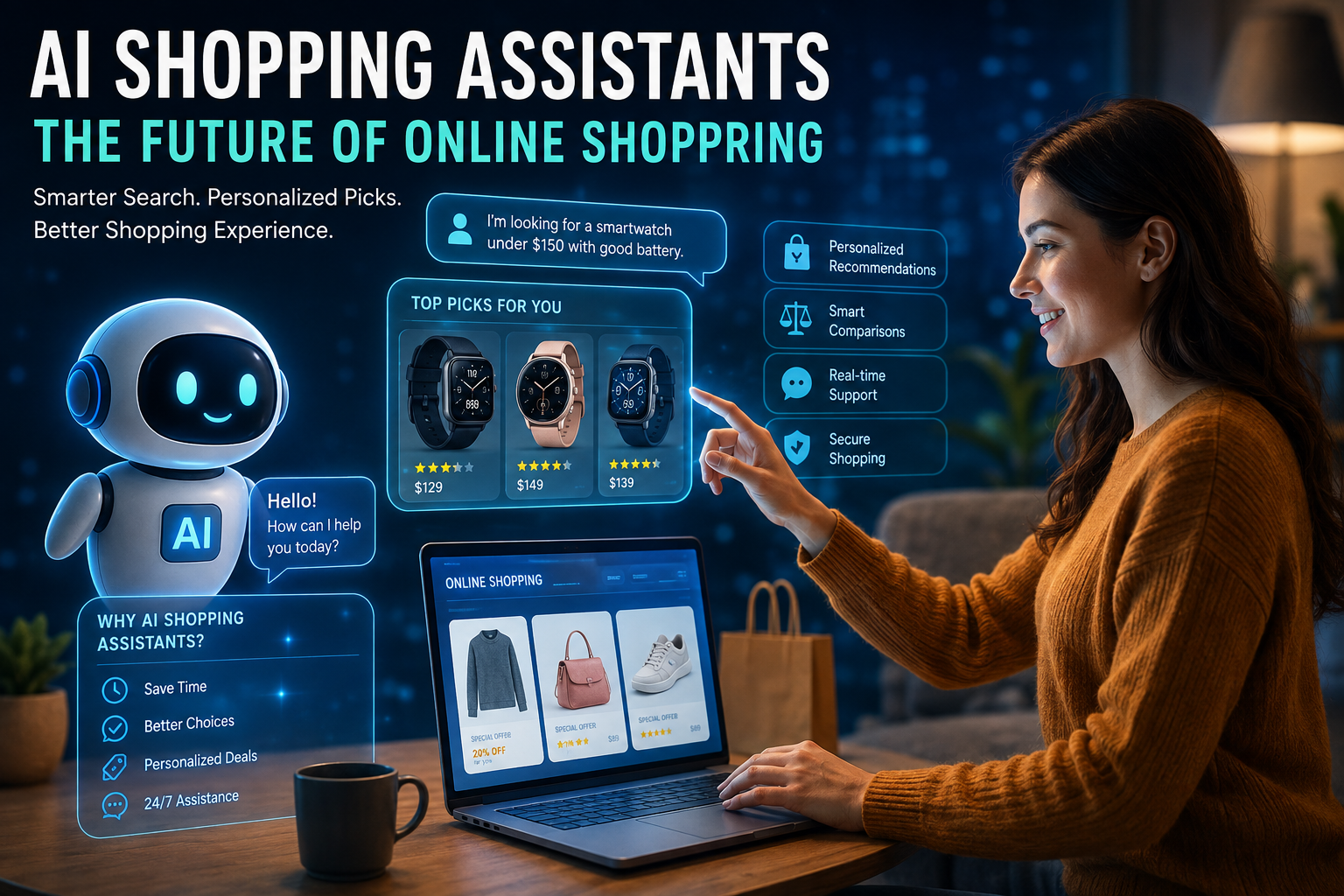
Online shopping is entering a new era, and AI Shopping Assistants are changing the way people discover, compare, and purchase products. Instead of spending hours searching through different websites, customers can use AI Shopping Assistants to describe what they need and receive personalized recommendations. This technology combines artificial intelligence, machine learning, natural language processing, and customer preferences to create a smarter and more convenient shopping experience.
What Are AI Shopping Assistants?
AI Shopping Assistants are intelligent digital tools that help customers throughout the online shopping process. They can understand natural-language questions, recommend products, compare features, explain product information, and answer common shopping questions.
Traditional online shopping usually requires customers to search for keywords, open multiple product pages, compare prices, read reviews, and make a final decision themselves. AI Shopping Assistants can simplify many of these steps by acting like a digital shopping guide.
For example, instead of searching for dozens of products manually, a customer could tell an AI assistant, “I need a lightweight laptop for university with long battery life and a reasonable price.” The assistant can understand these requirements and help identify suitable options.
How AI Shopping Assistants Are Changing Online Shopping
The biggest change brought by AI Shopping Assistants is personalization. Traditional e-commerce websites often recommend products based on browsing history and previous purchases. AI can potentially understand more detailed preferences and respond to specific conversations.
This means the future of online shopping may become less focused on browsing hundreds of products and more focused on having a conversation with an intelligent assistant.
AI Shopping Assistants and Personalized Recommendations
Personalized recommendations are becoming increasingly important in e-commerce. AI Shopping Assistants can analyze customer preferences, previous interactions, product information, and shopping behavior to suggest relevant products.
For example, someone interested in fitness may receive recommendations for running shoes, workout equipment, fitness clothing, and other related products. Instead of displaying random popular items, an AI system can focus on products that better match the shopper’s interests.
This can make product discovery faster while creating a more personalized shopping experience.
AI Shopping Assistants and Product Comparisons
Comparing products can be difficult when an online store offers hundreds of similar options. Customers may need to check specifications, prices, ratings, warranties, and reviews before deciding.
AI Shopping Assistants can help organize this information and explain the differences between products in a simple way. A shopper could ask an AI assistant to compare two smartphones based on camera quality, battery life, performance, storage, and price.
This can reduce the amount of research required and help consumers make more informed decisions.
AI Shopping Assistants Make Product Discovery Easier
Modern e-commerce platforms contain enormous numbers of products. Finding the right item can sometimes feel overwhelming because customers have too many choices.
AI Shopping Assistants can make product discovery more natural by understanding the context behind a customer’s request. Instead of relying only on exact keywords, AI can interpret requirements and preferences.
A customer might explain that they need a comfortable pair of shoes for walking, prefer a certain style, and have a limited budget. An AI assistant can use these details to narrow down the available choices.
This type of context-based product discovery could become one of the most important advantages of AI-powered shopping.
AI Shopping Assistants and Customer Reviews
Customer reviews are valuable, but reading hundreds of reviews can take a lot of time. AI can help shoppers understand large amounts of review information by summarizing common opinions and identifying frequently mentioned advantages or problems.
For example, an AI Shopping Assistant might explain that customers generally appreciate a product’s battery life but frequently mention concerns about durability.
However, consumers should still check original reviews before making important purchases. AI summaries can be useful, but they should support human decision-making rather than completely replace it.
AI Shopping Assistants and E-Commerce Businesses
The benefits of AI Shopping Assistants are not limited to customers. Online businesses can also use AI to improve their e-commerce operations.
AI can help retailers understand customer questions, improve recommendations, analyze shopping behavior, and provide faster customer support. Businesses can use these capabilities to create a smoother purchasing journey.
For online stores competing in crowded markets, providing a more intelligent and personalized experience could become an important competitive advantage.
AI Shopping Assistants and Customer Service
Customer service is another area where AI Shopping Assistants can provide significant value. Customers frequently ask questions about delivery, product specifications, returns, sizes, availability, and compatibility.
An AI assistant can provide immediate responses to many common questions. This can reduce waiting times and allow human customer-service teams to focus on more complex problems.
The future of e-commerce customer service may therefore involve a combination of AI assistance and human support rather than replacing people completely.
AI Shopping Assistants: Traditional Shopping vs AI Shopping
| Feature | Traditional Online Shopping | AI Shopping Assistants |
|---|---|---|
| Product Search | Keyword-based search | Conversational search |
| Recommendations | General recommendations | Personalized recommendations |
| Product Comparison | Mostly manual | AI-assisted comparison |
| Customer Support | Human support or basic chatbots | Intelligent AI assistance |
| Product Discovery | Browse multiple pages | Context-based suggestions |
| Shopping Experience | Search and click | Interactive conversation |
This comparison shows why AI Shopping Assistants could create a different type of online shopping experience. Instead of forcing customers to navigate large amounts of information themselves, AI can help organize and explain information according to their needs.
AI Shopping Assistants and Voice Shopping
Voice technology could become another important part of AI Shopping Assistants. As voice recognition improves, consumers may increasingly use natural speech to search for products and ask shopping-related questions.
For example, someone could simply say that they need a birthday gift for a friend with a particular interest and budget. The AI assistant could understand the request and suggest relevant options.
The combination of voice AI and personalized shopping could make online purchasing more convenient, especially when customers do not want to type long searches.
AI Shopping Assistants and the Future of Personalized Shopping
The future of AI Shopping Assistants could extend far beyond product recommendations. AI systems may increasingly understand individual shopping preferences, budgets, styles, and purchasing patterns.
Instead of simply asking, “What products are available?” consumers may ask, “Which product is best for my specific needs?”
This shift could make e-commerce more personalized, conversational, and intelligent.
AI Shopping Assistants: Benefits for Consumers
Consumers can potentially benefit from AI Shopping Assistants in several important ways. AI can make product searches faster, simplify comparisons, provide personalized suggestions, explain complicated product information, and offer immediate assistance.
For shoppers who feel overwhelmed by too many choices, an AI assistant can function as a digital shopping guide.
However, customers should remain careful when making expensive purchases. AI recommendations can be helpful, but shoppers should verify important information such as product specifications, seller reputation, warranty details, return policies, and independent reviews.
AI Shopping Assistants: Challenges and Privacy Concerns
Despite their potential, AI Shopping Assistants also create important challenges. AI systems may process information about customer preferences, searches, shopping behavior, and purchasing history.
This makes privacy and data security important concerns. Consumers should understand how their information is collected, stored, and used.
Another concern is recommendation transparency. If an AI system recommends a product because of advertising or commercial relationships, customers should ideally know that.
Building consumer trust will require businesses to focus on accuracy, privacy, transparency, and responsible AI use.
AI Shopping Assistants: Future Potential
As artificial intelligence continues to improve, AI Shopping Assistants may become a standard feature of online stores and shopping platforms.
Future AI systems could help customers identify what they need, find relevant products, compare alternatives, understand reviews, and make purchasing decisions through a single conversation.
The traditional online store may gradually move away from endless product pages toward a more interactive AI-powered shopping experience.
AI Shopping Assistants and Smarter E-Commerce
The next generation of e-commerce could be built around intelligent conversations rather than simple search boxes. Customers may explain their needs naturally, while AI systems process product information and provide personalized guidance.
This could benefit both consumers and retailers by making shopping more efficient and potentially improving the overall customer experience.
Conclusion: AI Shopping Assistants Are Transforming Online Shopping
AI Shopping Assistants are becoming an important part of the future of e-commerce. By combining artificial intelligence, personalization, product recommendations, conversational search, and automated customer support, they can change how consumers discover and compare products.
Although challenges involving privacy, accuracy, transparency, and trust still need attention, the potential of AI-powered shopping is significant.
The future of online shopping may not be about searching through hundreds of products. Instead, customers may simply explain what they need and let an AI Shopping Assistant help them find the right solution. As this technology develops, shopping could become more personalized, conversational, efficient, and intelligent.



One thought on “AI Shopping Assistants: The powerful Future of Online Shopping in 2026”